Reflections on Friends, Goodbyes and Budapest

Reflections on Friends, Goodbyes and Budapest

This was meant to be a post about ticking country 42 and my experience in Budapest, Hungary.  As I have spent some time over the week since I have been home, home in Warsaw, thinking, it has turned into something more than a review and a number on a list.  I belong to a Facebook Group of females over 50 who travel solo.
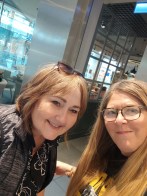
About a month ago, I received a private message from Hanlie, from South Africa, a member of the same FB Group.  She was going to be in Warsaw, and asked if I would like to meet up for coffee while she was in town?  Well, this morning, that happened. We had a lovely couple of hours sharing life stories, adventures, travel tips and mishaps, bucket lists, favorite places and experiences, food, you name it we probably covered it.  To steal a message I recently received from Maria (I’ll introduce you to her later), “It was a pleasure to meet another intrepid soul.”

I think people often don’t understand the concept of traveling solo and extended travel/life abroad.  I hear the questions, “Aren’t you lonely”, “Isn’t it dangerous”, and “are you trying to find yourself”, and I’m sure you can add your own questions here.  I have spent the better part of the last 9 years living outside of my home country.  I can honestly say, I don’t think I have ever felt truly lonely.  As a matter of fact, I believe you meet more people and it’s easier to meet people and have random experiences solo versus traveling as a group or couple.
Life on the road is no more dangerous than life in Warren, Ohio and in some cases, it’s probably safer.  Yes, I have had a few of my own “Eat, Pray, Love moments (mostly the eating part), but in reality, it’s just normal life in a different country.  Although, it is true that someone’s ordinary might be your extraordinary.  Maybe the hardest part of not just solo travel, but travel in general, is the realization that people with whom you have formed a bond, you most likely will never see again in your life.

At this point, you are probably asking yourself what this has to do with Budapest.  Trust me, it will all fall into place.  First, we must roll back sometime prior to 2006.  Before I became a Facebook whore, I was an active member of “Cruise Critics”.  A space where people going on cruises could interact with others on their sailing.  October 7 – October 22, 2006, Tom and I were embarking on a cruise out of Los Angeles, through the Panama Canal and ending in Fort Lauderdale.  On the cruise forum, I met Barb and along with her husband Danny, they would be on the same sailing.  We met on board the ship, saw each other throughout the cruise, and parted ways in Fort Lauderdale not knowing if our paths would cross again.  We did, however, become friends on Facebook and kept in contact through random comments and likes on each other’s posts.  She also followed my move to Paris, then China, Bali, and my current home Warsaw, Poland.
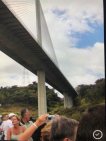
When Tom died in early 2020, Barb went through her photos and found pictures of Tom and me from the Panama Cruise and sent them to me.  Over the course of my years abroad, Barb also virtually introduced me to some of her family and friends who also had a love of traveling.  Late in 2021, Barb and crew would be coming to Amsterdam to board a river cruise.  Earlier in the year she planted a small seed in my head suggesting I meet them in Amsterdam, after all, it would be 15 years since I last saw them.

In November 2021, I booked a berth on a canal boat and a plane ticket to Amsterdam.  It was great seeing Barb and Danny again and I got to “really” meet her sister, Kay, and friends, Dawn, Randy, and Diana.  What can I say, we had a blast in Amsterdam, and before we parted ways, me back to Warsaw and them on their river cruise, another seed was planted. Their cruise ended in Basel Switzerland, and they would be going to Paris for several days.  If you know me, the word Paris doesn’t need to be spoken twice before I have a plane ticket booked.  Even if it would be for a mere 48 hours.
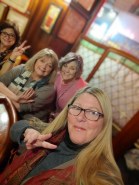
A Friday evening in December, at 21:00,  I got off the plane in Paris and went directly to Harry’s New York Bar to meet them.  Back on the plane Sunday and back home to Warsaw.


Relax…Budapest is next.

I think Barb has figured out that it doesn’t take much to convince me to hop on a plane.  The beauty of Europe and living in Poland is I can be in just about any country in Europe in 2.5 hours or less.  She told me the crew was taking a river cruise from Budapest to Amsterdam (no, I’m not going to Amsterdam again, I was there 3 times last year).  There would also be 2 others going on the cruise that I didn’t know.  That’s how I met Rosa and her sister Maria who I quoted above. And that my friends, is how I ended up spending Easter in Budapest, Hungary.

All that backstory probably isn’t necessary, but hey, I’m a storyteller and more people from my past will join later in the post.  Chatting today with Hanlie and then parting ways made me think about how many people I have said “goodbye” to.  I don’t really like to say goodbye.  It seems so permanent.  I prefer, see you next time, because as unlikely as it may be, you really don’t know when you may be fortunate to cross paths again.  Barb and Danny are proof of this.

Hungary would be a new country for me, and I knew little about Budapest other than it is the capital city.  I also realized I could not name one other city in Hungary.  Even after googling cities in Hungary, I still didn’t know any.  Surprisingly, the capital has a population of 1.8 million and the next largest city only 200,000.   I did a lot less research than I normally do and decided I would figure it out once I got there.  I rented an Airbnb for 6 days as I planned to work while I was there.  I arrived on Good Friday, a day before the crew.  I knew in advance that almost everything would be closed on Good Friday, Easter Sunday, and Monday.  What else did I know about Budapest?  Not a whole heck of a lot.

Landing at the airport in Budapest it is quite convenient to take the Airport Express Bus 100E.  I downloaded the Budapest Go app and purchased my ticket in advance.  You pick up the bus right outside the terminal.  The cost of a one-way ticket is 2200 HUF (Hungarian Forint) which is about 5.85 euros or $6.40.

When you board the bus someone will validate your ticket by scanning the QR code on your phone.  The bus drops you at the city center on the Pest side of the Danube at Kalvin, Astoria, or Deak ter bus stops.  Getting off at Astoria put me a 5-minute walk from my Airbnb.  Since I mentioned the bus stops on the Pest side of the Danube, let me explain.  Separated by the Danube, Buda, and Pest form the two halves of the Hungarian Capital.  They have been linked by the Chain Bridge since 1849.  The Buda side is known for its hills offering panoramic views of the city across the river and Pest is entirely flat.  Buda and Pest were once two separate cities and were united in the 1870’s.
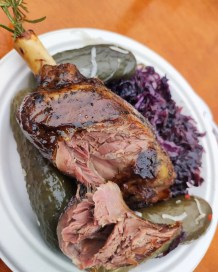
After getting settled in my flat, I decided to walk toward the river and see if I could find something to eat.  I also wanted to pick up some snacks and a bottle of wine.  I was happy to discover that there was a Spring/Easter Market around the main square and side streets.  I perused the kiosks and then made my way to the food area.  I indulged myself with a massive lamb shank, cooked red cabbage, and 3 giant pickles.


After eating I figured out where the crew would be staying when they arrived the next day and then walked down to the Danube.  I people-watched for a bit and tram-watched because I love my trams.  I then walked back to my flat and decided I wanted to check out the Ruin Bars I had heard so much about.  Funny how I didn’t know much about Budapest, but I knew about the bar culture.

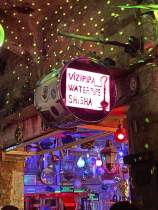
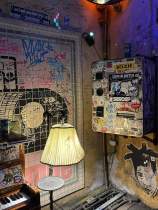
Ruin Bars popped up in Budapest around 2001.  They are found in once-abandoned, derelict buildings and unused outdoor spaces.  They have been transformed into friendly, chaotic, lively, colorful bars laden with graffiti and eclectic décor.  They are also known for cheap drinks. Little did I know when I booked my flat, I would be around the corner from the most famous of the Ruin Bars, Szimpla Kert.

That was my destination for the evening.  I had heard tales of long lines to enter, but being relatively early as party-going hours go, I walked straight in.  I ordered a glass of wine and walked around just to feel the vibe.  I was a bit tired, so I took some photos, finished my wine, and headed home.  On the way home I passed a small convenient store and grabbed some instant coffee, water, and some snacks.  I was all set for my stay in Budapest.

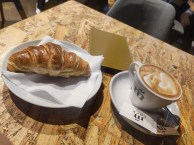
No rush to wake up, I slept late, made my instant coffee, and then headed out in search of “real” coffee.  I found the Blue Bird Café after googling coffee shops.  Arrived…the line was out the door, so I continued and found a cool little book café.
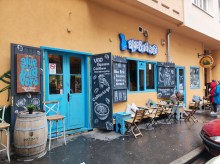
Inside, bookshelves covered the walls and cozy window seats, and giant pillows filled the space along with café tables.  Finished my coffee, I was getting a bit hungry as it was after twelve noon.  I strolled to the area where the others would be staying.  On the way, I chatted it up with a guy who was with the hop-on hop-off bus.  He directed me to a Mexican restaurant, and I also ended up with a 3-day pass for the hop on buses and river boats.

The Mexican food was so-so. After a bite to eat it started to rain.  Since I had time to kill before the arrival of the others, I decided to take advantage of my hop-on hop-off bus pass.  I was near stop number one and boarded by St. Stephen’s Basilica in which you can find the right hand of St. Stephen himself.  The bus has several different routes and I happened to catch one that completed a loop of the Pest side and then with a bus change I was able to do a loop of the Buda side.  A perfect way to spend time on a rainy afternoon.  After a couple of hours of sightseeing, I got off the bus about where I started.
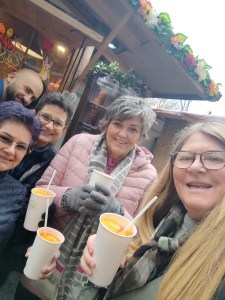
By now it was getting close to the time for the others to arrive so off I went to find them.  Before I found them, I found another cute little café (it was still drizzling) and had a glass of prosecco to pass the time.  They all arrived exhausted after the trip across the pond, but also hungry.  We decided a few of us would head out to the food kiosks and buy a bunch of food and bring it back to their 4-bedroom flat.  Of course, I suggested some adult beverages as travelers while we walked around deciding on the food…big gulp size Aperol spritz was the beverage of choice.  Oh, and if you know anything about European elevators, they are phone booth size.

Silly as we were, we decided to pack 5 people in the elevator.  It was a fun opening night, and I won’t tell the story of Danny and the broken table…I left them and the broken table early so they could get some sleep; I passed through the Ruin Bars on my way home and then called it a night.

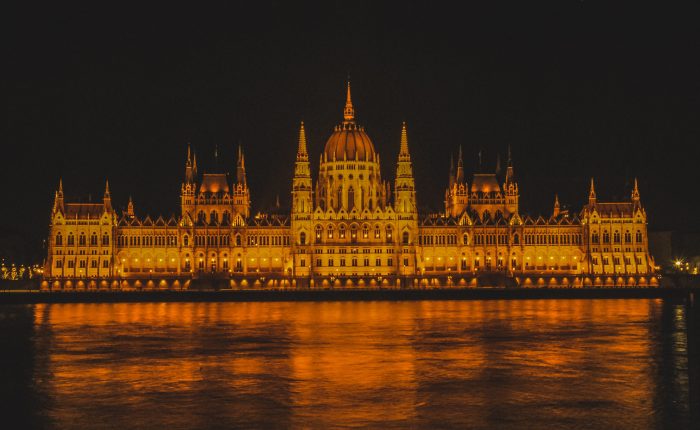
Welcome to Easter Sunday…made my instant coffee and then grabbed a traveler on my way to meet up with the crew in the square outside their flat.  We headed down to the river as we planned to follow the river to the Parliament Building.

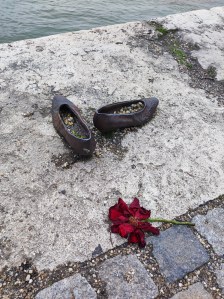
Near the parliament is a memorial called Cipők a Duna-parton or Shoes on the Danube Bank.  It is a memorial erected on 16 April 2005.  Conceived by film director Can Togay, he created it on the east bank of the Danube River with sculptor Gyula Pauer to honor the Jews who were massacred by fascist Hungarian militia belonging to the Arrow Cross Party in Budapest during the Second World War.  They were ordered to take off their shoes (shoes were valuable and could be stolen and resold by the militia after the massacre) and were shot at the edge of the water so that their bodies fell into the river and were carried away.  Most of the murders along the edge of the river Danube took place around December 1944 and January 1945, when the members of the Hungarian Arrow Cross Party police (“Nyilas”) took as many as 20,000 Jews from the newly established Budapest ghetto and executed them along the riverbank. The memorial represents their shoes left behind on the bank…A very powerful scene.
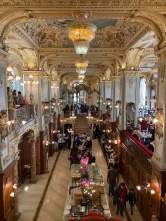
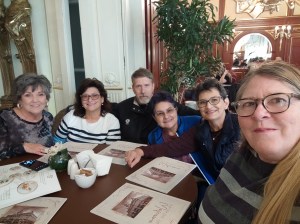
Being after one o’clock everyone was getting a bit hungry.  We decided to take our chances and see if we could eat at The New York Café.  Now Instagram famous it is dubbed as the most beautiful café in the world.  At the turn of the 20th century, the New York Café was the most beautiful and the most beloved coffee house in Budapest.  It was a popular place among writers and editors, in fact, the most influential newspapers were edited there, upstairs in the gallery.  After World War II, the once famous café fell into disrepair, and it served as a sporting goods shop.  Although the café reopened in 1954, under the name of Hungária, it wasn’t until 2006 that the New York Café was restored to its original splendor.  Today, the New York Palace, built in eclectic Italian Renaissance style and opened on October 23, 1894, gives home to the New York Café.  The day before during my hop-on bus trip, we passed the café and even in the rain the line was around the corner, but we said let’s go and try.  We grabbed a taxi. I ordered a vehicle for 6 people, and we all questioned the fact that they were sending a Prius.  When it arrived we all learned there is a Prius+ with 3 rows of seats.  Not pertinent to the story but if you could have seen us (we also had mulled wine while we were at the river) trying to figure out how a Prius could take the 6 of us…it was a laughable, memorable moment.  Arriving at the café, indeed the line was long, but I have a little tip for anyone who may be reading this and planning a trip to Budapest and the New York Café.  Walk to the front of the line, and there is a small sign that says, “fast track”.  It points you into the café and for 5 euros per person added to your bill, you can skip the line and we were seated without a wait.

The first thing we did as we perused the menu was ordered some lovely pink bubbles.  It is indeed a sight to behold…it is worth the 5 euro…food was good…I wouldn’t say it was out of this world, but the atmosphere made it a perfect place for Easter lunch.  By the time we finished a light, leisurely lunch, the others needed to head back to get ready for their 5pm Hungarian Cooking Class which would last about 4 hours.  We made plans to connect after they finished, and I went off walking to explore the neighborhood.

I had walked around for about 15 minutes, and I heard the sounds of Frank Sinatra floating out the door of what looked like a cool place.  It was Doblo Wine Bar.  I peeked in and was drawn inside by the music, the décor, and the thought of some more bubbly.  I ordered a glass of prosecco recommended by the bartender and got lost in the classic American music as I sipped. Next, I continued walking until I ended up back at the main square of the Spring Market and sat at another café since it was nearly 6pm, I ordered a meat and cheese platter, and people watched.  I then decided to go to the river and take an evening river cruise since it would be a few hours until the others finished cooking.  Bad idea!  There was a massive line, the boat that was leaving was full, and everyone would have to wait until the next one 30 minutes later.  Looking at the line, and hearing the people yelling at the poor guy checking tickets, I decided there was no way all those people could even get on the next boat.  I went on my merry way.  Walking along the river I caught a most glorious sunset and then stopped off for a coffee.  The group messaged me as they were finishing up the cooking class and it was decided a trip to the Ruin Bars was in order.

There was a short line when we arrived at Szimpla Kert but it moved quickly and soon we were inside ordering cocktails.  After a bit of picture-taking, a gin & tonic, a long island iced tea, a bit of dancing, and lots of laughing we decided to call it a night.  The line to get in had easily tripled as were leaving. What happens at the Ruin Bars stays at the Ruin Bars and I’ll just leave it at that.  A good time was had by all even when you end up in a wee street ruckus.

I knew there was no reason to rush on Monday morning as the others needed to check out of their AirBnb by noon and could move into their rooms on the riverboat around 3pm. So I slept late and then headed their way around 11 am.  The weather had been cool and rainy since I arrived, but this day looked promising.  I remembered a little coffee shop/bar in the square outside their flat, so I made my way and sat and enjoyed a cappuccino while I people watched.  I decided not to go up to the flat because somehow with 8 people packing luggage and moving around I figured I would just be in the way.  Herding kittens comes to mind. Soon I saw them come out and we got a table in the sun at Marty’s, a nice restaurant in the square.

After a leisurely lunch, it was time to get taxis to take them to the boat.  I should probably mention here that the waiter twisted our arms, really, and talked us into sampling some traditional Hungarian Pálinka.  Pálinka is a traditional fruit spirit (or fruit brandy) with origins in the Carpathian Mountains, more exactly known under several names, and invented in the Middle Ages.  Protected as a geographical indication of the European Union, only fruit spirits mashed, distilled, matured, and bottled in Hungary and similar apricot spirits from four provinces of Austria can be called “pálinka.”
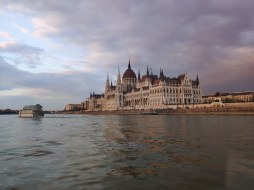
Since the boat was docking there overnight, I went along to see if I could go onboard and check it out.  It was the first time I had been on a Viking River Boat…very impressive.  I hung out for a while before heading out.  They had a night tour of Budapest scheduled through the cruise line and I was going to see if I could get on the evening hop-on river cruise.  Plans were to go to the Central Market the next morning.  I was successful in getting on the river cruise that was just before sunset, so it was beautiful to watch the city light up.  Picked up a pizza on my way home and had a quiet evening in my flat.

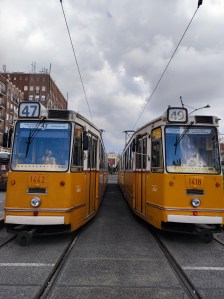
Grabbed a tram and headed to the market around 9am Tuesday morning and met up with the others.  I bought some spicy Hungarian paprika and a Budapest t-shirt that caught my because it had a tram on it.  After the market, we started walking toward St. Stephen’s Basilica.
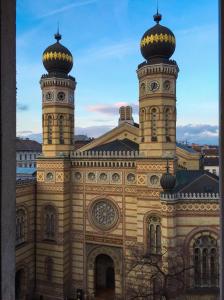
We had to pass the Dohány Street Synagogue also called the Great Synagogue.  It was at the end of my street but unfortunately, I never made it inside.  It is the largest synagogue in Europe and the second largest in the world.  The synagogue was built between 1854 and 1859 in the Moorish Revival style.  The synagogue was bombed by the Hungarian pro-Nazi Arrow Cross Party on 3 February 1939.  Used as a base for German Radio and as a stable during World War II, the building suffered some severe damage from aerial raids during the Nazi Occupation but especially during the Siege of Budapest.  During the Communist era, the damaged structure became again a prayer house for the much-diminished Jewish community.  Its restoration and renovation started in 1991, financed by the state and by private donations, and was completed in 1998.
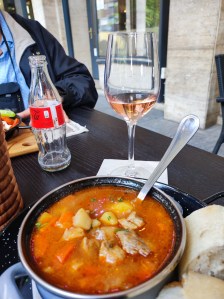
On the way to the Basilica, we stopped at a small bistro for some lunch.  The waitress to me the goulash was almost as good as her grandma’s, hence I had my first bowl of real Hungarian goulash.  It was delicious and filling, although Hungarian goulash does not have pasta like I was used to in the States.  On to St. Stephen’s where we would part ways and exchange our, “until next times” because with this group it’s not goodbye.  They were setting sail later that evening and I was having dinner with friends I hadn’t yet met.

As I said earlier in this post, which has been turned into a small novel, I would be bringing up others from my past along with a new cast of characters, Rosa and Maria being just two of those.  Not long after I posted on Facebook that I would be going to Budapest (no comments Mark, I know your opinion of Facebook), I received a message from a woman I had met at a wine tasting in my hometown.  Pamela was in Warren temporarily as CFO (I hope that’s right) of our local hospital.  Other than a few times at wine tastings, we didn’t see each other around town, and she eventually moved back to Arkansas when her time at the hospital ended.  When I moved to Paris, she came and spent the week between Christmas and New Year’s along with her friend Patty.  See what I mean by saying see you next time and not goodbye.  So, back to Budapest.  Pam messaged me that her husband’s brother and his wife lived in Budapest.  She even set up a group chat so we could exchange plans.  Being a holiday weekend, Matt and Erzsi were mostly busy with family plans, but graciously made time to take me to dinner on Tuesday evening and then an evening tour of the city.  We had a lovely evening at Rosenstein.   Rosenstein is a well-known restaurant in Budapest serving traditional Hungarian and Hungarian-Jewish dishes.  Tibor Rosenstein, currently eighty, started this family-run operation which is located a bit outside the city center and is currently helmed by his son Róbert.

What a lovely evening.  I had an amazing wild garlic soup and veal paprika with spaetzle along with red wine.  The best part of the evening is passing time chatting with people you just met, yet it feels like you have known them forever.  I know I overuse this quote by William Butler Yeats, but it is so true…”There are no strangers here; only friends you haven’t yet met.”  After dinner, we took a ride to the Buda side and up the hill to the Citadella which is the fortification located upon the top of Gellért Hill and offers amazing views of the city.  It was glorious at night.  Afterward, they dropped me at my flat and I turned in because I had early classes to teach in the morning before I checked out.

Over the weekend, I also received a message from another friend in Warren, Marty.  His cousin also lives in Budapest.  Unfortunately, our schedules didn’t match up because of conflicts for both of us.  Naturally, I said, “Well, maybe next time.”  There just may be a next time, Budapest is a one-hour flight from Warsaw, and I didn’t get to explore the Buda side of the city and I completely forgot about something my friend in Warsaw, Pawel, told me.  Did you know?

The Budapest Metro is the world’s oldest electrified underground railway system, and the second oldest underground railway system with multiple stations, after the originally steam-powered London Underground.  Budapest’s iconic Line 1 was completed in 1896.  I am so fascinated by trams, I completely forgot that he told me to ride the metro.  Even worse, he told me more than once.  I did, however, photograph a couple metro station entrances for whatever reason.

It was a fabulous six days in a beautiful city with amazing architecture and history. I met up with old friends and made new ones.  I am reminded of a quote from Brooke Hampton that my friend Andree sent me, “I am pieces of all the places I have been, and the people I have loved.  I’ve been stitched together by song lyrics, book quotes, adventure, late-night conversations, moonlight, and the smell of coffee.”

Life is good and I am blessed…thanks Pamela I took that from you.  Peace out!
Tanzania Part 3 ~ Bright English Medium School, A Serengeti Safari and Kilimanjaro

Tanzania Part 3 ~ Bright English Medium School, A Serengeti Safari and Kilimanjaro

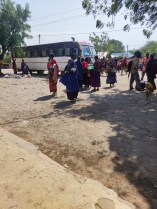
When I ended my last post, I said my goodbyes at the Maasai Giraffe Eco Lodge.  James and Timan were taking me by tuk-tuk to catch the bus to Wasso Tanzania.  It is the same bus that I had started my journey a mere 4 days earlier.  You remember, the crowded, hot, dusty Loliondo Coach packed to the gills with people, supplies, luggage, and even a live chicken.  The coach makes a daily 8–10-hour trip from Arusha to Loliondo.  I would be getting off in Wasso to go to Bright English Medium School where I had volunteered for a WorkAway.

Engare Sero Bus Stop

We arrived at the bus stop in Engare Sero, James had to get back to the lodge, but Timan stayed with me until the bus arrived.  Lidia from Bright School had pre-arranged my bus ticket and got me a seat in the first row next to the window and across the aisle from the bus driver.  Next to me was one young lady and sitting on bags of rice in the aisle was one gentleman and then the bus driver.

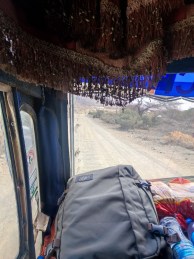
In My Seat
My backpack on the ledge


I’m not sure what was behind the driver, but it resembled a wood or coal-burning stove.  Luckily this was a longer-than-normal stop and most everyone got off the bus to grab a bite to eat so I was able to make my way to my seat easily.  Timan gave my suitcase to the driver to put somewhere, and I put my backpack on the front window ledge next to several loaves of bread and various other paraphernalia.   I took a minute to take in my surroundings and knew I was in for an interesting journey.

After 5 hot, dusty, bumpy hours on the bus, I arrived in Wasso. It wasn’t the most comfortable trip, but it was better than the ride to the Giraffe Lodge, mainly because of my seat position.  Also, looking out the window and seeing random giraffes and dazzles of zebras along the way somehow made it almost dreamlike.  I messaged the school inquiring if I should get off the bus in this small village called Wasso.  Lidia said, “no, stay on and let me talk to the driver.”

Back on the road and about 15 minutes later, the bus pulled to the side, dropped me off, found my suitcase, and I arrived at my home for the next couple of weeks.  When I said dusty, check out the photo of my suitcase when they took it off the bus and then after the ladies who cook and clean at the school washed it for me.

Before
After


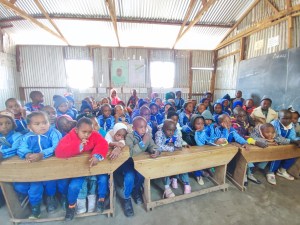
There were no children at the school as they would be arriving over the weekend to start the new semester.  Approximately 200 children live at the school and about 300 attend.  I was greeted by 6 other volunteers, representing Italy, France, Germany, and Austria, and shown to my room which I would be sharing with Sara from Italy.  There is no running water at the school.  This meant we would be taking bucket showers and using pails of water to flush the toilets.  The location of the school which is between Wasso and Loliondo, Tanzania sits about 2° south of the equator and at an altitude of approximately 2000 meters (6560 ft) above sea level.  Why is this important?

For my bucket showers
My bed

It is important because I arrived with flip flops and one pair of closed-toe Keen sandals, no socks, 1 hoodie from Zenira Camp and I think 1 long-sleeve shirt along with several t-shirts and some linen pants.  2° south of the equator in my mind meant hot.  What I didn’t take into consideration was the altitude.  The days were warm but breezy and once the sun went down it got downright chilly, even dipping into the mid-’40s (Fahrenheit) at night.  This might be a good place to add that along with no running water, there was no heating and cooling system…and electricity could be sketchy along with cellular service.  Before you ask, yes I was aware of the living conditions and somehow that actually enhanced the experience.

Stew with eggplant, carrots and potatoes

The other volunteers were busy doing things around the school, but I was given a hearty meal of chapati, potatoes, and a type of stew.  After which the ladies who work there insisted I empty my suitcase so they could clean it along with any clothes I wanted to be washed.  Everything is washed by hand even though they have a washing machine.  They have no running water to hook it up and are hoping that will change in the near future.  Next, a young girl showed up with a bucket of hot water so I could “shower” after my dusty journey.  Around the dinner table that evening I had the chance to meet all the volunteers and they filled me in on what was happening and what to expect the next day.

One of the buildings of the school

I woke up on the last day of August 2022, to a cool, breezy, partly cloudy day.  We would spend the day preparing the classrooms and dormitories for the return of the children.

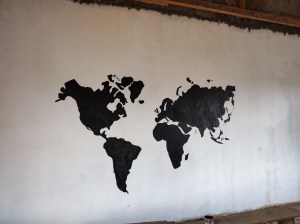
My world map task

My task for the day was to paint a world map on the wall of one of the classrooms.  Others were painting desks and chairs, measuring windows for replacement glass, and organizing the dormitories.  Part of the arrangement with WorkAway is that in exchange for room and board, you volunteer 3-4 hours per day during the weekdays.  Many WorkAways provide room and board at no cost to the volunteers.  At BEMS, we were asked to contribute the equivalent of $5.00, or about 12,000 Tanzanian shillings per day.  All of this was funneled back into the school and also helps cover the cost of food for the volunteers.  To put that into perspective, the school spends approximately 280,000 shillings per day to feed about 300 children, staff, and volunteers.  This is the equivalent of $120.00.

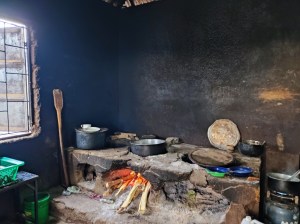
The kitchen for the school. They feed 300+ from here

Whereas the children ate basically the same thing every day (porridge in the morning and rice and beans for lunch and dinner), the volunteers often got fresh fruit (oranges, bananas, watermelons, and avocados), spaghetti, rice, potatoes, and sometimes stew, and always chapati.  It didn’t change much over the 2 weeks I spent there. Even contributing my $5 per day, I sometimes felt guilty about the food we received compared to the staff and children.

Sometime over the course of the day, I was approached by Lidia and asked if I was interested in going on a safari to the Serengeti the next day.  Since the children wouldn’t be arriving until the weekend, it would be the perfect opportunity.  The owners of the school, Baraka and Juliana Eliud also have a safari business, https://astrosafaris.com/.

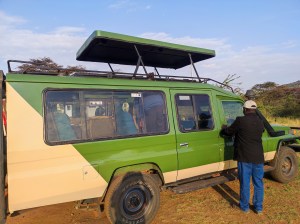
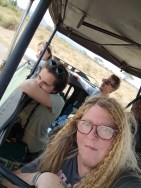
Not only does BEMS sit 2°south of the equator, but it is 120 km (75 miles) from Serengeti National Park.  I mentioned in an earlier post one of my reasons for choosing Bright English Medium School for my WorkAway was its location in regard to the Serengeti.  Baraka offers this opportunity to volunteers at a rate much lower than you would expect to pay as a “regular” tourist.  Again, after his expenses, (gas, etc.) all the money is put back into the school.  On top of the fee we paid to Astro Safari, we also paid an entrance fee at the park, and we divided the cost of entrance for Baraka and his assistant (less than ours as they are residents) between the 4 of us that went. I know many people go on weeklong safaris, but our one day was more than I ever imagined.

Our day started at 05:00.  Even though it is only 120 km to Klein’s Gate, where we would start our safari, it was about a two-hour journey over dirt roads and paths.  It is an exit or entry point near the northeastern border of Serengeti National Park. Completely remote, it is utilized by those going to or coming from the Loliondo game-controlled area, a rural Maasai territory — with lake Natron on the eastern end.  The gate and the route are seldom used due to it being remote and the Loliondo route being uncharted territory.  Still, part of the area is a wildebeest migration route.

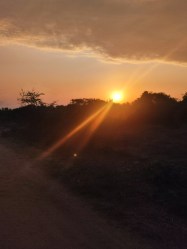
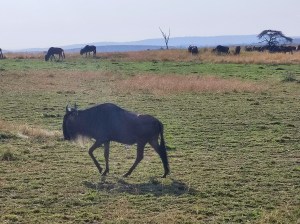
We witnessed a glorious sunrise and before we even made it to the official entrance to the park, we had wildebeest cross right in front of us.  It was still part of the great migration season and seeing herds, properly known as a confusion, of wildebeest, was a remarkable sight.

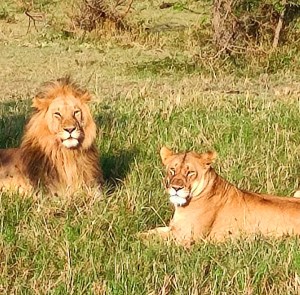
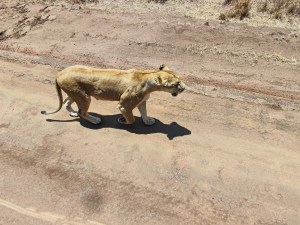
Near to Klein’s Gate, we spotted a lion (bull) and two lionesses lolling in the grass.  We stopped for several minutes just to gaze and then continued on to enter the park.  Inside Klein’s Gate, we parked our safari vehicle, paid our fees, and then at a picnic table enjoyed coffee and chapati prepared for us by the school.  When we finished Baraka had spoken to the park ranger and we decided to go back to where we saw the lions.  Inside the park, you are not permitted to exit the paths designated for vehicles, but the lions were outside the boundaries of the park and Baraka was going to go off-road and see if we could get close to them.


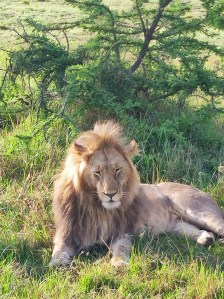
Well, they were still there when we got back, and as promised Baraka got us practically within petting distance.  We were within about five meters of the beautiful creatures.  They completely ignored us, and we got amazing photos but spent most of the time staring in awe.  Finally, we decided, we need to move on as we hadn’t even entered the Serengeti.  Little did we know what the day had in store for us.

The Serengeti ecosystem is a geographical region in Africa, spanning northern Tanzania.  The protected area within the region includes approximately 30,000 km2 (12,000 sq mi) of land, including the Serengeti National Park and several game reserves. The Serengeti hosts the second largest terrestrial mammal migration in the world, which helps secure it as one of the Seven Natural Wonders of Africa, and as one of the ten natural travel wonders of the world.  The Serengeti is also renowned for its large lion population and is one of the best places to observe the prides in their natural environment.

Over the course of the day, we saw many simbas (simba is Swahili for lion) including a pride of about 15 and a mother with 2 young cubs frolicking in the grass.  Later on in the day, we had a lioness walk alongside our vehicle for quite a ways. So close I could have reached out and touched her.  Leaving the park, the lions we saw first thing in the morning were still there.  Then several minutes down the road, we spotted another lioness who appeared to be hunting.

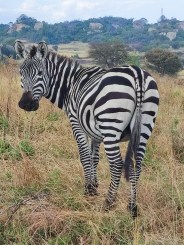
It seemed like zebras were everywhere.  I couldn’t stop watching them and photographing them.  Luckily our driver had no problem pulling over and letting us just gaze. Also, our guide took some of my photos/videos so I could just watch. It is utterly amazing seeing them wander the savannah of the Serengeti.  There were even some that wandered around the fields by the school.

In the vast plains of Serengeti National Park, the annual migration of two million wildebeests plus hundreds of thousands of gazelles and zebras is one of the most impressive nature spectacles in the world. The biological diversity of the park is very high with at least four globally threatened or endangered animal species: black rhinoceros, elephant, wild dog, and cheetah.

You can’t even imagine the number of wildebeest.  To see them run across a field is a sight to behold.   The 800-kilometer trek of the immense wildebeest herd is the largest mammal migration on earth. It is of the most sought-after experiences for wildlife and nature enthusiasts, the Great Migration is the ever-moving circular migration of over a million animals across the Serengeti-Mara ecosystem.  The ecosystem supports two million wildebeests, 900,000 Thomson’s gazelles, and 300,000 zebras as the dominant herds.

We didn’t see that many giraffes up close and personal. But when you are very near you can’t help but be astounded by their size.  Vulnerable due to an observed population decline of 36–40% over three generations (30 years, 1985–2015). The factors causing this decline (direct killing and habitat loss) have not ceased throughout the species’ range. The best available estimates indicate a total population in 1985 of 151,702–163,452 giraffes (106,191–114,416 mature individuals) and in 2015 a total population of 97,562 giraffes (68,293 mature individuals).  These elegant animals need around 30 to 60 kilograms of vegetables or leaves a day. Since they are quite choosy about their diet, they spend up to 14 hours a day eating. They have plenty of time because giraffes sleep just one hour a day!
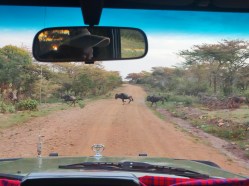
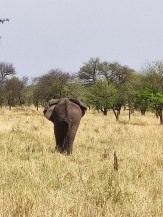
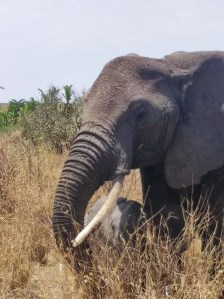
We had several up-close encounters with the world’s largest land animal. Although our first sighting was a lone elephant in the distance on a hill. Even from a distance, it looked massive.  Our second encounter was when one crossed the road directly in front of our vehicle. All I could do was watch.  Which is why I only have a photo of the elephant’s butt. Then we got to be up close with several frolicking with a couple of young elephants too.

Elephant populations in Serengeti National Park have increased from 6,000 in 2014 to more than 7,000 in 2020, according to the Tanzania Wildlife Research Institute (TAWIRI).  African savanna elephants are the largest species of elephant and the biggest terrestrial animal on Earth. They are easily distinguished by their very large ears—which allow them to radiate excess heat—and front legs which are noticeably longer than the hind legs. It’s the world’s largest land animal, and seeing one in its natural habitat is simply thrilling.

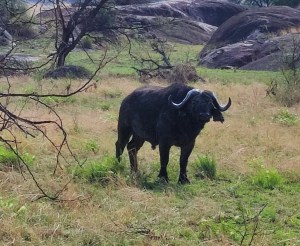
The buffalo is considered one of the “big five” in the Serengeti. The term “Big Five” originally referred to the difficulty in hunting the lion, leopard, rhino, elephant, and African buffalo. These five large African mammal species were known to be dangerous and it was considered a feat by trophy hunters to bring them home.  The Buffalo is among the most dangerous species of animals in Africa, with only a few predators, like lions.  It is believed, that there are over 30,000 Buffalo in the Serengeti.

We came across several pools of hippos.  The Hippopotamus is a two-ton, amphibious tank of Africa and the third-largest land mammal on Earth (elephants first, rhinos second).  These rotund, water-loving behemoths can grow the length of an adult giraffe and can weigh over twice the size of an average sedan. Often found lounging in mud baths of their own refuse, hippos are not to be messed with.  The hippopotamus is a name of Greek derivation suggesting them as a “water horse,” but hippos are far from equestrian. In fact, they might just be the strangest and most dangerous animal you will witness on safari, half-submerged sixteen hours a day along rivers in their groups, or “bloats,” of 10-20 hippos.

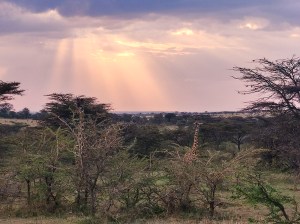
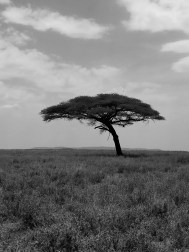
We spent 10 hours exploring the park.  Although we didn’t see all of “the big five”, it was an awe-inspiring experience with the landscape being as captivating as the wildlife.  The landscape of the Serengeti is mostly savannah.  The savannah consists of grasslands, plains, kopjes, marshes, and woodlands.  I was surprised by the diversity of the landscape which seemed to change every 20 minutes.  Seeing the iconic umbrella acacia on the open savannah was beyond description.  The day exceeded all expectations.  Making our way out of the park at the end of the day, watching the sunset, and noticing giraffes behind the trees with the 3 lions still lounging underneath will be forever etched in my mind.  Arriving back at the school I had trouble settling down for the night as I replayed the day before falling into an African dream.

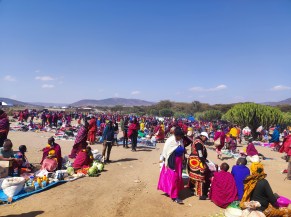
Slept in a bit on Friday as there were no kids at the school yet.  Sipping my coffee, still thinking about my safari it was soon time to continue work on the classrooms and dormitories.  Soon Lidia came around and asked if anyone wanted to go to the Maasai Market.  I jumped on the opportunity.

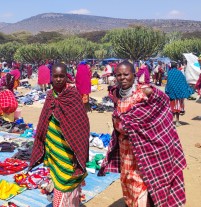
It is a weekly market where Maasai people from villages all over the area including Kenya gather to buy and sell goods and cattle. Currently, about 80% of the students at the school are Maasai.  The Maasai are semi-nomadic people located primarily in Kenya and northern Tanzania. The Maasai are cattle and goat herders, and their economy is almost exclusively based on their animal stock, from which they take most of their food: meat, milk, and even blood, as certain sacred rituals involve the drinking of cow blood. Moreover, the huts of the Maasai are built from dried cattle dung.  Despite the growth of modern civilization, the Maasai have largely managed to maintain their traditional ways, although this becomes more challenging each year. The ability to graze their cattle over large territories, for example, has diminished considerably in recent years, due to increased urbanization and the declaration of the Maasai Mara and Serengeti game reserves, which were all formerly Maasai grazing land.

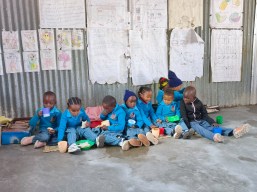
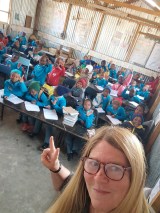
The weekend arrived and students began to trickle in.  And we kept busy playing with the children and continuing work around the school.  One of the current projects going on at the school is building a new toilet and shower room for the boys’ dormitory. I had a chance to chat with the young man who is making the concrete blocks one at a time. He told me if needed he could produce up to 300 blocks per day. He has been doing this type of work for 4 years. The blocks he was working on were for the sewage/septic tank.  Maybe because my brother deals a lot with the concrete industry, I was fascinated by the making of the blocks which take about a week to dry.  The weekend flew by in a flurry of activity and on Sunday night the children had a small worship service in the dormitory.  Monday brought even more children to the school and I was spending my days in the preschool classroom teaching the littlest one’s songs and dances.

Soon the “Hello Friends” song I taught them was heard all over the school grounds.  Another favorite was “Baby Shark”….not mine…theirs. Somehow the week disappeared.  I want to point out that there are no televisions at the school, and children don’t have cell phones or tablets.  Free time is spent jumping rope, kicking a mostly flat soccer ball around the school grounds, and just having fun.  My days were filled with smiles and laughter.  I had my laptop with me and downloaded several movies.

The next time you think you need a larger television screen, think about these kids (at one point about 60), crammed around my little computer screen watching “Lion King”.  I eventually went into the small village and bought a small Bluetooth speaker so they could at least hear the sound a bit better. At the close of every school day, while some were waiting on the school bus, it was the same plea….Can we watch “King Lion”?  Yes, they got it backward but every day my answer was, “of course, we can watch it”. Being in a remote area the evenings gave us epic sunsets and chilly nights.

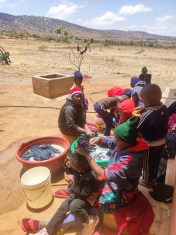
How did the weekend get here?  I had Saturday morning classes with the littles.  The weekends were also cleaning up time.  All the kids who lived at the school, washed their clothes (by hand), and hung them on lines or on bushes to dry.  While the clothes were drying, they polished their shoes and played some soccer in between.  I took a couple of nice walks on the roads around the school and bumped into some Maasai men tending their herds.  I noticed the ground was full of crystal-like rocks, so I picked up a few to bring back with me.

The children put on a worship service Sunday morning complete with empty water bottles on overturned buckets for drums.  The singing, dancing, and drumming were as good as any church service I attended.

The next thing I knew, my time at the school was over.  If there is one thing I have learned during my travels, it is that goodbyes are never easy.  It was time to make my rounds and say not only goodbye but thank you to the beautiful people who had become part of my life, my journey, and my memories these last two weeks. It has been an unforgettable experience.  The happiness and love I felt there was almost indescribable, but I think you can see it in everyone’s eyes and smiles and you will understand.

My wonderful host and owners of the school presented me with a lovely letter and certificate but also a Maasai shuka which I will treasure.  I was blessed with one last beautiful sunset. I had to be up the next morning at 5am to catch my bus for the 9-hour journey to Arusha followed by an hour taxi ride to my hotel in Kilimanjaro. I won’t be sad because it’s over, but happy because it happened. So, lala salama, and on to the next chapter.

Somehow, after everything I experienced the last few weeks, not only at BEMS but also at the Giraffe Lodge, made the long, hot, dusty, crowded, often uncomfortable bus ride was not too bad.  I arrived in Arusha around 2:30 in the afternoon.  Max, my driver,  picked me up at the bus station in Arusha and it was a bit over an hour’s drive to my adorable guest house, Le Parlour which is near Kilimanjaro. I was greeted by Mama Angela, the proprietor who showed me around and made sure I had hot water for a much-needed shower.  My first “real” shower in almost 3 weeks. It was heavenly.  She then asked if I would like an early dinner so I could have a relaxing evening. She told me to be at the little red bungalow at 18:00. I was served way too much food…chicken, pasta, greens, veggies, and of course chapati. I told her I liked spicy food so she made sure her homemade chili sauce was there for me. I also met her daughter Eileen, who made all my arrangements to get from Arusha (Max had my name on a placard and whisked me away) to their guest house. I am sipping a G&T and can hear someone strumming a guitar outside. I think it will be an early night with my Kindle. No plans for tomorrow so I will just see what it brings.

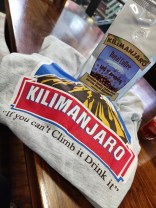
After a wonderful sleep, it is my last full day in Tanzania.  Eileen and Mama Angela prepared a beautiful breakfast. Chapati with avocado and scrambled eggs with homemade chili sauce, coffee, and freshly squeezed juice. My plan was to just relax and then take a walk.  Which is exactly what I did.  I will settle for seeing Kilimanjaro from the distance.

I spent the last of my Tanzanian shilling in the gift shop at the airport and then found out I could have a cheeseburger and a glass of South African Chenin Blanc….life is indeed good.  Taking off for Ethiopia, our pilot made sure to give both sides of the plane an up-close view of Kilimanjaro.  It was an amazing time in Tanzania, but I was ready to get back home to Warsaw.


It really was a lifetime experience and thanks to each and every one of you that followed. Again…count your blessings! Then remember these kids, remember how happy they seemed. I rarely saw them without smiles, they were happy with their meals and thankful for the time the volunteers spend with them. Maybe it is really them that are blessed.  Peace my friends.

“Once you carry your own water, you will learn the value of every drop.”

Year in Review 2022 ~ Life is Short…I Want to Live it Well!

Year in Review 2022 ~ Life is Short…I Want to Live it Well!

A mere 4 days until 2023.  As usual, I am staring at a blank page pondering my prose.  Not to mention, I have part 3 of my Tanzania story still unfinished.  I have a very quiet week, but somehow, the more time I have the less I accomplish.  I guess I work best under pressure.

For the last few years, I have written my year-in-review blog and put together a slide show set to music.  This year I ran across a song by Switchfoot which I had never heard, but it has quickly become my mantra.  Here are a few lines to see where my head is:  “Life is short; I wanna live it well.  One life, one story to tell.  Life is short; I wanna live it well.”  As the year 2022 got closer, the phrase “life is short” entered my mind at least weekly, if not daily.  2022 was going to be a tough one for me.  In August 2022, I would turn 60.  I’m sure you are all saying things like it’s just a number, you don’t seem like you are 60 (trust me my body feels it some days), and all those other things you say when someone mentions “an age”.  Why was 60 going to be a rough time for me?

22 years ago, at the age of 60, my mom died after a long, hard battle with Primary Sclerosing Cholangitis.  She fought a good battle, but DAMN, she was only 60, that’s the number I will reach this year.  It’s tough wrapping my head around that.  I am now the same age my mom was when she died an ugly death.  So yeah, “life is short, and I definitely want to live it well.”

Without further ado…here’s my story which starts where last year finished.  You are an important part of my journey and I hope you found Peace, Love, Light, and Lots of Laughter in 2022.  And mom, this year was for you.  Especially my time with those kids at Bright English Medium School in Loliondo Tanzania.  When my brother looked at my photos and heard my stories, what he said to me was the greatest compliment anyone could give.  He said, “you are our mother’s daughter for sure”.  I could feel her emotions and her presence.  I have one life and hopefully, my life is my story.

January kicked off with friends next door at the Tapas Bar, some fireworks, and bubbles.  Next, it was Tamara’s birthday and we met for dinner at a great restaurant, Warszawa Wschodnia, in the Praga District of Warsaw.  It had a very cool whale tail piano.  January 6th, Epiphany, or a day my mom called “Little Christmas”.  Epiphany is also called Feast of Epiphany and Three Kings Day.  It marks the day when the three wise men or kings went to visit baby Jesus.  In Warsaw, there is a large parade of kings.

It is a reenactment of the nativity and the three kings on camels ride from Old Town to Plac Marszalka Jozefa Pilsudkiego.  Thousands of people follow the parade with the kings.  It was quite a sight to behold as I walked the route with the throngs.  January was quickly turning to February.

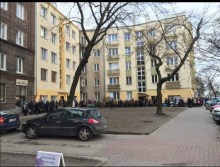
February found me starting my own company in Poland called Language Nomad and I could freelance as an English teacher.  In Poland, we celebrate Tłusty Czwartek or Fat Thursday (not Tuesday).  It is the last Thursday before Ash Wednesday.  It is also playfully known as “pączki day”.  This is because across Poland more than 100 million pączki (traditional donuts filled with rose or plum jam) are consumed.  I decided I needed to get my pączki from one of the most famous bakeries in Warsaw.  I knew people wait in line to get these delectable treats, but little did I know I would wait in line for nearly 3 hours.  Wednesday morning, I set off for the bakery.  When I got off the tram, I saw a line around the corner of a building and knew I was at the right place.  What I didn’t know was that there were 3 “corners” to go around.

After 30 minutes, I was happy to make the first turn, happy until I made the turn and saw that I had a ways to go.  I decided I had already invested this much time; I may as well stick it out.  On a side note, it was also drizzling rain but warmish. When I finally got in sight of the door, and thankfully there had been a coffee shop along the way so I had a double espresso, I discovered why the line moved so slowly.  First, the shop was so small only 2 people could enter at a time.  Second, there was a limit to how many of the 3.50-zloty (about 80 cents) pączki you could buy.  I figured it would be a limit of a dozen, but NOOOOO.

Everyone could purchase 40, you read that right, FORTY!!!  It seemed everyone was buying the limit.  Well, after nearly 3 hours wait, I wasn’t about to buy 1 pączek (the singular of pączki) and leave, so I took a dozen.  Was it worth the wait?  Put it this way, I probably wouldn’t wait 3 hours again, they were delicious, and it is all about the experience, but now I can say, “been there, done that”.

Tłusty Czwartek also coincided with the Russian invasion of Ukraine and the start of the current war.  The influx of refugees into Poland started almost immediately.  The last weekend in February I attended a demonstration in front of the Russian Embassy protesting the war and Putin.  I went with my flatmate, Zaka, and it is an experience I won’t forget.  Across Poland, people were coming together to help the 100’s thousands of mostly women and children crossing into Poland.  By the beginning of March, Poland had already accepted 500,000 refugees.  At its height, this number would rise to over 3 million with the population in Warsaw increasing by 17%.  The month of March was an emotional roller coaster.  My eyes were opened to things I never thought about.  Things I can’t imagine ever going through myself.  I met people who had no idea what their future would look like.  I witnessed humanity and compassion that I thought didn’t exist anymore.

During my first year in Poland, I was always searching for interesting things to do.  I happened to discover Pinball Station; an interactive museum established in 2016 by 2 hobbyists.  One evening, as I was scrolling, I saw a post by Paweł, one of the founders of the museum.  It read (translated version),  “To everyone who wants to help refugees.  Pinball Station has launched a coach bridge between the border and Warsaw.  I, Paweł Nowak, have personally been to the border 5 times.  We have coaches and drivers available.  Today at 5 am we transported another 48 people.  In total, it is already about 150 people transported in two days.  We ask you to help raise money for the next transport.  Out of 150 people transported, there were only a few men, the rest were women and children, even babies.  I am determined, I am in constant contact with foreign countries, and we are looking for accommodation and further transport for them.  Please help.”  I had been going to the train station to volunteer whenever I could, but when I saw Pawel’s post almost simultaneously I received a message from a travel friend asking if they could send money to me and I could make sure it was put to good use.  Soon, without even asking, other friends were contacting me with the same question.  I was also contacted by my hometown newspaper, The Tribune Chronicle asking about life in Poland during the war.  I told them my story up until that point and that I planned to return to the train station the next day to help.

I had no idea the tidal wave that was about to hit.  They published an article, “Drive to Save Lives”.   Within a few days, I received over $13,000 in contributions to Pawel’s efforts.  This money was not only used to transport refugees, but it helped purchase ambulances that were sent to Ukraine, and food for the shelters.

March quickly turned into April, and I was fortunate to meet up with a friend from my hometown who was in Warsaw with the International Red Cross helping with the war effort.  We only had time for lunch and a short visit, but it’s always great to see someone from “home”.   Also in April, I was contacted by a good friend who told me he had given my phone number to a woman from his church.  Soon I was contacted by a member of her family explaining that they had a grandson who had escaped from Kharkiv Ukraine with his mother and grandmother.  Lana and her son had both been wounded by bullets and shrapnel with Lana requiring surgery when she arrived in Warsaw.

They were trying to get to the United States.  I visited them several times while they were waiting on a visa appointment for the grandmother.  The stories they told me were unbelievable.  I’m happy to report that after 4 months, all documents were in order, and they were able to make it to the United States near the end of June.

April brought me the sad news of the death of one of my young students at Yayasan Widya Guna school for special needs in Bali.  I had an opportunity to go with Pawel to see the ambulances which had been purchased and were ready to head to Ukraine along with medical supplies, body bags, and food staples.  Even seeing what all Pawel was still doing, deep down, it was feeling like the war was becoming just a normal part of daily life. Myself, I was headed to Paris for a two-week holiday with my friend Cathy.   Sadly, the war would be all but forgotten as I enjoyed the sights and sounds of Paris and beyond.  I took her to all my favorite places in Montmartre and a few others around the city.  We even discovered a few new places and traveled to Moulin, France, and St. Genevieve des Bois to visit sights associated with Rudolf Nureyev.  We even managed a day trip to Amsterdam.

One of the highlights of the trip was meeting up with Lenore.  I met Lenore online through a fellow Kiwanian in Warren Ohio, Leonard, who was in Paris during WWII and shared my love of the city.  I had only met Lenore through Facebook, but her Panther Organization was in Paris to visit WWII sights and travel to Normandy.  After many years of Facebook exchanges, and the death of Leonard, we were finally going to meet face-to-face along with Cathy and members of her group.  What an evening that was on the steps of Sacre Coeur.   As we watched the sun go down, listened to buskers, laughed, cried, and sipped Calvados, Leonard’s words of wisdom were in the back of my mind, “beware of the Calvados”.  Truer words were never spoken.  I will leave it at that.  The two-week holiday flew by, and I think I have another Paris convert, right, Cathy?

Arriving back in Warsaw in mid-May, spring was in the air.  The month ended with a whirlwind of activity, meeting with friends, wrapping up the school semester, and getting plans settled to head to Bulgaria in June.  I saw Lana, Anton, and Lidia one more time to say goodbye and wish them well as they started a new life in the USA.  The highlight of my year took place one weekend before I headed to Bulgaria, I have no photos because I just enjoyed the company of my brother and sister-in-law who came to Warsaw to visit me.  I was thrilled to show them the city I currently call home.  We walked all over, ate good food, shared some wine, took in a Chopin concert in Lazienki Park, and just savored our time together.  On June 22,

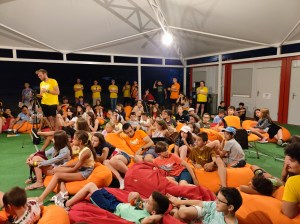
I boarded a plane to Burgas, Bulgaria on the Black Sea to spend the next 8 weeks working at Zenira Language Camp in Kiten.  Life at camp never stops, it’s exhausting, exhilarating, and sometimes frustrating, but always rewarding.  You make it to the end of the first 2-week session, take a breath and the next thing you know, it’s mid-August and you are saying your goodbyes.  Somewhere during the period of June – August, I planned for my next big adventure. I also quietly celebrated that number…six-zero.

“You will never understand the true meaning of your life until you travel and experience how others are living theirs!”

I don’t know who to credit for this quote, but it sums up my most recent experience in Arusha Tanzania but most especially at Bright English Medium School. I knew I didn’t want to return directly to Warsaw as the new semester kicks off at the beginning of October.  Last year after camp I flew to Cairo to experience the pyramids.  Then I decided to head to Casablanca and Marrakech Morocco.  Both were exhilarating journeys that fueled my soul.  I tossed around a few possibilities, including a return to Egypt for Valley of the Kings or India but I didn’t have a specific destination, and finally Kenya and Tanzania.

In my dreams, I didn’t have visions of sugar plums, not even lions, tigers, and bears, but baobabs, zebras, elephants, giraffes, and epic sunsets behind massive acacia trees.  Another visit to Egypt and a trip to India would have to wait, so I narrowed it down to Kenya and Tanzania.  During my research, I remembered I had joined an online community a few years ago called WorkAway.  The thing that finally tipped the scales to Bright English Medium School was the quote, “go big or go home”.  To me, going big was the Serengeti.  BEMS (Bright English Medium School) mentioned their proximity to the Serengeti in their host write-up.  Soon I was messaging back and forth with Juliana and Lydia from BEMS and the next thing I knew; I pulled the trigger on a one-way plane ticket to Arusha from Sofia Bulgaria.  But, before I headed to Sofia, I took a train from Burgas to Veliko Tarnova to visit friends who had come to the USA as high school students nearly 20 years ago.  After a couple days of visiting with them, I boarded another train to Sofia and my African adventure was about to begin.

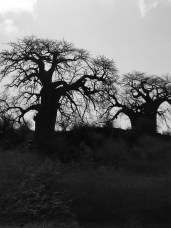
Sofia to Doha Qatar and then an overnight flight to Zanzibar Island Tanzania…landing on Zanzibar Island would give me a new stamp in my passport and tick country number 41.  I had a 5-hour layover on Zanzibar before flying to Arusha on the mainland.  After breakfast and my first taste of chapati,  I found a driver and for a fee, he took me on an island tour.  Made it back and boarded my prop plane for the mainland. I landed in Arusha and went to get my luggage and that’s when I discovered it didn’t make it.  That’s a whole other story and you can read about it here.  You can also read about my crazy bus ride to Massai Eco Giraffe Lodge where I would be spending 3 nights.  The bus ride even had a live chicken.  It was 4.5 hours across hot dusty terrain with no real roads and then we were stopped at the border to the National Park area, and I was asked to get off the bus like I said another story and you can read about it at the link.  I will say, I was in awe looking out the window and seeing massive baobabs and giraffes and zebras wandering freely.

Luggage-less, I made it to the Giraffe Lodge, my home for the next 4 days.  The lodge is an oasis in the middle of nowhere. It was heavenly.  You pay an activity fee to the lodge which then provides you with a Maasai guide who takes you on a trek and introduces you to the Maasai culture.  My guide was Timan and you can read about my adventures with him, here.  At least I can say my life is never boring.

My luggage did arrive and before I knew it, it was time for another crazy bus ride to Wasso/Loliondo Tanzania for my WorkAway at Bright English Medium School.  BEMS is in a remote area of Northern Tanzania, in the heart of Maasai country and on the edge of the Serengeti.  Two days after my arrival at the school, our host arranged to take us on a safari in the Serengeti.

There were six other volunteers when I arrived and 4 of us chose to go on the safari.  It was a dream come true.  We paid a small fee in comparison to other safaris and the money would be put right back into the school. The children many of whom live at the school hadn’t returned for the new semester when I arrived.  With a WorkAway, you volunteer a few hours a day in return for room and board.  Before the children arrived, we spent our time painting classrooms.

After they arrived, I spent my time in the kindergarten classroom teaching English.  The school had no running water, which meant we took bucket showers and flushed toilets with buckets of water.  Electricity was sometimes spotty so having a power bank and charging all devices whenever possible was a must. The nearest village was a 30–40-minute walk.  Luckily I was able to catch a ride if I needed anything from the shops.  I am still writing my blog about my experience there, but I will say it was one of the most rewarding things I have ever done.  I was sad to see my time there come to an end, but I needed to get back to Warsaw to prepare for the new school year.  I said my goodbyes the night before as I had to be by the side of the road at 05:30 for the bus to pick me up for a 9+ hour ride back to Arusha.  Once in Arusha, I had arranged for a car to take me to my homestay in Kilimanjaro.  I spent 2 relaxing days before catching a flight to Addis Ababa Ethiopia, to Stockholm Sweden, and home sweet home to Warsaw.

Back in Warsaw in mid-September, I took some time to relax, regroup and reflect on my whirlwind summer.  At the beginning of October, I was with my Nepalese friends as they celebrated Dashain, a Hindu holiday that symbolizes the victory of good over evil.  The school semester started up and the rest of the month was quiet.

November 1st in Poland is All Saints Day, and it is celebrated by going to the cemetery and placing mums and lighting candles at the graves of loved ones.  It is a very important holiday, and the cemeteries are a sight to behold.  November 11th is Polish Independence Day and along with Tamara, I attended the Independence Day March. The rest of the month was quiet which was just letting me breath before my crazy December started.

December kicked off with me showing the cousin of one of my friends around Warsaw.  She was in town to give a seminar and in a couple short days we had a Lebanese dinner, drinks at the Panorama Bar overlooking the city, walked all over Old Town, watched the changing of the guard at the Tomb of the Unknown Soldier, took in the Christmas lights on the evening of the official lighting and walked the royal route.  Being from the south of the USA, the snowy, cold weather in Warsaw called for extra coffee stops.

I said goodbye to Patty and on December 5th boarded a flight to Amsterdam to meet a friend from Florida.  Maribeth and I spent the day and evening wandering the streets, taking a canal cruise, and walking the Red-Light District.  The next morning we boarded a flight to Krakow.  Staying in Old Town, we wandered the Christmas Market and ate dinner al fresco.  The next day we took a tour of Auschwitz and Auschwitz Birkenau before catching the late train back to Warsaw.

The next few snowy days were spent going all over Warsaw and then taking a weekend day trip to Gdansk for the Christmas Market and a boat ride to Westerplatte, the location of the first battle between Polish and German troops and the start of WWII.  We ended her visit with a trip to the Garden of Light at Wilianow Palace.

Maribeth left on the 13th and on the 15th I boarded a plane to meet my friend Guy, who I worked with for 2 summers at Zenira Camp, in Paris.  We spent 4 days walking 8-10 miles per day all over the city.  We had mad fun at an Ice Bar and even found two ladies that I first met back in 2013.  I’m not sure how I fall more in love with Paris with each visit.  Back to Warsaw in time for Christmas.  I made a turkey and celebrated with friends.

Here it is the eve of the new year…2023!  I am about to open a bottle of prosecco and share a toast with my flatmate Zaka and his friend Tarlan.  Then we are off to a birthday/New Year party, and we will hit the streets with fireworks and sparklers for midnight.  Na zdrowie!  Thank you all for having a part in my journey.  The messages, cards, and video chats are meaningful, and I cherish every interaction.  Life is short….Live it well!

Why I Am Grateful for the Global Pandemic

Why I Am Grateful for the Global Pandemic

As the Thanksgiving season is upon us, it is time to consciously think about things we are grateful for.  Sure, we all go through the list of family, friends, a place to live, a job, food to eat, etc.  Now, before you jump down my neck and say, how can you be grateful for a global crisis that, according to Worldometer, has now affected over 250,000,000 people and has caused, along with other comorbidities, 5,000,000 plus deaths?”,  let me explain.

In a few short months, we will be two years into what started out as “two weeks to flatten the curve”.  Sometimes it is hard to wrap my head around the fact that two years have nearly passed and that I will have been living in Poland for two years and have received temporary residency.  My original plan, although I should probably say “my original thought” as I didn’t really have a solid plan, was to spend just over a year in Poland.

Then I wanted to return to Bali and my Balinese family for a special ceremony that was planned at the temple in Peliatan.  After a few months in Bali, possibly move on to a WorkAway in India, Kenya, or Tanzania and then consider a return to Poland.  A mere six weeks after I arrived in Poland, the world stopped turning.

As the pandemic progressed,  information from the State Department in the USA, encouraged American citizens abroad to return home.  Having a job and a flat, I chose to stay in Warsaw.  A choice in no way I regret and am thankful for.  Henry Rollins once said, “a great way to learn about your country is to leave it.”   Looking at my country, it seemed a bit chaotic.  Since this is somewhat of a gratitude post, I’m not going to address that here.   Other than working remotely, my life in Warsaw was copacetic.  Although, it was becoming obvious that “two weeks to flatten the curve” wasn’t happening.

Today, I started a one-on-one English lesson with a new student.  She asked me to “tell her my story”.  I’m sure she had no idea what she was getting herself into.  I finally ended my story explaining that because of the pandemic, I am still in Poland and have agreed to another school year and I have residency until 2024.  I guess she is a glutton for punishment, she then asked me to tell her my feelings about Warsaw and life in Poland.  Wait a minute, I’m supposed to be the teacher here, but her question made me think.  I didn’t need to think about how I felt about life in Poland, but it made me realize how much I came to appreciate Poland because of or maybe despite the pandemic.  Without further ado, reasons I am grateful for the pandemic.

Having visited Warsaw once before in 2014, I knew it would be a great home base for travel throughout Europe.  I pictured weekends in Paris, visiting family and friends in Germany, seeing Erwin in Norway, heading off to Finland or Sweden to see the Northern Lights, and picking up some new stamps in my passport along the way.  Of course, those plans were shattered when the pandemic hit, and Poland closed its borders.  I had a choice to sit at home or go out and explore my city. Although many things were closed, I started walking around my neighborhood.

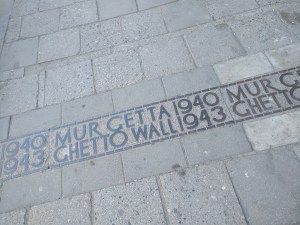
This led to the discovery of remnants of the Mur Ghetto or Ghetto Wall.  The memorials show the outline of the former ghetto which in 1940 had a total length of about 18km.  There is a line on the sidewalk or street reading “mur getta”.  I learned that if you can read the words straight on, you are outside the ghetto and if they appear upside down, you are inside the ghetto.  Finding these memorials, I became curious as to what I didn’t know about Poland and WWII.  As I researched, I discovered more and more places I wanted to visit not only in Warsaw but all of Poland.

Not usually being one for historical fiction,  I was suddenly drawn to novels about Poland and WWII.  With the pandemic in full swing, I had plenty of time to up my reading habit.   Books like, “The Lilac Girls”, “The Zookeeper’s Wife”, “The Rabbit Girls”, and “The Book of Lost Names” piqued my interest in other places in Warsaw and other cities across Poland.

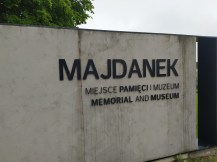
Although I love zoos and often visit them, after reading “The Zookeeper’s Wife” and learning how Jan and Antonina Zabinski began smuggling Jews and hiding them in empty cages and even in their villa, I knew my visit to the Warsaw Zoo would have me see it in a different light.  “The Lilac Girls” introduced me to Lublin, Poland, and the State Museum at Majdanek.

I had never heard of the Majdanek Concentration Camp and Lublin was only just over 2 hours by train from Warsaw.  It was an easy day trip and one spring day I caught the train and because of a book, I visited a place I may never have known about.

Walking my neighborhood, I found out I was a couple of blocks away from the Warsaw Uprising Museum.  The Warsaw Uprising broke out on Tuesday, August 1, 1944, at 17:00 PM.  The interactive museum is difficult to take in during just one visit.  Also near me is the Polin Museum.  The Museum is a modern institution of culture – “it is a historical museum which presents the 1000 years of Jewish life in the Polish lands.” Again, too much to wrap your head around during just one visit.  I live in the Wola District of Warsaw.

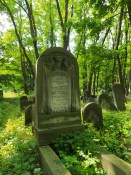
As I walked around my neighborhood, I noticed more and more markers on the street, signs on walls of buildings, and free-standing monuments.  With so much history of Jewish Poland right in my neighborhood, I also spent time wandering around the Jewish Cemetery which is just a few tram stops from my house.

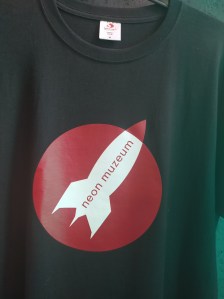
The city had me intrigued and I started t look for unique things to do and see.  That’s how I discovered the Neon Museum and the Pinball Museum.  Places I probably wouldn’t have discovered were it not for the pandemic situation.  I also visited the Vodka Museum and the Stacja Muzeum (Train Museum).  While visiting the Stacja Muzeum, I learned of a narrow-gauge rail museum in a nearby city.  As restrictions around the country began to be eased, I started taking short day trips from Warsaw.  One was to the city of Sochaczew to the Narrow-Gauge Railway Museum which also offered a short train ride to the Kampinos Forest and a cookout.  I didn’t know Poland had lavender fields and one day found myself on a train to the city of Żyrardów.  From there I took an Uber to a Lawenda pod Skowronkami and came home with bouquets of fresh-picked lavender.  In Warsaw I was enjoying the many parks, wandering around Old Town, and life near the Vistula River.

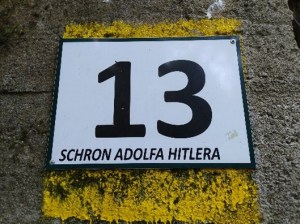
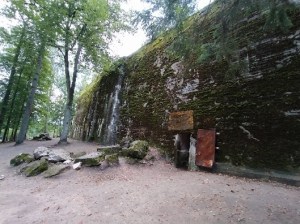
As summer was ending, I decided to take more than just day trips.  My first adventure took me to the city of Kętrzyn which was the city nearest to Gierłoż.  What caught my interest in Gierłoż?  By this time I had been in Poland for over 6 months, I was hungry for more and more information especially related to WWII.  As I was scrolling Facebook one day, I came across information about Hitler’s “Wolf’s Lair” or “Wilczy Szaniec”.  Hitler’s abandoned eastern front military headquarters during WWII and site of an assassination attempt is an eerie reminder of the atrocities of the Nazi regime.  Located in Gierłoż forest, I discovered I could stay on the grounds in a renovated WWII bunker and explore the grounds.  I spent a day and a half wandering the grounds where Hitler spent more than 800 days during the war.

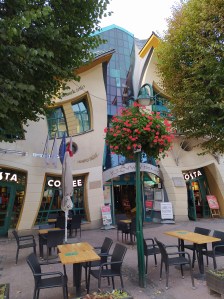
Come October, I decided to spend a few days at the Polish seaside on the Baltic Sea.  I visited the tri-cities of Gdansk, Sopot, and Gdynia with a side trip by train to Hel Peninsula which is a 35-kilometer-long sand bar peninsula separating the Bay of Puck from the Baltic Sea.  At the end of the Peninsula is the town of Hel.  From Hel, I took a ferry back to Gdynia.  The tri-cities are connected to each other by an intercity train which makes going back and forth quite simple.  While in Gdansk I went to Westerplatte which was the site of the first clash between Poland and Germany thus the beginning of WWII.  In Sopot, I discovered the longest wooden pier in Europe and the famous “crooked house”.  Because of the pandemic, I was working remotely so it was great being able to travel and work at the same time.

The end of November brought thoughts of Christmas as Warsaw started to light up for the holidays.  I took a late afternoon trip to Wilanów and the Garden of Lights.  Wilanów is home to the Wilanów Palace often called the Polish Versailles and was the second home to various kings.  I toured the Palace and by the time I finished the gardens were lit with thousands of lights and many displays.  Old Town in Warsaw was brightly decorated and a great place to stroll while sipping a warm cup of grzane wino or mulled wine.

As December rolled in I decided to spend Christmas with friends, and we headed to the Tatra Mountains and the city of Zakopane.  It was perfect as we were hiking the mountain on Christmas morning and light snow began falling.  Christmas evening I took a sleigh ride around the city and to the base of the mountains at nightfall in that lightly falling snow.  It was magical.

After Christmas, the pandemic restrictions tightened up a bit.  Between that and the cold weather, I spent the first 3 months of the year mostly working and enjoying my city.  As soon as the weather broke and restrictions were lifted, I was ready to see more of this country I was now calling home.  Through my English classes and one of our lessons, I learned that many people in Poland make a Pilgrimage to the city of Częstochowa.  The city is known for the famous Pauline Monastery of Jasna Góra, which is the home of the Black Madonna painting, a shrine to the Virgin Mary.  Every year, millions of pilgrims from all over the world come to Częstochowa to see it.


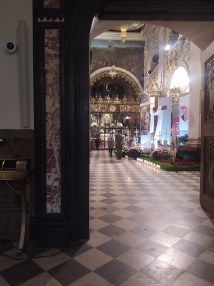
I decided to pay a visit to Częstochowa and see the Black Madonna over Easter weekend.  Probably not one of my brightest decisions being there were still some restrictions and Poland being a very religious country, most everything was closed the entire weekend.  No matter, I made the best of it by walking around the Old Town which had some amazing sculptures and eating kebabs, pizza, and McDonald’s as those were about the only restaurants open.  I also visited the Jasna Góra twice.  The Black Madonna is only available for viewing during certain hours, but I did manage to get in to see it.  I was also able to be there for a part of Good Friday services.  The other thing about Częstochowa was the beautiful building murals. My main goal was to see the Black Madonna at the Jasna Góra and I accomplished that task.
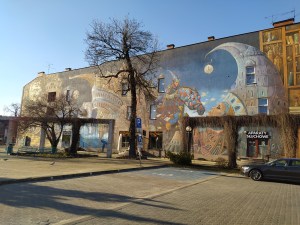
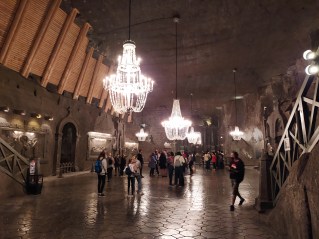
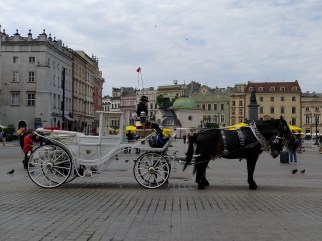
The first weekend in June I headed for Kraków.  Kraków is home to the company I work for here in Poland, English Wizards.   I had a checklist of things I wanted to accomplish while in town.  I wanted to meet up with the people who had hired me (I was in China when I applied and everything was done by Skype), hang out in the Old Town, wander the streets of the Jewish Quarter, visit Auschwitz, see Wawel Castle, and go to the Wieliczka Salt Mine.  A lot to pack into a long weekend, but I’m happy to report that all items got ticked.  I spent the first evening bar hopping in the Kazimierz District with my fellow wizards and eating late night/early morning zapiekanki (Polish Pizza) at the Okrąglak.  My hotel was in Old Town, so I had plenty of opportunities to wander the streets and eat and drink at the cafes.  Making a visit to Auschwitz is an experience I will never forget.  The Wieliczka Salt Mine was fascinating and walking around the Jewish Quarter in the Kazimierz district was very educational.  I ended my long weekend with a BBQ at the English Wizard headquarters and got to meet many of my co-workers.  Three hours by train and I was back in Warsaw.  June flew by and before I knew it, it was time for my first trip out of Poland in 16 months.  I was off to spend the summer in Bulgaria at Z-Camp, a youth sports and language camp on the Black Sea.


How can I be thankful for a global pandemic?  I’m grateful for the opportunities it forced me to take.  Don’t get me wrong, it’s heart-wrenching when I think about friends and family who have suffered and even died due to the pandemic.  The divisions it has caused between friends and family are sad.  Yes, the big picture of the last nearly 2 years is often bleak, jobs and businesses were lost.  I am one of the fortunate ones who was able to work more because of the situation.  I also decided to take advantage of the city and country where I chose to stay during this crisis.  I know I saw more of Warsaw and Poland than I would have if the world hadn’t stopped turning and there is a good chance I wouldn’t even be in Poland right now.  I am grateful that my eyes have been opened to a beautiful country that I knew so little about.  I am more understanding of their horrific history, appreciative of their culture and traditions, grateful to my students who I now call friends, and in awe of the beautiful country, I am currently calling home.  I challenge everyone during this season of Thanksgiving to look back and find something to be grateful for.

Thank you, Poland for making me feel like one of your own.

Credit for feature photo to Tomeyk_Krakow