I’ve been living in Kenya for more than eight months now, and somewhere along the way, things that once stopped me in my tracks have simply become part of everyday life. Then, within a matter of weeks, three friends came to experience this part of my world for themselves. Margie spent two weeks exploring northern Kenya, Eric packed an incredible amount into just four days, and Cathy joined me for ten days of wildlife, adventure, and a little taste of my everyday life. Three very different itineraries, three very different journeys, and three people seeing Kenya for the first time. And I realized it might be interesting to stop looking at Kenya through my eyes for a change and see what they saw.
Rather than tell their stories entirely from my perspective, I decided to turn the tables and let them do some of the storytelling. I sent each of them a series of questions tailored to their particular journey. Not the usual safari questions, but ones that might reveal what caught their attention, surprised them, made them laugh, or left a lasting impression. After all, we may have traveled some of the same roads, but that doesn’t mean we saw the same things. And as I discovered when I finally sat down to read their answers, a few of those observations surprised me, too.
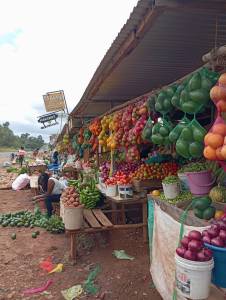
One of the first things that struck me while reading their answers was how much attention they paid to things that have become perfectly ordinary to me. Livestock wandering alongside busy roads, the chaos of traffic in Nanyuki, roadside fruit and vegetable vendors, and children tending animals in places where there isn’t another building in sight. These are things I encounter regularly, often without giving them a second thought.
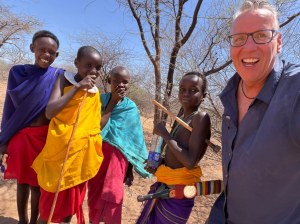
Of course, there were elephants, giraffes, lions, leopards, rhinos and plenty of other wildlife. But there were also barbershops, local pubs, markets, schools, conversations with strangers and long stretches of road between destinations. I’ve always believed there’s more to experiencing a country than visiting its tourist attractions. Kenya has some of the most extraordinary wildlife on the planet, but there’s an entire country and millions of people beyond the gates of its national parks and conservancies.
For me, the wildlife may be what brings people to Kenya, but the people, their cultures, and everyday life are just as much a part of the experience. I’ve never understood traveling halfway around the world without wanting to know something about the people who call it home.
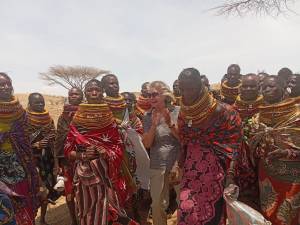
Some of the most memorable encounters happened far from the usual tourist stops. In Nachola, near Baragoi, we visited a school where classes are held beneath a tree. The terrain was too rough for our vehicle, so we parked some distance away while boda bodas carried our supplies down to the school. News of our arrival had preceded us, and parents from the Turkana community were already waiting. The mothers came up the hill singing, took Margie by the hand and led her down to the school. We sat on bags of rice we’d brought while the parents thanked us for remembering them and returning, and porridge was prepared over an open fire for the children. Margie described the experience as “momentous,” remembering how she was enveloped in warmth and gratitude.
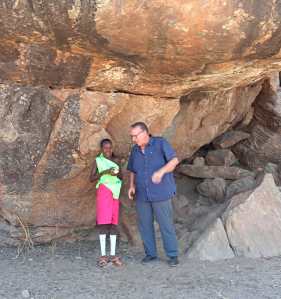
On another journey, we stopped along a remote road where a young girl was tending livestock. Eric spent about twenty minutes with her, sharing water, some of our breakfast leftovers and a couple of cookies, while Sammy and I watched from a distance. She drank the water and ate the food eagerly, as though it might have been her first meal of the day. Despite the language barrier, they exchanged laughter, and she was comfortable enough to tell him about her family and explain the meaning behind the colors of her clothing and the intricate beadwork she wore on her shins. As Eric later wrote, “I pray she felt the admiration I have for her and her culture.” He remembered her smile and the gratitude he saw in it. What struck Sammy and me was how naturally the two connected, despite coming from such different worlds.
Not every connection happened along a remote road or in a village. Sometimes it was as simple as sharing a meal, having a conversation, or spending an evening with friends in Nanyuki. Cathy described meeting people for the first time and feeling as though they were already friends. Over ten days, she got to know some of the people who have become part of my everyday life here. There were lunches, dinners, evenings at Jibs, strawberry milkshakes courtesy of Alvin, and apparently, and apparently a little more tequila at the bush camp than she would have liked!”
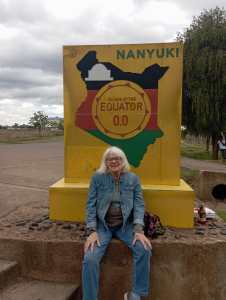
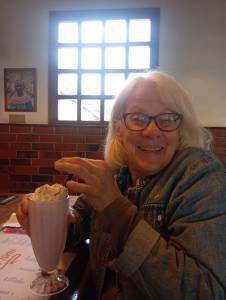
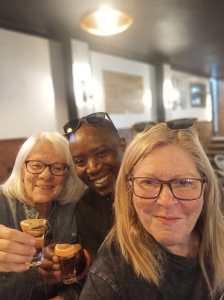
Back home, Cathy finds herself trying to explain my life in Kenya to people whose first thoughts are often about civil wars, parasites, wild animals and disease. She tells them about my home, my friends and my willingness to head off on another adventure. But as she put it, “I still get blank stares.”
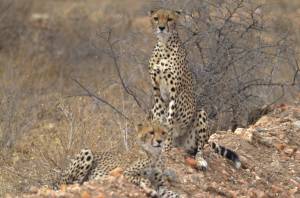
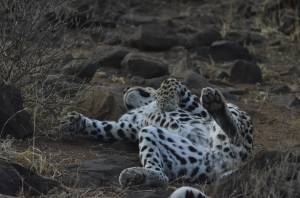
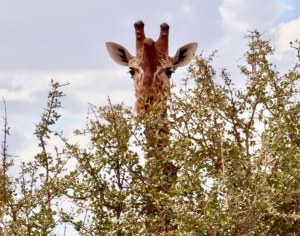
Of course, no visit to Kenya would be complete without spending time with its wildlife, and there was certainly no shortage of memorable encounters. Between the three visits, we watched elephants feeding and playing, giraffes wandering across the savannah, lions on the hunt, leopards lounging in trees, and one rolling around on the ground like an ordinary house cat, which Cathy, a cat lover herself, said she could have watched forever. Eric recalled having a giraffe peer over a tree and engage him in a staring contest, while Cathy had told me before arriving that she hoped to experience that same eye-to-eye encounter she’d seen in so many of my photographs. There was a cheetah mother with her cub, rhinos, buffalo, zebras, antelope and more birds than I could begin to identify. And when I asked everyone to choose a favorite encounter, I discovered I’d asked a rather unfair question. After all, I live here, and I still can’t choose one myself!
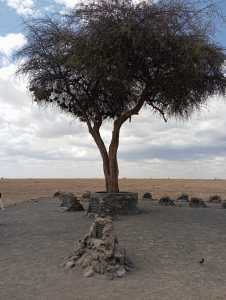
Not every wildlife encounter was simply about the excitement of seeing an animal in its natural habitat. Some brought home the reality of just how vulnerable these species are. Margie wrote, “You know how much I loved our elephant encounters. I’m not alone in viewing those magnificent creatures as some of nature’s greatest marvels, but seeing, even at a distance, the white rhinos and feeling such grief over their likely extinction, remains vivid.” Equally vivid was her memory of the rhino memorial at Ol Pejeta, where she described the story of “wanton murder and cruelty.”
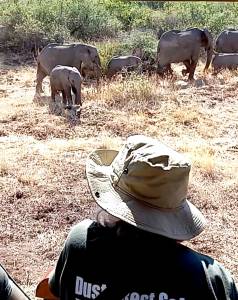
At Reteti Elephant Sanctuary, Cathy had questions about the future of Long’uro, the young elephant who lost much of his trunk to hyenas. “I know they are teaching him/her to adapt, but I still wonder how it will work out,” she wrote. That word, adapt, has particular meaning for Cathy. She even chose it for a tattoo during her visit to Kenya.
Cathy was also impressed by the dedication and compassion of Ol Pejeta’s anti-poaching unit, while recognizing that protecting wildlife is only part of the challenge when demand for ivory, rhino horn and other animal products continues.
Eric approached the subject from another perspective. “I expected to see some animals on a game drive. I did not expect to be constantly surrounded by elephants, rhinoceros, hippopotamus, monkeys, baboons, giraffes and so many varieties of birds. There were so many animals, it’s hard for me to imagine that any of them are now or were ever endangered.”
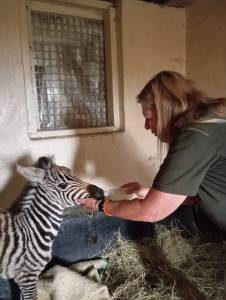
Reteti offered another perspective on conservation, particularly through the involvement of the surrounding Samburu communities. Margie was fascinated by the Milk Mamas, local women who supply milk for the youngest orphaned elephants, and by the dedication of the keepers caring for the animals. Watching the youngsters eagerly approach for their bottles was memorable enough, although a young Cape buffalo provided some unexpected entertainment by chewing the nipples right off the milk bottles! Apparently, not everyone at Reteti was interested in following the feeding routine.
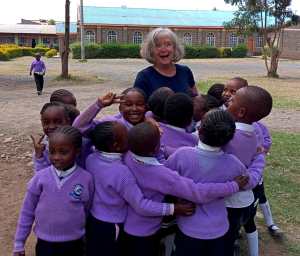
Education was another part of Kenya that made an impression, particularly during our visit to Brookwell Harmony School in Nanyuki. We spent time in a PP1 classroom with four-year-olds, and Margie wrote, “What moved and impressed me particularly was the small children we visited on my first morning. The focus and attention and participation of those little ones, their grasp of concepts I’d have thought them too young for, was astonishing to me as were their teachers.”
I couldn’t agree more. Between visits to Sammy’s son’s boarding school, schools involved in Laikipia Wildlife Forum’s conservation through education program, and others I’ve visited during my travels, I’ve seen firsthand what teachers and students accomplish with limited resources. It makes you wonder how much of what we consider essential in a modern classroom is really necessary for learning.
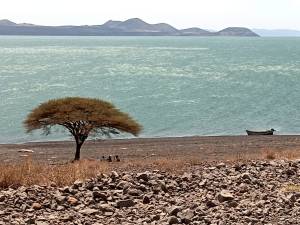
The journeys between destinations proved to be experiences in themselves. Northern Kenya can change dramatically within a few hours of driving, from green landscapes and mountain views to rocky terrain, vast stretches of desert and the brilliant blue waters of Lake Turkana, often referred to as the Jade Sea. Cathy was intrigued by the constantly changing scenery, watching the landscape transform as we traveled from one region to another. She also discovered that spotting wildlife takes a little practice. What initially appeared to be another tree trunk might suddenly become an animal standing perfectly still, and before long, she was getting the hang of knowing what to look for. Margie described Lake Turkana as looking like another planet, its blue water surrounded by a landscape so barren and dusty it hardly seemed real.
For Eric, the journey was just as much about the people we encountered along the way. Roadside fruit and vegetable stands, conversations with vendors, laughter shared with strangers and glimpses of everyday life were experiences he valued as much as the game drives. It wasn’t necessary to arrange a special excursion to meet people or experience local culture. Sometimes all it took was stopping along the road.
The roads themselves were another matter! After hours of traveling across the Chalbi Desert, with little sign of civilization and no guarantee of assistance if something went wrong, Margie admitted feeling anxious about the possibility of a breakdown or medical emergency. Reading that made me smile because I’ve become so accustomed to these journeys that I sometimes forget how daunting they can seem to someone experiencing them for the first time. Sammy kept promising that Marsabit would be “paradise,” with cooler temperatures and a welcome escape from the heat and dust. By the tenth day, even the dust had become part of her routine.
Of course, no account of these journeys would be complete without Sammy, my friend, guide, driver and the man who somehow manages to know someone just about everywhere we go. His famous “I know a guy” became a running joke, although more often than not, he actually did know a guy, or a girl! Between his colorful commentary, questionable sense of humor and ability to keep everyone entertained through hours of rough roads, he became as much a part of the experience as the places we visited.
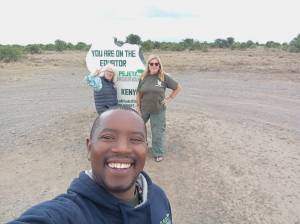
Margie certainly came home with a few memorable Sammy expressions, including “Wendy, love of my life,” and the considerably less romantic announcement that he needed to poop in the bush, followed by asking me where the toilet paper was. Considering some of the places I’ve relieved myself here in Kenya, I was hardly in a position to judge!
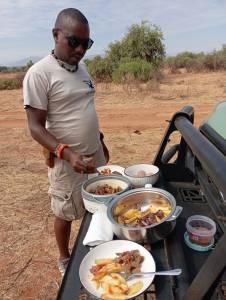
There’s also a much more knowledgeable side to Sammy, although I wouldn’t want all this praise going to his head! Eric, who normally spends months researching and planning his solo adventures, handed the responsibility for his four days in Kenya over to the two of us. That’s quite a leap of faith when you consider that Sammy and I don’t always know where we’re going next ourselves! Cathy appreciated his explanations about wildlife, including how to distinguish black rhino dung from white rhino dung and how to tell how recently an elephant had passed by examining its poop. He really does know his “shit”! And Margie got to experience firsthand his ability to navigate some of the most challenging roads in northern Kenya, connect with people along the way and somehow always find a solution when plans changed. Between his knowledge of the wildlife, the land and the people who call it home, Sammy brought far more to these journeys than simply getting us from one place to another.
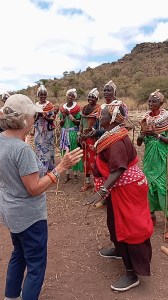
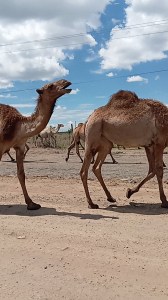
Our visit with the Rendille community in Karare was another memorable experience. After learning to milk camels that morning, and even sampling the milk, we spent the afternoon with the women, admiring their colorful clothing and elaborate beadwork. Margie was drawn into a traditional rain dance by one of the women, an experience she remembered vividly. The community was struggling with drought, and as we were leaving, a light drizzle began. Hardly enough to call rain, but we hoped it was a sign that more might follow in the days ahead.
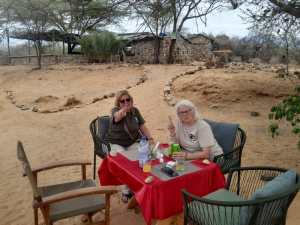
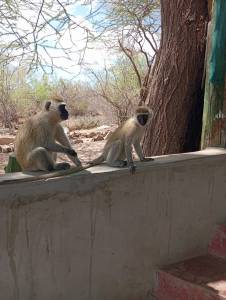
Cathy also got a taste of sleeping in the bush at our riverside camp, complete with good food, including the traditional Kenyan dish Irio, Lucy’s hot coffee and a few curious vervet monkeys she affectionately called “velvet monkeys.” She enjoyed the experience enough to say she’d do it again, although I suspect she’d keep a closer eye on those monkeys than I did. I lost eye contact for two seconds, and one of the little thieves made off with my hard-boiled egg!
Cathy also went home with two permanent reminders of Kenya. One was the word “adapt,” representing another 180 degrees in her journey and seeming particularly appropriate after everything she’d experienced during her visit. The other was the Southern Cross, a constellation visible from this part of the world. Not your typical vacation souvenirs! Two small tattoos marking a particular time and place in her life.
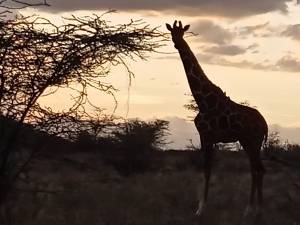
When I asked Margie which single hour of her two-week journey she’d choose to relive, her response was, “Wendy, are you determined to be difficult? Just one hour?” Apparently, I wasn’t making these questions easy! But she eventually settled on our first sundowner in Buffalo Springs, marveling at the giraffes silhouetted against a gorgeous African sky. After two weeks of extraordinary places, people and wildlife encounters, it was that particular hour she wanted to experience all over again.
A few more observations from fresh eyes:
“The best part of Kenya was the landscape, changes of geography, and the warmth of the people.”
“I was kinda’ gobsmacked by the difficulty of getting there, only to be regularly gobsmacked by the similar (or worse) conditions throughout much of the rest of the trip.”
“One thing I won’t miss is the garbage in the rural areas.”
“There is no replacement for that. And there is no imagining what that will be like, there is only experiencing it and living it.”
“I came to Kenya expecting an adventure. I left Kenya thinking I’m a wiser, more well-rounded woman.”
One of the questions I asked Margie was what someone looking only at our photographs would completely miss about the trip. Margie’s answer caught me off guard. She wrote, “What they’d miss, due to the awesome experiences the pictures show, is how deeply I came to care about you and Sammy.” She went on to say that although we’d been friends for a quarter of a century, “this trip cemented a relationship that is rooted in admiration and respect and feels close and personal and lifelong.” I’ll admit, that one brought tears to my eyes. Some things simply can’t be captured in a photograph.
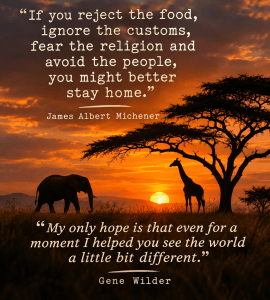
I’ve often quoted Gene Wilder, who said, “My only hope is that even for a moment I helped you see the world a little differently.” I’ve always loved that thought, and perhaps it’s part of why I share so much of my life and travels. So, to Margie, Eric and Cathy, thank you for coming to Kenya, for sharing this part of my world, and especially for taking the time to answer my questions. You reminded me that even after eight months here, there’s still plenty to discover when I look at familiar places through someone else’s eyes.
I invited three friends to see my world. Turns out, they helped me see it differently, too.