Can One’s Own Country Feel Like Foreign Land?

Can One’s Own Country Feel Like Foreign Land?

Is it really possible I have lived in China for 2 years?  Can I say China feels like home to me now?  Can one’s own country really feel like foreign land?…..yes, yes and yes!

Where is home?  It is said, “Home is where the Heart is”; “Home is where the bra isn’t”; “Home is where you hang your hat”; “Home is where the wifi connects automatically”; and “There’s no place like home”.   So where is home for me?  Home, my roots, will always be Warren, Ohio, but living and traveling abroad for roughly 3 years (if you count my stint in Paris), I honestly have to say, I feel like home has been so much more than Warren, Ohio, I have left my heart in so many places. Currently, I have been “on the road” for nearly 6 weeks living out of a suitcase and am now “back home” in Warren, Ohio, briefly, but still living out of a suitcase.  My house is no longer my house and nearly everything I own is in storage.  I have to admit, moving to China did have its share of culture shock, but now being back in the states has its own share of things that seem foreign.

6605f7245b0e0b713d9aa6e5cc12be99

How can returning “home” be foreign?  Well, living in China, a country with 1.4 billion people, we don’t flush toilet paper.  It goes in a trash bin beside the toilet, or as in many cases, beside the squatty potty.  Yes, even after this amount of time it seems strange to actually flush TP.  Okay, maybe that is TMI to start with, but seriously, my first reflex is to look for the bin.  Toilets, in general, are strangely foreign when landing back in the states.  My first reaction when I open a bathroom door is “surprise”!  A real western toilet, I can sit instead of squatting.  Not that squatting is all bad, the reality is, it is supposed to be the healthy way “to go”.  But yes, seeing a real toilet does seem foreign.

Driving is definitely foreign to me.  Yes, I drive a scooter in China, but not quite the same as driving a car.  The hardest part about driving, other than the fact that I can’t back up, never could and I have a tendency to hit things, is paying attention to street signs, stop lights and stop signs.  When I am in a car in China, I always have a driver, I don’t worry about which way I am going, how to get there or rules of the road.  Since there aren’t many rules of the road where I live, meaning no lane lines, no stop signs and traffic signals that no one pays attention to, I found myself oblivious to these things when I was first driving back in Warren.  I found myself not paying attention to these things until I realized that maybe, just maybe, I would have a problem if I didn’t heed stop signs and traffic signals.  You would think driving a car is like riding a bike, you never forget, right?  Wrong, after not driving at all for the most part over 2 years, it felt strangely foreign to me.

Having to cut food in order to eat it…….weird, right? In China, food comes already cut in bite-size pieces.  Of course, I have become accustomed to using chopsticks to eat everything from rice, noodles, vegetables, and meat to peanuts.  So it seemed strange to have to cut my food with a knife and fork before I could eat it.  Other than when I prepare food in my home, food in China is mostly served family style and all dishes are shared, so having an entire dish to myself seemed strange, at first.  Don’t worry,  like “riding a bike”, everything eventually begins to feel natural again. Although, I have to say looking for the trash bin to toss TP never really went away.

It was strange to hear English spoken everywhere and see people with all skin tones and colors of hair.  Living abroad, I have really stopped noticing race.  I don’t see Chinese kids in my English class, I just see kids.  Maybe that comes from living in a culture where everyone has much the same skin tone, dark hair, and dark slanted eyes.  Everyone kind of does look the same, of course, I don’t see myself in my surroundings and only realize I stand out when I see a group photo.  It did seem strange to suddenly notice race.  I basically hear only Chinese spoken pretty much 24/7. It has become commonplace for me and you slowly realize you are starting to pick up a few words and phrases.  Leaving China is like stepping out of your fishbowl. Everything just looks, sounds and feels different.

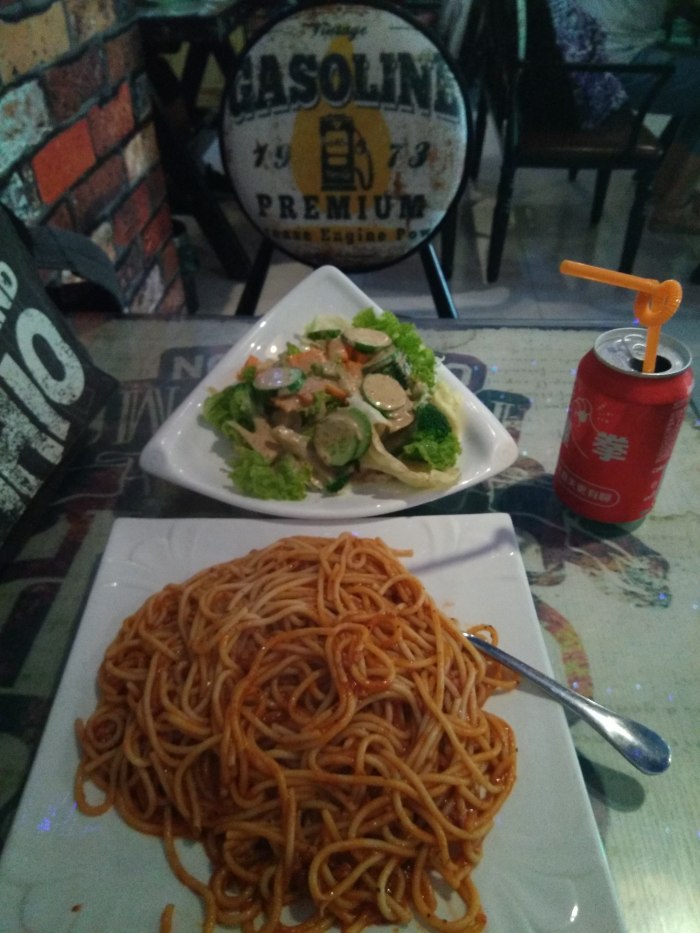
Sticker shock….wow, this was one of the things that is really strange.  A salad and a plate of pasta with a coca cola would cost me $3.45 in Dong’e. I am pretty sure I couldn’t even get a salad for $3.45 in Warren.  Being gone for a long period of time, you forget the cost of things and boy do you hate paying the price when you think about “what it would cost me back home in China”.  No 2 to 3 times a week massages in Warren, sorry Leslie. You forget what things “really” cost.

IMG_20170811_115706
My $3.45 meal. This is one of the most expensive meals I eat. Also, the only place in Dong’e that gives you an actual fork and not chopsticks.

Okay, I guess I have to say it, blue skies are foreign.  Well, we don’t always have our share of blue skies and sunshine in Warren, but, it is a rarity in China.  A clear day is when the AQI is below 100.

So, can coming “home” really feel like a foreign country?  In the beginning, I said yes.  Sitting here writing this blog, I still say yes, but that does start to change after you have been back for 2 weeks and things start to feel normal, if there is such a thing.  I am back in Dong’e finishing up this post and I have to admit, right now, I am back home.  This too will change, there will come a time when I just say, “I’ve had enough” and it’s time to go back to my roots.  Of course, that won’t be anytime before my condo in downtown Warren is ready.  So for now, a nomad I remain, and my home is living abroad.

I will leave you with a quote from F. Scott Fitzgerald, “It’s a funny thing coming home.  Nothing changes, everything looks the same, feels the same, even smells the same.  You realize what’s changed is you.”

6126d8c97777bd2a40e10eee8189cb45

What’s the Difference?

What’s the Difference?

こんにちは Kon’nichwa   你好 Ni hao  Hello

Japanese and Chinese characters are much different.

Granted, I was only in Japan, technically 5 days, and spent much of the time travelling.  I was briefly in Osaka, took the bullet train to Tokyo and enjoyed an afternoon and evening with a high school classmate and took off the next morning for 2 nights in Kyoto. Unfortunately, I had a touch of the stomach flu hit me in Tokyo and lasted until I returned to Dong’e where I spent 1 whole day in bed.  I somehow managed to push myself to do some touristy things and even eat, which I paid dearly for, but how can you NOT eat Kobe beef when in Japan.  Admittedly, I am using only 3 fairly large cities in Japan as comparisons to my China experiences and that being said I have never visited Shanghai, the largest and probably most modern city in China. Also, living in Qingdao for 6 months, I feel I can give a good comparison as it is a large, fairly modern city.

I was actually surprised to discover that Japan is a total 360 from China.  First off, it is MUCH more expensive than China.  Tokyo and Osaka rank 4th and 5th behind Singapore, Hong Kong and Zurich as the world’s most expensive cities.  Not counting Hong Kong, whose currency is the HK dollar, not the Chinese Renminbi, Shanghai is the only Chinese city in the top 20 coming in at 16.

800x-1


18699877_10211192733628798_4021274522529708471_n
Park in Tokyo

In my opinion the cities I visited didn’t have that “Asian” feel to me nearly as much as does China. Of the 3, Kyoto, had the most traditional feel to me.  As a matter of fact, they felt almost European/Eastern European to me. Although, the part of Tokyo I visited had kind of a Times Square feel.  After walking around, stopping for an iced coffee, then later for a Gin and Tonic and a cheese plate….yes, cheese in Japan, we visited a large park right in the middle of the city. It was very much like Central Park.  People hanging on the lawn, listening to music, playing with their dogs, just enjoying the day.   Yes, when I was in Kyoto, there were girls running around in kimonos, but somehow it lacked an authentic feel. Especially when I saw about 4 shops where you could rent them for the day.  I also never saw a “real” geisha as they try to stay away from the limelight, except when they put on their seasonal dances.  You can, of course, “rent” a geisha for the evening, at a fairly steep cost.

18700178_10211205257221880_4382570485468100318_n
Renting a Kimono for the Day


18739232_10211204610805720_8637016158446451229_o


That being said, there is also a strong British influence in Japan.  The uniforms of the school children are very “British Like”.  I am not sure how I made it to adult life and didn’t realize they drove “on the wrong side of the rode” in Japan. So, I guess that is the second big difference between Japan and China, cars driving on the wrong side, well, unless you factor in my little village of Dong’e where you just drive on whichever side is convenient, at the moment.

I got the feeling that Japan is much more “tourist friendly”, especially “Western” tourist friendly or maybe I should say more prepared for Western Tourists.   Many signs were in English, I don’t see a lot of that in China, not even in Beijing or Qingdao.  Shanghai, sorry, can’t say.

18740397_10211196427401140_105480267063846893_n

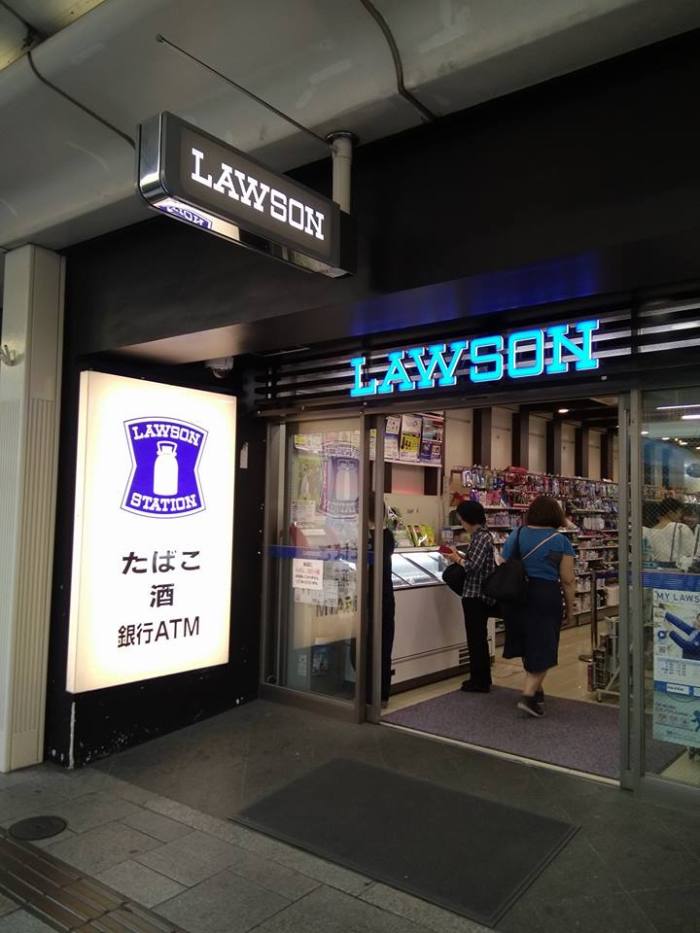
I was surprised to find 7-Eleven and Lawsons everywhere.  Although, much to my dismay, no chip dip in Lawsons.  I have to admit, I did buy a ham and cheese on white bread with lettuce and mayo at Lawsons. I almost felt like I was back in elementary school as I sat on a bench and actually really enjoyed it.  Not something I would likely find in China.  I was also surprised at how many people spoke at least a little English, especially the taxi drivers.

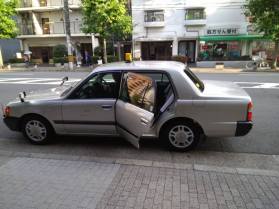
Speaking of taxis’s……Taxi’s in China are just your typical taxi’s, not so much in Japan.  Taxi’s were more like chauffeur driven vehicles with many of the drivers in suit and tie and most all wearing white gloves.  Arriving at your destination, the driver pushes a button and your door pops open.  I learned quickly, don’t close it, they will also handle that from the driver’s seat. If you happen to have luggage, pop, another button and he opens the trunk, jumps out and handles your bags.  In China, 7 out of 10 times, it has been up to me to handle my bags in and out of the trunk.

18765739_10211196996855376_1384750693990649357_n


18698547_10211196999095432_2951371074235365018_n

Hotel’s…..I stayed in all Japanese brand mid price range hotels.  In China, I normally stay at Western Brands, if available, or a Chinese brand in the mid to high range.  I found the mid range Japanese hotels to be several notches better than the Western Brand/best Chinese brand hotels.  They were just better, construction-wise, cleanliness, customer service and amenities.  Not that the hotels in China had anything terribly wrong with them, I’m just saying the Japanese hotels were just all around better. You are just going to have to trust me on this, It is difficult to explain, something you almost need to experience.

18699900_10211196995895352_8615207283202100508_n

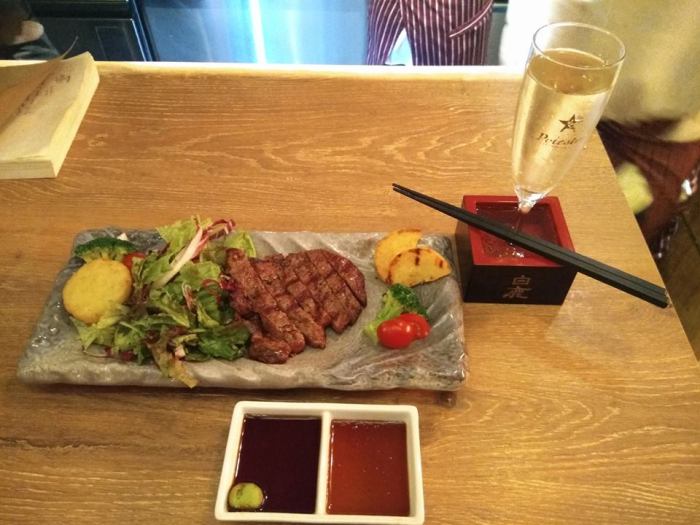
Food…..Beef, I have yet to find a steak in a typical Chinese restaurant.  Being Japan, they are well known for Kobe beef.  I had probably one of the finest steaks I have eaten, cooked to perfection and served with a small salad and veggies. No, I didn’t have sushi, yes it is Japanese, no it isn’t as widely eaten as one might think.  I was told, yes, we eat sushi….sometimes. What seems to be widely popular is Yakatori, which is basically chicken kabobs.  They are grilled and served with different toppings.  I had them with wasabi, plum sauce and a type of basil, which actually looked more like a seaweed to me.

18740321_10211195915828351_5350197275419390562_n
Kobe Beef
18700171_10211192701627998_1196530508332448882_n
Yakatori

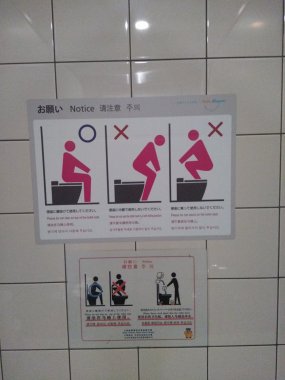
Of course, there is the subject of toilets.  China, 90% of the time…..squatties.  I never came face to face or should I say bottom to hole in the floor with a squatty in Japan.  China, always carry your own tissue.  I always found TP in public restrooms in Japan.  China, throw your used TP in a trash bin next to the squatty/toilet….DO NOT FLUSH! Japan posts signage telling you to please flush your tissue DO NOT discard in the bin.  I have decided that I want a Japanese toilet in my home.  They have all kinds of buttons to let you choose everything from heated seat to how much spray and how wrm the water to clean yourself and sometimes even a drying option.  I found these even in many public places.  They were often accompanied by a sign requesting people not to squat on the toilet seat, but please sit.

18814201_10211196993215285_8268982838415548266_n
Toilet Instructions


18739852_10211177853856813_8067542999707285379_n
Please Sit Don’t Squat


18739837_10211196993935303_842254607604005625_n


I don’t real feel like I have done a good job explaining why I feel China and Japan are 360 degrees different.  I think the more I try, this will become a more boring post than it already is.  Easiest way to explain is this; Japan is more civilized.  I had this discussion with my classmate who is living in Tokyo and that is the best word we could come up with. I have to agree, Japan is more civilized.

That being said, I have no desire to live in Japan, although, I would like to visit again.  I feel that I am getting much more of a cultural experience here in China.  Boy, did I struggle with this post, saying Japan is more civilized almost made me feel like I had been cheating on China.  I really do enjoy my life here and the opportunities and experiences it has provided.  Hope I can do better with the next post, any suggestions for topic are welcome.  I will leave you with some photos.

18670869_10211184997595402_7404860842661281331_n
Women Only Train Car

18739639_10211205133218780_182037072003453679_n18813989_10211192817510895_3753516463071849964_n

Qomolangma~The Mighty Mount Everest

Qomolangma~The Mighty Mount Everest

Qomolangma is the Tibetan name for Mount Everest.  It’s known as Sagarmatha in Nepalese and Chomolungma/Zhumulangma Feng in Chinese.

Climbing season officially closes on the mighty mountain on June 1st.  I just learned that 4 more have lost their lives bringing this season’s death toll to 10.  They were found in a tent at camp four, 7,950 meters (26,085 feet), by a rescue team who were there to retrieve the body of a Slovak climber who died on the mountain earlier in the week.

With nothing exciting happening in Dong’e, I decided to reminisce about my journey to Mount Everest nearly one year ago.  Since having the overwhelming experience of camping overnight at base camp, I feel a connection to the mountain and a bit emotional when I hear that “another one or four” succumbed to the fierce mountain.

20160627_170817
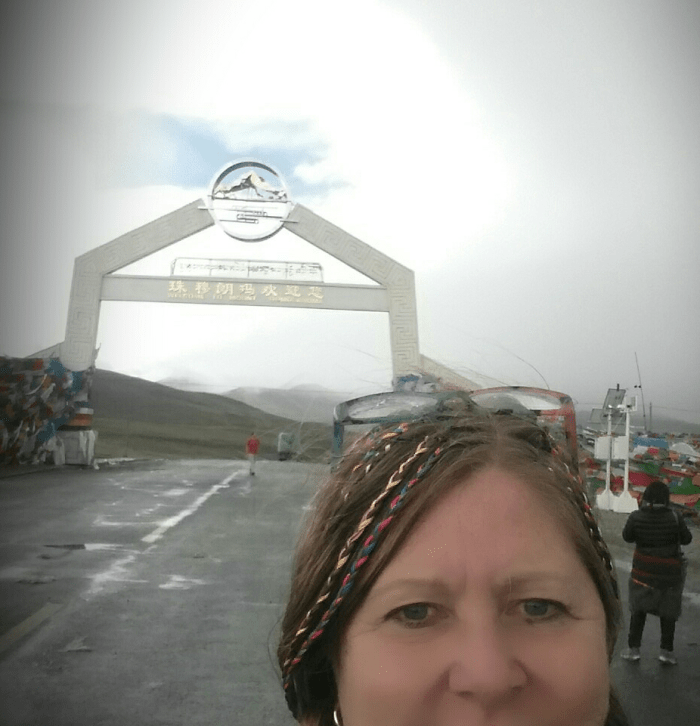
Entering the Mount Everest Recreational Area

Even before I came to China, I had an interest in Tibet and meeting the Dalai Lama is on my bucket list.  Yes, I know he no longer lives in Tibet, that aside, how could I come all the way to China and not visit Tibet.  Let the research begin.  As I soon found out, getting to Tibet isn’t as easy as jumping on a train or plane and getting off in Lhasa.  An individual cannot enter Tibet without a travel permit and a Tibetan guide.  In other words, an individual cannot just turn up in Lhasa and hang out for a few days and travel around the region.  My plan was to go in June at the end of the school semester.  I would travel places easily accessible from Changning, Hunan where I was living and then continue on to Tibet before returning to the USA.  I applied for my Tibetan Travel Permit and found a guide and a group following the itinerary that I was interested in.

Working our way south from Changning, I was initially travelling with my Russian roommate, Yulia, I would leave her in Gungzhou and continue to Shenzhen on my own.  In Shenzhen, I would begin my 53 hour train ride to “The Roof of the World’ or “The Land of Snows”, otherwise known as Tibet.  I decided on the train, first of all, because why not, it should be beautiful, right? How bad can 53 hours be?  It was actually quite enjoyable as I met a Malaysian girl named Song and we hit it off famously.  Secondly, Lhasa sits at about 3,500 meters or 12,000 feet above sea level. Taking the train is supposed to make it easier to acclimatize. Each train compartment has oxygen that is released periodically or also can be released manually.  It is also recommended to spend a few days in Lhasa before heading to EBC, Everest Base Camp, which is at 5,200 meters or 17,000 feet above sea level.

When they say you can’t enter Tibet as an individual, believe it.  When my train reached Lhasa, everyone excitedly exited, passport and travel permit in hand as instructed.  Upon exiting, you had to show the documents to uniformed police/soldiers, I wasn’t sure.  After checking the documents you were led to another building and again checked before finally being handed off to your official guide who had to meet you there with his credentials or you weren’t going anywhere in Lhasa.

EBC is about 500 miles from Lhasa. After spending 3 days in and around Lhasa (I had a free day as I arrived one day before our official tour began), my group spent two days traveling and touring Gyantse, Shigatse and Dingri before arriving at base camp.  That journey itself was spectacular and I will address it at another time……on to one of the most amazing experiences of my life thus far.

IMG_20160627_185603
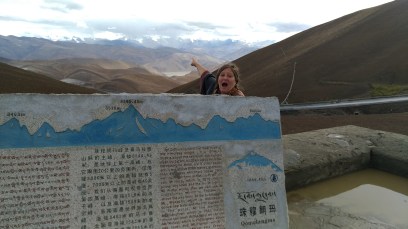
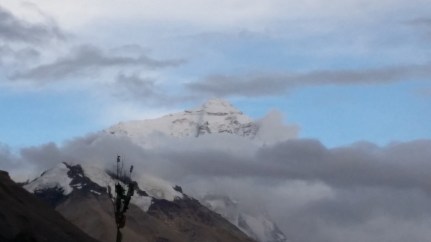
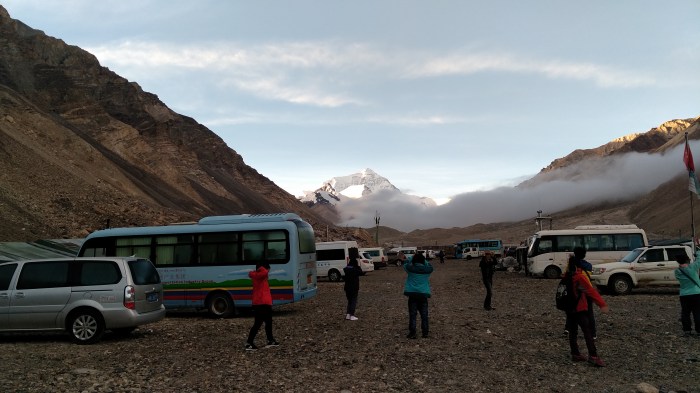
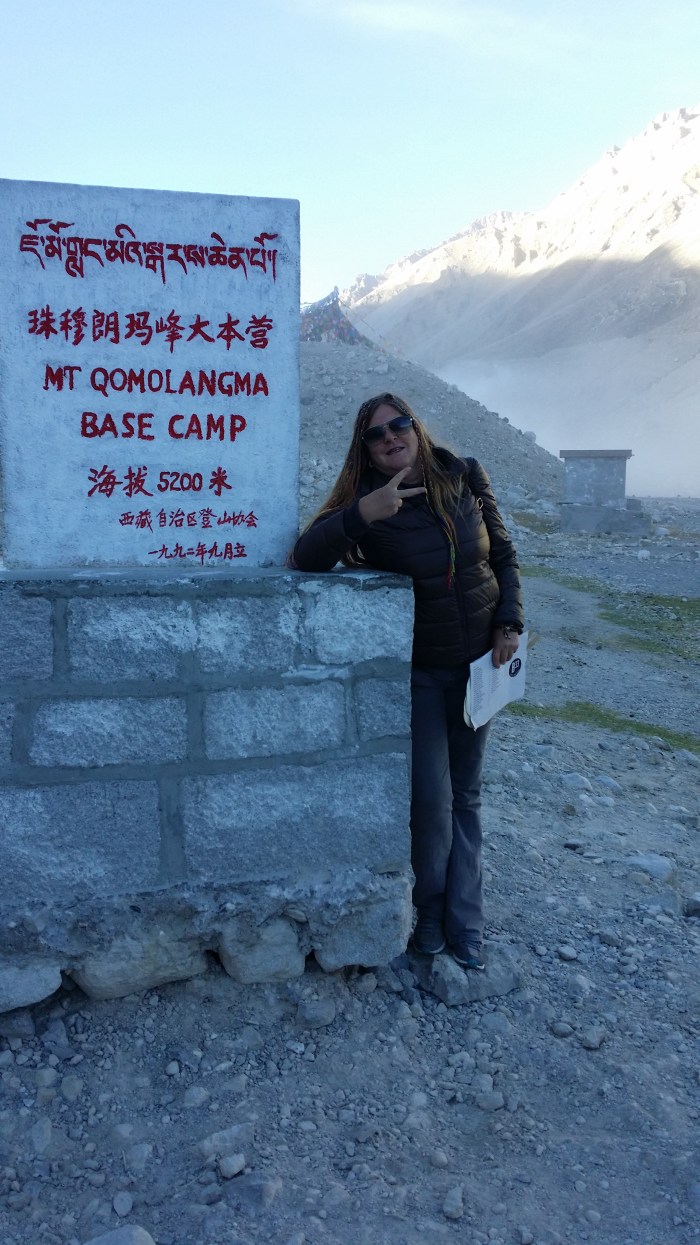
First actual view of the mountain from a distance
IMG_20160627_190228
Yes, I was pretty excited

We arrived at EBC as sunset was nearing. I hadn’t given any thought as to our accommodations and we hadn’t brought any “gear” with us.  The first thing our guide told us was that we were actually about 3 km from where the “real climbers” overnight.  Without an Official Everest Climbing Permit, this was as far as we were allowed to go to sleep.

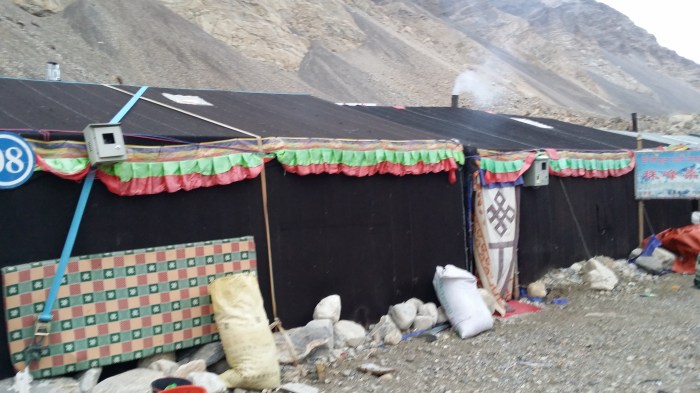
Our accommodations were called “tent hotels”.  They are owned and operated by local nomads.  There are approximately 30 tents at base camp, each housing 5- 10 persons at a cost of 40 rmb per night or $6.00. Tents are made of yak hair as it withstands heavy rains, snows and strong sun.  Inside the tents are daybeds with a table in front for eating and personal belongings.  There is a stove in the center fueled by yak dung that heats the entire tent.  The tent also has a small kitchen which serves basic food such as rice, noodles and eggs.  Beer and baijiu are also available even though they recommend no alcohol at this altitude.  The beds were cozy and the tent quite warm. The latrines…..not so nice.  The latrines were across the way from my tent and cost 1 rmb or about 15 cents to use.  Home sweet home for the night.

20160627_210119
Number 8….my home for the night

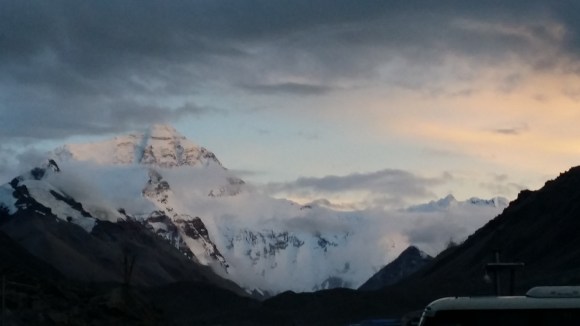
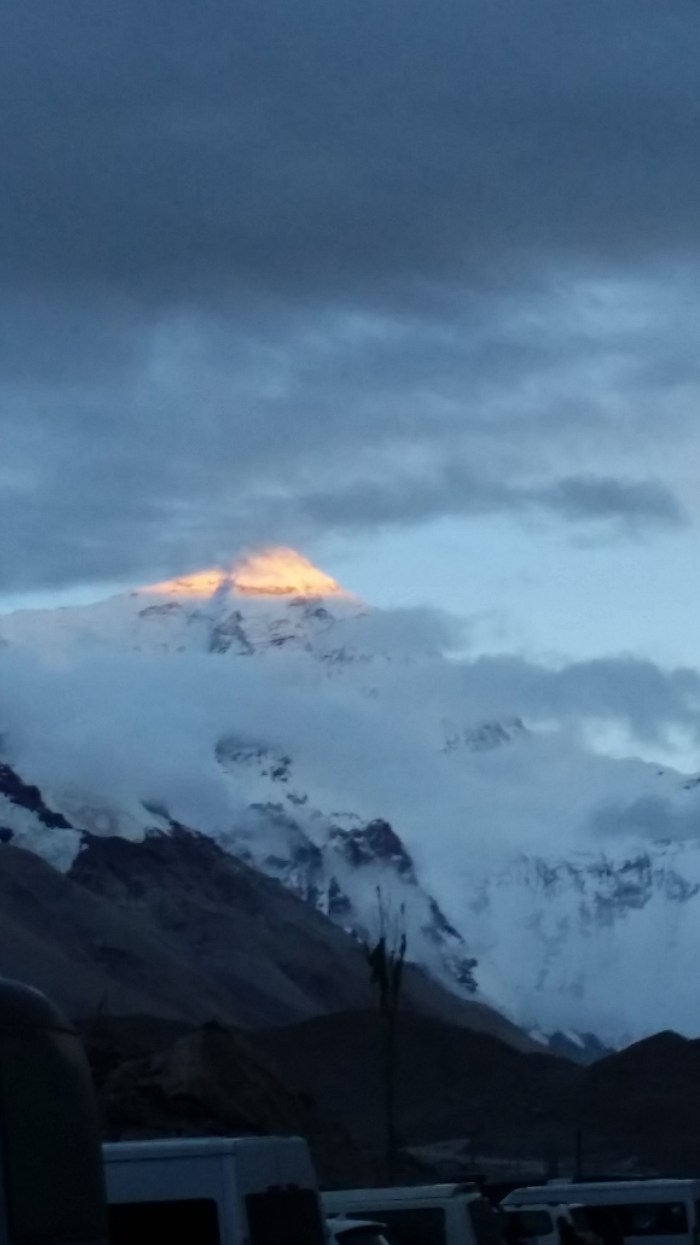
As I mentioned, we arrived just before sunset.  Sadly, the peak of the mighty mountain was under cloud cover.  We got settled in our tent, I was rooming with George and Phillipe, who I had become quite close with during our time together and a French couple who had also hung out with us during most of the trip.  It was nice being just the 5 of us in our tent.  We were still getting settled in, when we heard a bit of a ruckus outside.  Dropping everything we went to see what was causing the commotion.  I got outside and everyone was looking toward the peak of Everest.  The skies had opened and we witnessed the sun setting on that magnificent summit that has claimed the lives of so many, so many who are still buried in her breast.  All I could do was look to the sky and cry.  I turned to George and Phillipe and we all knew we were witnessing something amazing. The peak of Mount Everest, a glowing orange triangle bathed in the setting sun.  They gave me a squeeze and we just stared in silence.  I don’t think I will ever forget how I felt at that moment in time.  Pictures snapped, tears dried, we headed back to our tent for hopefully a good nights sleep.  Of course, me being me, had stuck a couple of those airplane size bottles of absolut in my bag.  As the evening air was quite cold, they were nicely chilled and we all had a toast to life.

20160628_08351020160627_204123

20160627_212037
Clearing skies
20160627_211606
My photos come no where near the actual beauty of this moment.

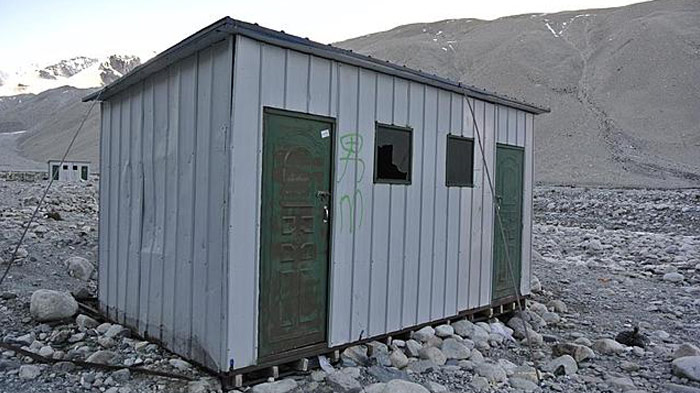
Okay, the sun has set, it’s dark, why didn’t I think to use the toilet when I could actually see where I was walking.  This isn’t exactly a walk in the park to take a pee. I mean, I am on a mountain, no not any mountain, I am on THE Mountain.  Find my phone for light, there is no outside lights at base camp, grab a 1 rmb bill, I can’t believe someone stays up all night around a smelly latrine to collect 15 cents.  Whatever, shoes on, I hike across the stones to a box with a hole in the ground so I can squat and relieve my bladder.

everest-base-camp-toilet
A photo of the latrine I snagged from the website.  Trust me, this must be from when it was new.
20160628_065953
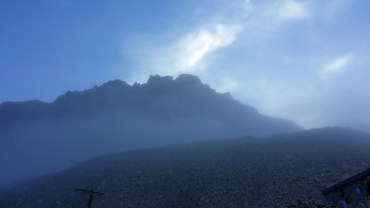
Dusk

Outside, I am once again filled with awe as I stare up at the shining moon amongst what looked like a million stars.  If you don’t believe in God or a higher being, you might start here.  “I think to myself, what a wonderful world”….beyond description, I could have looked up forever, except for the fact I was freezing my nuts off, well if I had them they would be freezing off.  Back to the tent and under my nice thick, warm, cozy quilt.  I awakened a short time later, feeling a bit funny, maybe it was the alcohol at this altitude, maybe it was the yak dung stove fumes, maybe the food didn’t sit so well, I just felt like I needed fresh air……it was about 4 am, I went outside the tent.  Alone, under the stars on Mount Everest.  I just breathed in the cold night air and was swept by emotion.  Not sure how long I was out there, but it was a most peaceful, serene feeling that encompassed me.

Peaceful and serene until my bladder said you aren’t going back to bed yet.  Well, there was no way I was making my way back across the rocks to that lovely latrine.  Besides, I was the only person outside, there are no lights, I have lived in China long enough to just drop and squat outside the tent.  I did make sure I moved out of the walkway.  Back inside and sweet dreams until morning.

IMG_20160628_073333
We woke to an amazingly clear view of the summit

Morning arrives and we have the option of trekking the 3km to the “official” base camp or taking the bus.  Still feeling a little light headed, I opted for the bus, which isn’t really a bus, but a dilapidated van with no heat.  I also found out I wasn’t the only one who felt a little funny, I think maybe we had a touch of altitude sickness.  Nevertheless, I walked outside to a glorious morning and the peak of the mountain in perfect view.  Going to the official base camp and seeing where the “real” climbers begin their ascent was pretty cool.  In order to try to summit Everest, you must purchase a climbing permit at the price of about $11,000.  Wow….that’s all I can say……wow.

IMG_20160628_090415
Climbing the last bit and over the hill to the “real” base camp.
20160628_082759
I made it, Barrel33 menu in hand. and Nick and Lou in my bag.  The “real” deal, this is where those that are attempting to summit from the North Face begin their trek.
20160628_085106
Overwhelmed

Upon leaving EBC, we were supposed to head to the Tibet/Nepal border and on to Kathmandu.  Because of the 2015 7.8 earthquake in Nepal which triggered an avalanche on the south base camp (Nepal Side) killing 22, the border between Tibet and Nepal had been closed.  When I booked my trip, it was scheduled to open the week before my EBC excursion.  After we arrived at EBC we were told the border was still closed and they would transport us back to Lhasa and make arrangements to fly us to Kathmandu.

So ends this journey to a magical but controversial part of the Middle Kingdom…..the Roof of the World…..Tibet.

I hope you don’t mind me jumping back in time with some past excursions in Down the Rabbit Hole.  Until next time, here are some more photos from this once in a lifetime experience.

20160627_204539
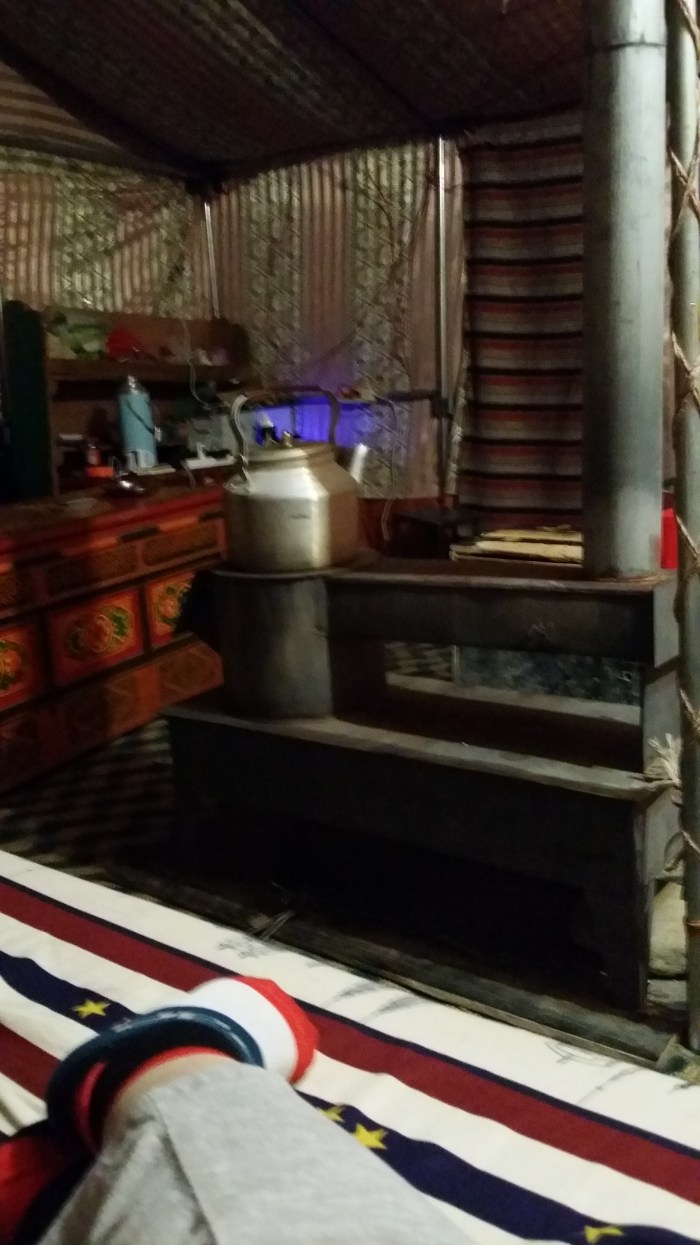
Inside our tent…..looking patriotic.
20160628_080010
Couldn’t have asked for a more perfect morning
20160627_223438
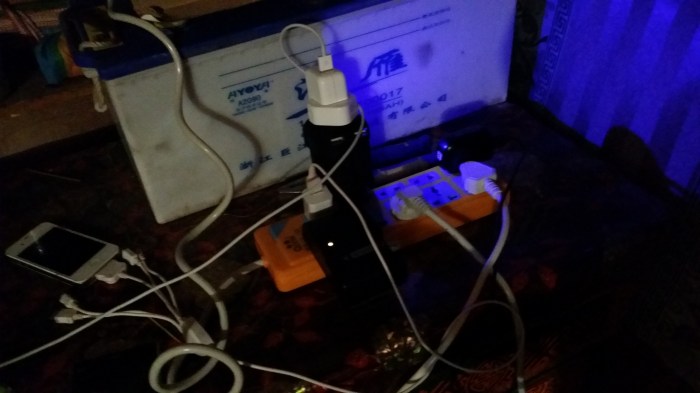
The fight for power in our generator powered tent.
20160627_222130
Fire fueled by yak dung
EBC-1024x683
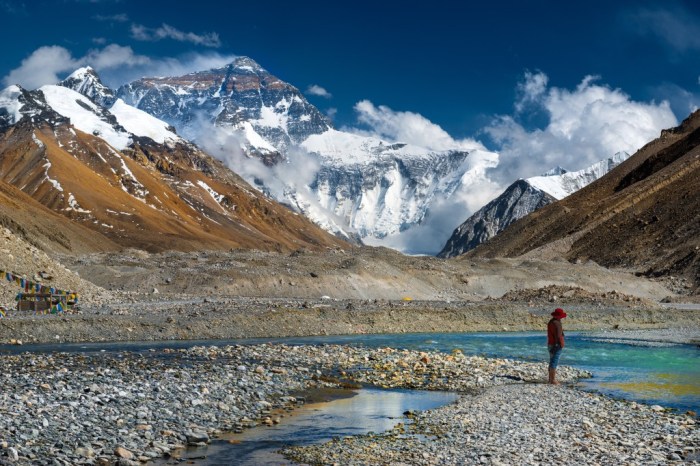
Not my photo, taken by one of my travel buddies with a real camera instead of a cell phone.  Beyond beautiful
IMG_20160628_084638
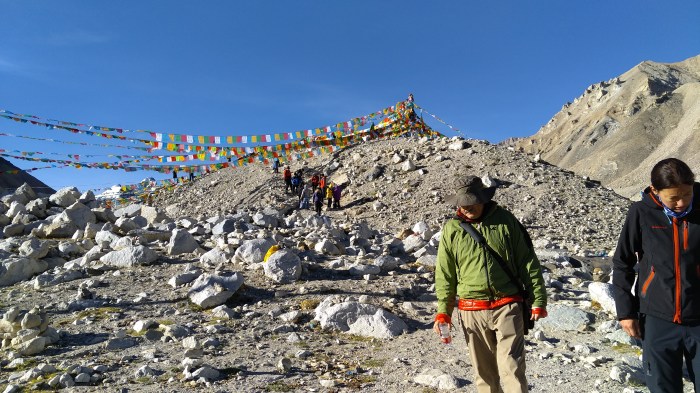
Tacked it to the pole with our Tibetan Prayer Flags.
20160628_082630
Yes, I let Nick and Lou out to enjoy the view!
FullSizeRender
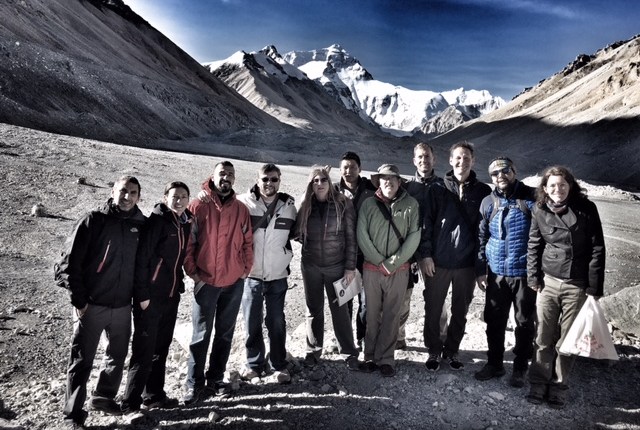
The gang I traveled with in Tibet and Kathmandu.
IMG_20160627_185833
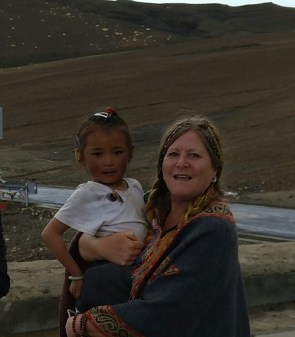
Little nomad girl I found behind the sign where I had my first glimpse of Qomolangma.
IMG_20160627_190300-1
Her little cheeks were so chapped.

Who Was General Tso and Why Do Americans Eat His Chicken?

Who Was General Tso and Why Do Americans Eat His Chicken?

During the Qing Dynasty, Tso TsungTang was a ruthless “war hero”. In 1850-64, during the Chinese Civil War, the Taiping Rebellion, he caused many to flee China, eventually making it to America to work on the transcontinental railroad.

Hailing from Hunan Province, General Tso’s relatives, to this day, have never heard of General Tso’s Chicken.  Now, I have only been in China a short time, about 20 months, I have never seen General Tso’s Chicken on a menu nor have I seen anything in any restaurant that even resembles what we in America know as General Tso’s Chicken.  Not only have I never seen the General’s Chicken, but, I am sorry to have to tell you that egg rolls, chop suey, crab rangoon, sweet and sour pork/chicken, pu pu platter, fried rice, hot mustard and finally fortune cookies basically do not exist in China.  For that matter, I can’t think of one thing from a Chinese menu in the USA that I have actually seen or eaten in China, except white rice.

I am fairly certain that American Chinese food at some point in time actually had roots in mainland China cuisine.  Back to General Tso for a minute, rumor and history claim that a Chef from Taiwan actually created a dish to honor General Tso.  Chef Peng ChangKuei, fled Hunan Province under Mao Zedong.  He fled to Taiwan and this is where he supposedly created his dish.  During the early 1970’s Chinese cuisine was booming in NYC.  Chef’s were always creating dishes claiming “first time in America”  “Authentic Chinese Dish”.  Of course they really were first time dishes because they were created to satisfy the American palate and yes, they did have roots in authentic Chinese cuisine, but those roots really weren’t too deep.  Mostly because most Americans wouldn’t stomach some authentic Chinese dishes such as feichang 猪肠 pig’s intestines,

main-qimg-127a38f3af271e77ec673d29b7a4890b-c
Pig Intestines

fengzhao 鸡爪  chicken feet, duck’s blood soup, jellyfish, seaweed, goat kidneys, hearts, you name it, they eat it in China.  So, back to Chef Peng, the story goes that 2 chef’s from NYC went to Taiwan for inspiration and ate at Peng’s restaurant.  They brought his most famous dish back to America, recreated and bastardized it.  Peng finally also came to NYC and was disgusted to see what had happened to his dish honoring General Tso.  Not only that, he couldn’t convince anyone that it was originally his dish.

So, the whole point I am trying to make is that American Chinese food is really just American food made by people of Chinese decent.

A few other ways food/dining culture here in China differs is that you rarely find anything fried or breaded.  Egg rolls do not exist, although spring rolls do.  Spring rolls have a much lighter thin translucent wrapper and are not fried but steamed.  Chicken dishes in China are not nice diced pieces of boneless chicken.  If you order a chicken dish in China, expect a dish to arrive that is a chicken chopped, bones, skin, head and feet all in the dish.

20160527_182712
This was a chicken and potato dish I ordered. Yes, the head and the feet came in the dish, along with bones, skin, fat,,,,,

Don’t get me wrong, it is always delicious, sautéed with herbs, spices and sometimes vegetables, but never a breaded and fried and slathered in sauce dish.   Usually a touch of oil, soy or vinegar, never swimming in a sweet and sour or any other sauce.  If a dish has sauce, it is always on the side for dipping and this is usually just for meat dishes.  Vegetables are prepared in such a mouthwatering way with ginger, garlic, chili peppers, peppercorns, etc, there is no need for any sauces.


IMG_20170311_120333
Various animal parts to choose from, notice the duck heads.

Chinese also love grilling.  When I am out in the evenings the smell of lamb, chicken and beef being grilled on the street is heavenly.  Now, when I say grill, don’t think hamburgers, chicken breast or a big fat sirloin, they grill most all of their meat on kabobs served with small dishes of spices to dip.

IMG_20170328_195432
Grilled Chicken Wings


Chinese cuisine in China also pays more attention to veggies and bean products versus meat and fried dishes like in America.  The Chinese have a way with eggplant that I can’t explain.  It is simple and amazing.  I hope to find someone to teach me to make it.

IMG_20170420_181158
I can’t describe how amazing this eggplant dish is

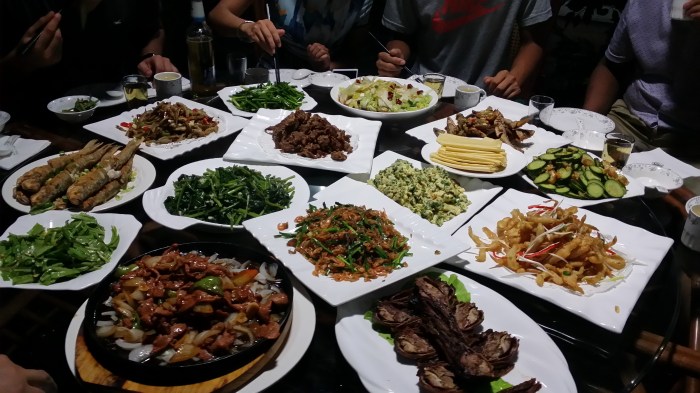
A few other differences; in China you never order/get individual servings.  Everything is served family style.  You also don’t serve food on to your personal plate and eat.  Mainly because you don’t really receive a plate.  You do get a small saucer size plate and a small bowl.  This is to basically catch scraps, put things to cool or put waste.  Yes, you spit the bones on the table or on your small plate.  Depending on the restaurant, it is perfectly acceptable to spit your chicken/pig/sheep bones onto the floor.  Using your chopsticks, you just grab a bite of whichever dish you want and eat.

20150827_192523
Lazy Susan Dining. Grab and Eat

Don’t expect bing shui, cold water in China, basically it doesn’t exist.  You will ALWAYS be served hot water with a meal.  It can be the middle of summer and the spiciest dish on the menu, you get hot water.  Okay, so you think, I will order a beer……. room temperature.  Tipping doesn’t exist. A receipt for your meal, forget about it, unless you ask for a “fapiao”. This is a receipt with an official government stamp you can use if you need to be reimbursed.

So, China is a huge country, cuisine does differ from province to province.  Hunan spicy is much different than Szechuan spicy, some provinces favor sweeter foods,  bottom line, Chinese food on mainland China is not what we eat in America.  I did google to find out the most popular dish throughout all of China.  Surprise, a simple egg and tomato dish.  I have to say I believe this to true.  No matter where I have been in China, I do always see eggs (usually sorta scrambled) mixed with tomatoes.  It is delicious.

IMG_20170212_123928
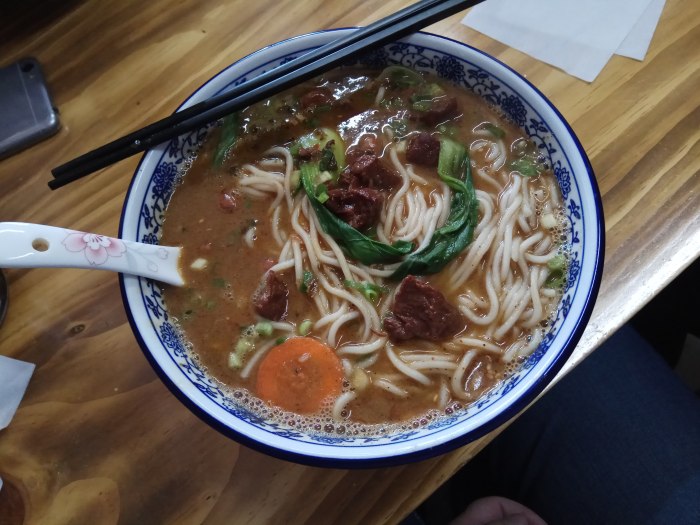
One of my favorite dishes, spicy beef noodles

Depending on where you live, rice or noodles may be more popular.  Noodles differ by region, rice noodles, egg noodles, tofu noodles, fat, thin, etc.  2 other popular dishes, baozi which is a steamed bun stuffed with meat or vegetables and jiaozi or dumplings.  Both are usually dipped in a garlic vinegar sauce.

20160207_124155
Baozi, meat or vegetable stuffed steamed buns.  Garlic Vinegar for dipping.
IMG_20170316_182018
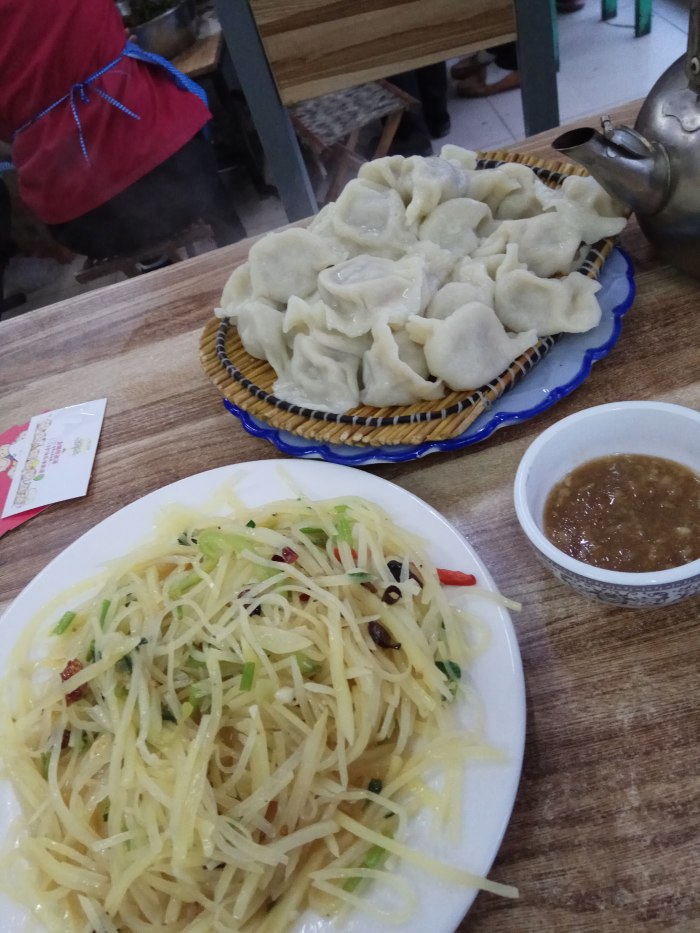
Lamb filled dumplings and spicy potatoes

What do I miss most….sometimes I crave a big juicy burger, a pepperoni pizza, a thick blood rare steak, chardonnay……. I can usually find a way to satisfy these cravings. I am sharing some photos of typical dishes that I enjoy and maybe some I don’t.

My biggest disappointment:  NO CHEESE IN CHINA!

Some more photos of food I have had in China………

IMG_20170328_193014
Spicy Brussel Sprouts
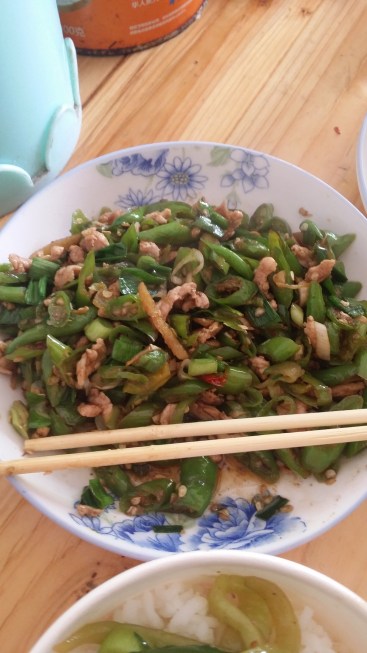
20160401_124641
Pork, Celery and Hot Peppers
20151225_115426
Yes, bugs often grace the table
IMG_20160327_123402
Lotus Root
20151010_131716
My favorite food in Xiashan. A crepe with an egg, chicken, spicy sauce and a wonton like crisp.
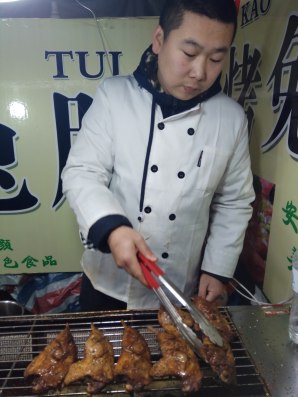
IMG_20170210_200007
Grilled rabbit, another favorite
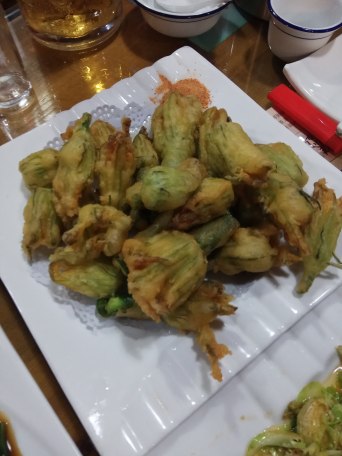
IMG_20170328_193321
One of the few fried dishes I have seen, pumpkin blossoms.
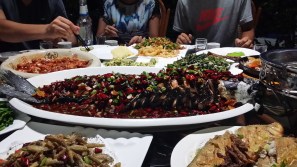
20150827_194312
Fish with chili peppers
IMG_20170304_191008
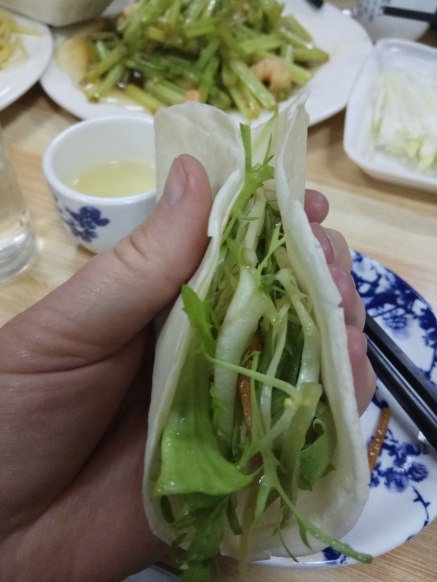
Potato dish, sauteed celery, frisee, peking duck
IMG_20170304_191124
Proper way to eat Peking Duck.  Put the duck in the crepe, top with frisee and hoison sauce.
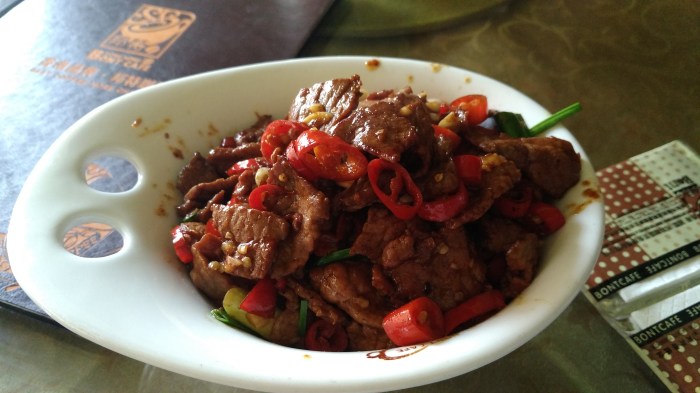
IMG_20160327_122414
Pork and red chilis in Hunan Province

It’s “Chinese Culture” or “Saving Face” ~ When is it Real or a Form of Manipulation

I’m sure this will raise some eyebrows. I mean I get the whole Chinese culture thing. Every culture has their own set of “rules”, their own way of doing things. I totally agree that whenever you travel to a foreign country you should try to learn at least a few basic phrases and the basic do’s and don’ts.  I have lived in China for just over 20 months now.  My mandarin is still poor at best and maybe I don’t try as hard as I should, but I do get by.  I think I understand the basic “cultural stuff” in this country of 1.3 billion people with a rich history and one of the oldest civilizations on the planet. I actually love this country, the opportunities it has given me and the amazing places I have visited and the things I have experienced. But…..does China, or should I say the people, who are worldly and “get it”, push the envelope and use it to their advantage as a method of manipulation or am I really causing someone to lose face?  And…..is it different in the countryside versus city?  Why do I ask?  Because after being in this country for this long, every now and again I feel I am being “manipulated by tradition”.  Please don’t take this as I am fed up with China, well, yes I do get pissed off every now and again, but not ready to kick China to the curb and say nice knowing you……too much I still have to explore in this place……..so…….

When I first arrived in China, August 2015, I spent 2 weeks in training in Beijing.  Part TEFL training, part Mandarin language training, some calligraphy classes, a little TaiChi and a lot about Chinese Culture, traditions, do’s and don’ts, what is saving face, be careful of the baijiu and so forth.  We, me and 70+ other newbies, (actually 98% of we were kids fresh out of high school doing a gap year) bought into all the Chinese culture, tradition, saving face stuff.

I mean, okay, if it will cause someone to lose face if I offer a tip for service, no problem, I can easily forget about tipping.  Yes, I can remember not to stick my chopsticks upright in my rice because it will look like incense sticks at a funeral.  No, I won’t randomly touch strangers, especially on the head (shit, I don’t touch strangers in Warren, Ohio), but why don’t YOU recognize personal space and queue up?  No, I won’t give a clock, umbrella, a green hat or anything that comes in fours as a gift. Nor, will I be offended when you refuse my gift at least 3 times before finally accepting it, after all, it is the “Chinese Way”.  And yes, I will always remember to accept your gift with 2 open hands. This one’s easy, if I am invited to dinner, I will never offer up money which would cause my host to lose face. I could go on and on, because at least once a day I hear, “it’s the Chinese way”, “It’s Chinese tradition”, “Save Face”. If I ask the simple question, “Why?”, I am usually met with, “no why”.

Back to the original question, “is it real or a form of manipulation”?  Many times I have been requested, at the last minute, to do something or change my schedule. When I say last minute, I literally mean “last minute”. It can be on the spot and you are put in a position you can’t really say no.  “It’s the Chinese way!”  Numerous times I got up in the morning, dressed and reviewed my lesson, only to arrive at school and be told, “sorry, no English class today, they have exams”.  Are you effing kidding me, you didn’t know this last week, or really, even last night. Did someone wake up and just decide, oh, lets give the whole school a test today.  Don’t get me wrong, I’m not complaining about having the day off, but, it would have been nice to stay in my cozy bed instead of arriving and being sent home.

Take this past Saturday for example, I give private lessons from 9 to noon to 2 students in my home.  Being in my home, I stay in bed as long as possible then piddle and sip my coffee until I absolutely must be presentable when my students arrive. I finally rolled out of bed at 8:15 and put the water on for coffee.  I kid you not, there was a knock at my door at 8:25.  Really……it was one of my students. I quickly threw a track suit over my pajamas. That works, right? I am in my own home and have nothing planned for the day, except to venture out at some point for my $6.00 massage.  I hand him a copy off The Little Prince Chinese/English version and continue getting ready for the lessons.  June, my assistant arrives at 9 and my second student at 9:05.  Soon we are deeply involved in fruits, vegetables and all kinds of food.  Laughing, reading, tasting, making deviled eggs, popping popcorn and practicing our English.  All is right with the world……wrong. June gets a phone call and I get a wechat message from Peter at about 11 am.  It says Hot Pot at noon.  Notice the lack of a question mark.  I reply with a simple no.  A few minutes later, June says, we must go have Hot Pot at 12.  Again, I politely say no and explain. First, lessons don’t finish until noon and I have pajamas on under this track suit because he arrived at 8:25.  I shoot the same message to Peter.  Who says, “it’s okay, we will wait”.  Okay, I am no longer feeling “polite” and put Zootopia on for the kids to watch while they eat popcorn. I ask June, who is we and why MUST we go.  It is the headmaster of the Primary School.  He is inviting you. You can’t say no, he will lose face.  “June, I am not happy about this and I will not be there at noon.”  I send the kids on their way, June waits for me to quickly/not quickly get dressed and she drives us to lunch.  Yes, it was a lovely lunch, the headmaster was very happy to have me, we drank two bottles of wine and despite the fact I was fuming inside, I smiled and played nice.  Needless to say, after 2 bottles of wine and small talk, mostly in Chinese, we finished around 4 pm.  My day was shot.

Many people claim you develop a love/hate relationship with China.  To an extent I must agree, but as I stated earlier, I am not ready to kick China to the curb quite yet.  It really is an amazing culture with many amazing people who will be my life long friends.

Would he have really lost face or was I manipulated?  I will let you be the judge.

IMG_20170415_132007[1]
At least Peter had all of my favorite dishes waiting.  This is raw beef which you dip in a horseradish vinegar sauce.  I love love love this.  It looked much better when it was first served, but I forgot to snap a photo.

Random Acts of Kindness

IMG_20170401_181406
A beautiful evening to start an adventure

April 2 begins the 3 day Qingming Festival in China. Qing Ming, or Tomb Sweeping, is a traditional Chinese festival on the first day of the fifth solar term of the traditional Chinese lunisolar calendar. Basically, the 15th day after the Spring Equinox, either the 4th or 5th of April in a given year.  Other translations include Chinese Memorial Day or Ancestor’s Day.  The holiday is associated with eating qingtuan, green dumplings made of glutinous rice and barley grass.  During Qingming Festival, Chinese people visit columbaria, graves or burial grounds to pray to their ancestors.  It is an opportunity to remember and honor ancestors at the grave sites.  Young and old alike pray before the ancestors, sweep the tombs and offer food, tea, wine, chopsticks, joss paper and libations to the ancestors.

What does this mean to me?  Simple, extra days off work and the opportunity to travel and tick a bucket list item.  Xi’an is a quick 6 hour ride by bullet train from Jinan, the capital of my province. Why Xi’an, you ask? On March 29,1974, local farmers, while digging a well, unearthed what is one of 11 things billed as the 8th Wonder of World, The Terracotta Army. The Terracotta Army is a collection of terracotta sculptures depicting the armies of Qin Shi Huang, the first Emperor of China. It is a form of funerary art buried with the emperor in 210-209 BCE and whose purpose was to protect the emperor in his afterlife.  But, enough about the army, that will be a future post as I am currently on a train 302 kph towards Xi’an. Thanks also to Wikipedia for filling in some details on Qingming and the army.


Now back to random acts of kindness.  Although I have been traveling throughout China as a solo female off and on for about 18 months, Peter has been concerned for my welfare ever since arriving in Dong’e.  In order to travel to Xi’an and make the most of my time, I would need to catch the bullet train from Jinan.  Jinan, depending on where in the city you are going is anywhere from 75 to 90 minutes by car.  I usually have a driver available to take me most places I want to go. However, this time, Peter asked if I would mind taking the bus as all 3 drivers that are usually available for me were tied up.  The bus would take about 2 hours.  I told him that it was no problem taking a bus from Dong’e to Jinan.  The bus was leaving at 5:10 pm and Peter purchased my ticket for me since he was feeling bad about not being able to drive me.  Of course, he escorted me to the coach station, 45 minutes early, I might add.  His idea not mine.  So while we wait on the bus to arrive, Peter insists he wait so he can talk to the bus driver to be sure I get off where I need to and can go to the train station to get my ticket the night before so I don’t have to fight holiday travel crowds early (my train was 7:08 am)  to pick up my ticket.  The bus arrives, I board, its packed to the gills, and find a seat in the last row.  Peter is running around talking to the driver, chatting with random people, etc.  Next thing I know he is on the bus looking for me.  He then points at a young man near the front of the bus and tells me that the gentleman would look after me.  Okay, whatever, this isn’t my first rodeo, I just smile and say thank you.

IMG_20170401_181619
A view of the road the bus was traveling from Dong’e to Jinan

So, the journey begins.  An overcrowded, rickety bus and bumpy countryside roads, I put my headphones and figure I will close my eyes and relax.  Problem number one, headphone is broke. Problem number two, the bus has stopped and is backing up on the narrow single lane road with busses and trucks coming in the other direction.


IMG_20170401_181520
Straddling the road, teetering on a ditch, blocking traffic while making a 3 point turn.


Next thing I know, the bus is attempting a 3 point turn around, or so I thought.  We are actually trying to turn, and not fall off the road into a ditch, and head down what looks like a dirt path through a field.  We make the turn and we are on our way again.


IMG_20170401_181539
Taking the road less traveled


About 2 hours later, the man in the front of the bus is motioning me to come with him and get off the bus.  Okay, it looks like we are on some random back street outside of town. This is where faith kicks in and you get off the bus and go with the man, who carries your suitcase for you. He leads you to a waiting car, puts your suitcase in the trunk, opens the car door and motions for you to get in.  Not knowing where I am and the bus has pulled away, I get in the car and say “nihao” to the lady driving the car.  My escort tells me in his best English, they will take me to the train station so I can get my ticket tonight because it will be very busy in the morning.  We get to the train station and I say thank, you. He says, “No, I will go with you so you have no trouble”. Into the station we go, he waits in line with me and I get my ticket. He walks outside with me and I again thank him and plan to get in a taxi to my hotel.  Again, he says, No, I will find a taxi for you. I told your friend I would get you to the hotel”. Although his English wasn’t that good, he got the point across.  He also pointed to a building nearby and said he worked in IT in that building so it is no problem to help me.  We get near the main road and he speaks to a woman and tells me to pay her 20 rmb ($3.00) and she would make sure I got to the hotel.  I jump in the backseat of the car while she puts my suitcase in the trunk and about 15 minutes later she delivers me to the hotel.

This is the lovely Boutique Hotel I posted the video.  Again, the people at the hotel were so kind despite language barriers.  The lady at reception checked me in, took my suitcase and carried it to my room, turned on the lights, showed me around, said, “okay”?  I said “yes, xiexie”.  After she left, I realized I forgot to tell her I would need a taxi at 6am to the train station. I put the info in my google translate (a lifesaver when in China) and went downstairs.  She said okay.  In the morning, my phone rang a little before 6am and the lady said “come”. I figured my taxi was here and headed downstairs.  She hadn’t called me a taxi, but got someone she knew to drive me to the train station.   End of story, he delivered me to the station and I got on my train to Xi’an.

I know I ramble a lot for a such a short, but the kindness of the people I have met in China is worth telling. Not only that, but I didn’t have anything else exciting to post on my blog. I am writing this as my train is heading towards Xi’an where I am sure I will have some more exciting things to blog about, but for now, this is what you get.

IMG_20170401_202341
Home sweet home for the night in Jinan. Xi’an here I come.

The Great Firewall of China

The Great Firewall of China

Bottom line, internet in China sucks. Not only does internet in China suck, but we have to deal with “The Great Firewall of China”.  No, this has nothing to do with the 2300 year old, 13,171 mile long structure, which CANNOT be seen from space by the human eye.  The Great Firewall of China per wikipedia:  The Great Firewall of China (abbreviated to GFW) is the combination of legislative and technological actions that have been taken by the government of Mainland China (which is controlled by the Communist Party of China, CPC) to regulate the Internet domestically. It is the main instrument used by the government to achieve Internet censorship in China. These CPC regulations include criminalizing certain online speech and activities, blocking from view selected websites, filtering key words out of searches initiated from computers located in Mainland China, requiring international online service provider store their Chinese customer information within China, and slowing down cross-border internet traffic.

So much for freedom of speech, etc.

Basically, this means that technically, while in China, I have no access to anything google related, no facebook, no instagram and many other blocked websites.  How am I posting to facebook you may ask.  VPN, virtual private network, before arriving in China, I PAID FOR, downloaded and installed Astrill as my VPN.  This allows me to access these sites while appearing to do so outside of Mainland China.  Periodically, the PRC shuts down VPN access.  Generally, it is really just a pain in the ass to have to log onto a VPN each time you want to access these sites.

My only point being, I have been trying to post to my blog. I am trying to post an entry with photos.  Internet sucks, I have been trying for 4 days to upload a post.

This is just a little PSA to let you know I am still recording #mychinalife. I am just having some technical difficulties.  Please stay tuned.

I Survived a Chinese Hospital

I know there is a lot of controversy going on in America right now regarding health care.  Trust me, it is still better than China, especially rural China. I am sure things are probably different in Shanghai or Beijing, but the following is my experience.


A few random comments, if you have to visit a hospital in China, it is definitely to your advantage being a laowai, foreigner.  You get pushed to the front of every line, even if there appears to be 15 to 20 people already waiting in front of you.  Be prepared for lack of privacy as tests are not given in nice little individual sanitary rooms, no hippa in China. Be prepared to have everyone in the room watching only you, the non Chinese person.

download (1)
Typical Scene in a Chinese Hospital

I received a phone call one day last week from XinLe. She was formerly a teacher here in Dong’e, but quit to open up a shop. When Peter is unavailable she will escort me on marketing events, of which I have done several and she also assists me during the 2 group lessons I give.  Back to the phone call, she said she was picking me up in one hour, I had to go to the hospital for a “body check”.  Body check, ummmm, what does that mean.  She said, “you know, they check your body.”  Not really liking this last minute announcement, I got myself ready and went to meet XinLe for my “body check”.  She explained that some cities require a health check for teachers, but she didn’t know what all I would need.  We arrived at the Dong’e Women’s and Children’s Hospital about 5 in the afternoon.  Walked up to the desk, after I walked through a lobby of faces and fingers pointing at me.  You know, why is the laowai, foreigner, at the hospital.  XinLe has a long conversation with the girl at the reception desk. She looks something up on her computer, makes a phone call, more conversation…….come back tomorrow, reason being, I have to have a blood test and no eating or drinking after midnight.

8 am the next morning, XinLe picks me up and back to the hospital.  Lots of conversation, finally we get a piece of paper. XinLe says, “Wait here”. She was only moving 10 feet away from me to the cashier.  She had to pay the 100 rmb or $15 for my body check, which, other than the blood work, I have no idea what I am in for. Breath deep, well, maybe not so deeply, and get ready for a new experience.

XinLe, looks at the paper and determines, “we go that way,” as she points to a crowded area at the end of the hall.  We get to a window at the end of the hall, us and about 20 Chinese people wanting to get a look at the laowai.  She takes all my things from me and has me take off my coat and roll up my sleeve, ahhhh, the blood work.  Which I now realize is pretty much like going up to a teller window at a bank.  3 people are behind the counter and 3 people with their arm on the counter having a blood sample taken. Chinese people don’t really que up for anything so it is pretty much whoever works their way to the front and gets their arm down on the counter gets the next needle.  Well, the waters divide and I am pushed to the counter. Arm down, everyone pointing at my tattoos, band gets slapped on and the needle inserted. I didn’t even have time to see it coming in this assembly line process. Needle out and I am handed a q-tip to stop the bleeding and pushed out of the way.  Whew, hope that’s it.

Nope, XinLe, checks the paper and says, “that way,” as she points to another window with even more people.  She works her way to the window, says something to one of the 4 or 5 workers and then hands me a tiny plastic cup, about the size of one that comes with a bottle of Nyquil.   My guess is they want me to pee in this smaller than a shot glass container. Sure enough, XinLe says, “urine test” and directs me across the hall to a public bathroom which looks like it has been cleaned…..never!

download (3)
This is how the restroom looked

There was actually a toilet brush laying on the window sill. Unfortunately, or maybe fortunately, so to spare you all the gory details, XinLe had all my things including my phone, so I couldn’t snap any photos.  You will have to rely on my verbage for pretty much my entire experience.  Well, at least there are doors on the squatty potties.  Ok, doors, but they don’t really shut.  So here I am, tiny plastic cup, drop drawers, squat, take aim…..okay now what, you have filled the cup, not to mention soaked your hand and god knows you must have dampened your pants, how do you get your TP, which you have to provide yourself, then manage to get your pants up all while balancing a tiny shot glass of urine.  Well, only choice, set the shot glass on the window ledge and take care of business, trying to clean your hand best as possible.  Leave the bathroom balancing your cup of pee while trying to avoid the others coming and going to the bathroom, with and without cups, remember, it is a public toilet.  XinLe tells me to take the cup to the counter. I maneuver my way to the counter and I am, by way of hand motions, signaled to set my cup on a piece of paper.  The girl behind the counter dips a test strip in and then places it in a tiny vial.  She then motions for me to take my cup of pee back. I pick it up and look for XinLe who tells me I need to take it back to the bathroom and flush it down the toilet and throw away the cup.  Work my way back through the crowd, mission accomplished. I then take my purse from XinLe and find a wet wipe and clean my hands. I am not sure where the sinks were, but in China, you always carry tissues and wet wipes.  Blood done, piss test done, hopefully that is it.

No such luck, XInLe says we need to go upstairs, heart check.  I can hardly wait.  We arrive upstairs and are directed to a room.  Wow, an actual room, not a counter in the hallway.  We enter the room, lo and behold there are about 15 people in the room and an archaic EKG machine. Of course everyone turns to look, again, gee I get to go next. I am instructed to lay down on the table, I am positive the sheet does not get changed between patients.  Next thing I know, what felt like shackles were put on my wrists and ankles and my shirt was lifted.

ECG machine
This is exactly what the EKG Machine looked like

Oh yes, that was one for the record books. Chinese women don’t have much in the way of breasts, well, they, men and women alike in the room got an eyeful when they saw mine.  Next a paint brush was used to paint some sort of liquid where they tried to attach the EKG pads.  I say tried because when they tried to put them in place the shackles on my ankles popped off because the cables were a little short. I guess you could say I am too tall for China.  After some adjustments they were finally able to take the EKG.  Again, no hippa in China, my printout got handed around to every Tom, Dick and Harry in the room before they gave it back to XinLe.  Okay, I was totally ready to get out of that room, I’m not usually claustrophobic, but it was getting a bit too crowded in there for me.

We leave, I ask XinLe if we were done, she said, “no,” got on the translator on her phone and showed me the translation……gynecological exam.  To which I promptly said, “no fucking way.” Please pardon the profanity, but it was what slipped out of my mouth.  I have seen archaic equipment, the group exams, witnessed a bit more than I wanted too.  She said to follow her and we went to the desk. I again told her there was no way I would do the gyno exam.  Another phone call, she then told me the doctor said it is okay if I didn’t take the exam, damn straight, I would have walked out.  Are we done yet, I asked like a whiny kid asking are we there yet? No, we have to see the doctor.

Down the stairs, by the way, no such thing as an elevator in this hospital, its stairs or nothing.  We are escorted into a room with 2 men that appear to be Doctors and in fact they were. As Gomer would have said, “surprise, surprise, surprise,” we are the only people in the room and for guess what?  I finally have a test in private and it is a blood pressure check.  Really, I just had an EKG with 15 people gawking, but my blood pressure test is in private and with 2 doctors.  Of course, the BP device was from last century, but even after all the excitement I had just been through my BP was perfect.

bp
I remember we had one like this when I first started at the YMCA in 1980.

“Can we go now?” “No,” she said. Nooooo, really…..okay what next. The Doctors wanted to take photos with me.  I imagine I was the first laowai to have a “body check” at this hospital.  At least my experience ended with a laugh as we took multiple photos and selfies, of which I have none as XinLe still had my things.  And yes, even Doctors give the peace sign in photos.

As we were leaving the hospital XinLe told me we had one more stop, we had to go get one inch photos for my “body check” card.  At this point, taking a photo was nothing……so somewhere in Dong’e, most likely hanging or on file in the kindergarten is my “body check” card.

Another reminder of things we take for granted.

Note: The photos are from the internet but fairly represent my experience and survival of a Chinese Hospital.

I Ate Donkey and I Liked It

I have pretty much settled into life in Dong’e County 东阿县.  Dong’e sits on the banks of the Yellow River or Huang He.  The Yellow River is the second longest in Asia and the sixth longest river system in the world.  I am lucky to have an apartment on the 24th (top) floor of a building overlooking the river and a beautiful park.  Dong’e County is made up of several small villages, of which I travel to two on Tuesdays to teach kindergarten in the countryside.  Total population of the county is 420,000 in 308 square miles. Definitely small by China standards.

The nearest big city, Liaocheng 聊城市, is about 22 miles away.  Liaocheng has a population of 5.8 million in 3,365 square miles.  The capital, of my province Shandong, is Jinan. Jinan 济南市 is about 60 miles from Dong’e and has a population of about 7 million in 3,157 square miles.  As you can tell, I live in a very small community. Now that you know a little about where I live, on to the “meat” of the story…..pun intended.

Dong’e is regionally and nationally known for the production of Ejiao 阿胶. Ejiao, aka donkey-hide gelatin or ass-hide glue, is obtained from the skin of the donkey by soaking and stewing.  Donkey-hide gelatin is made in other coastal provinces, but got the name Ejiao from Dong’e County. History tells that there is a well in Dong’e that was kept closed and sealed. It was only opened when water was taken to prepare Ejiao for the Emperor’s Court. I can actually see this well from my apartment.  Ejiao is considered one of the top 3 most important “herbs” in TCM, Traditional Chinese Medicine. For more info follow the link Ejiao.

Peter, my boss, also has a family business which makes wine.  They have several wines which contain Ejiao. Yes, I have drank them and no, it does not alter the taste of the wine.  If Peter hadn’t told me, I never would have known.IMG_20170223_182009

Okay, so Dong’e is known for production of Ejiao. I asked where these donkey’s are raised and are they raised only for their hide? Peter told me his cousin would take me to visit the donkey ranch.  This should be an adventure, I thought to myself, she speaks absolutely zero English and my Chinese, well, pitiful..  Having had dinner at their home earlier in the week, at least I had already spent some time with her and her husband.  She (I still don’t know her name) picked me up the next afternoon and off we went to the donkey ranch just outside of the city.  I have to say, it was quite nice and the donkeys seemed well cared for. After a few selfies with the donkey’s we headed back into town.  We stopped at a park, which I now overlook from my apartment, and spent a couple hours wandering around as there is an Ejiao Museum there.  I have no idea what she said to the guard at the gate, but we didn’t pay the 50 rmb entrance fee to the museum.  It was actually quite impressive.

Luckily, WeChat (a highly used app in China, since FB is blocked) does a great job of translating.  She was taking me to her place of employment, The State Grid, the electric company.  She wanted me to meet her co-workers (she had taken the day off) and then we would wait on her husband to get off work and we would go to dinner.  Seriously, my first 10 days in this town were feeding frenzies. After I met EVERYONE who works with her and took 100’s of selfies with them, we  finally were ready to head to dinner.

Here is where I get to the “meat” of the story…..cousin, as I call her husband, insisted we go for donkey for dinner.  Having just visited a donkey ranch, this didn’t sit real well with me, although it did answer my earlier question, do they only raise donkeys for their hide.  Evidently, no, they also raise them for their meat.  They finally convinced me to go for a donkey meat dinner and I would at least try it. There would be many other things to eat if I didn’t like it.  Off we go to the restaurant. Peter was meeting us there along with his high school English teacher. As we were were sipping our Ejiao wine and a little Baijiu, the food started arriving.  There was a beautiful plate of, if I didn’t know better I would have thought to be roast beef, donkey.

All I am going to say, and end it here…..I ate donkey and I liked, no, loved it.

Transitioning ~ Lessons in Baijiu 白酒

Transitioning ~ Lessons in Baijiu 白酒

I have officially been in Dong’e  东阿县  for one week.  It has been a whirlwind week.  Being the only laowai 老外, foreigner, in about 50 miles, I have created quite a stir.  Evidently, they didn’t expect a foreign teacher to actually move to the city as I don’t really have a job right now, although I am getting paid and have been given a beautiful apartment.  I am eventually going to be teaching English to children at an Activity Center on Saturday and Sundays.  Currently I have been to a Kindergarten and a Chinese Youth Training Center where I have given several demo lessons to children and their parents.  During these “recruiting” sessions, Peter, my boss, who by the way is new to the business, signs kids up for the program.  When will it start?????  I have no answer.  Truth be told, my main activity has been going to dinners with various people in the community so they can meet me.

Let me try to explain a Chinese Business Dinner.  Anywhere from 4-12 people sit around a giant lazy susan table.

img_20170224_205111
Lazy susan style dining

Massive amounts of food are brought out throughout the evening. The evening can last from 1.5 to 5+ hours during which you eat and drink baijiu, which I will address shortly, but first more on the dinner.  In many Chinese restaurants, tables are in individual rooms. Upon arrival to the room, no one can sit until the host arrives.  I was the “guest of honor” and there was a certain position at the table where I had to sit.  This position would be the center of the table facing east or facing the entrance to the room.   At your seat you will find you place setting which is shrink wrapped in cellophane. The setting includes a small plate, a small tea cup, a rice bowl, spoon and juice glass. A set of plastic wrapped chopsticks is separate.  Supposedly, they are shrink wrapped to ensure cleanliness. Unfortunately, this isn’t always the case.  So the first thing you do, after opening, is stack them plate first, rice bowl, tea cup, juice glass and spoon inside the juice glass.  Next you pour hot water or hot tea into the juice glass until it overflows into the teacup.  Dip your chopsticks into the juice glass, remove the spoon, dump the water onto the next layer and so forth, finally dumping the remainder of the water over the plate into the trash bin which is under the table.  Now that your dishes have been properly sanitized, someone at the table will pour everyone tea.shrink-wrapped-eating-utensils-01  Let the feast begin.  Your small plate is placed in front of you, but it is there to basically eat over and catch any droppings.  At a dinner in China, you do not fill your plate, but merely take food with your chopsticks from whatever dish is in front of you and eat.  As more and more food is brought out the table is rotated by people at the table so all dishes get around to everyone. Basically it is communal eating.  By now the host has opened the baijiu and has filled everyone’s juice glass to the brim.   At some dinners, the women don’t drink baijiu, usually tea, fruit juice or beer (pijiu 啤酒).  At my first dinner, everyone drank baijiu, the host brought a case.  The host and then various people around the table will give a toast to welcome you.  You will either clink glasses or touch the glass to the table and nod if the person giving the toast is across the table from you.  If you hear the word “ganbei” 干杯, this literally translates to “dry cup” and is the Chinese version of “bottoms up”.  The tricky part of the dinner is pacing yourself as you must continue drinking until the host is finished.

Per the blog chinaslostpanda.com:  “As crazy as it may sound to some people, drinking (excessively) is a respectable quality in China.

It is even integrated in the Chinese language itself. The word 酒品 (jiupin) literally means “alcohol integrity”, and to some extent is believed to reflect the 人品 (renpin) “personal integrity”.

Drinking in China is therefore an indispensable social ritual. Not among college students, but among mature, grown up men. The goal is not to get wasted (even though it is hard to avoid), but to show that one is trustworthy and upright”.

My first dinner was with the owner of several kindergartens in Dong’e, Peter, some teachers and 3 educators from Beijing who were in town to do a training with the kindergarten teachers.  Let me tell you, they could handle their baijiu.  After my first juice glass of baijiu, Rich, the owner of the kindergarten, saw me sipping and then said I had to finish in 4 drinks, or the next 4 toasts.  It was a record night for me, 4 glasses of baijiu and I didn’t fall down the steps when we left.  Needless to say, I was invited to dinners the next 4 nights, all which included baijiu.  Luckily for me, after my first glass of baijiu, I convinced my hosts to let me switch to red wine.

So, you may ask, what exactly is baijiu 白酒?  My usual response is, “its Chinese hooch or moonshine”.  Literally it translates to “white alcohol”  In fact it’s a grain alcohol made from one or more of the following grains; sorghum, glutinous rice, wheat, barley or millet. It can even be made with corn and peas.  Legend has it that the first baijiu was accidentally made from cooked sorghum seeds (still usually the spirit’s base grain) that were left inside a hollow tree stump during the Xia Dynasty (2100 to 1600 BCE). Baijiu comes in several aromas or fragrances. Frankly, I can’t tell one from another, of course maybe if I went to a baijiu tasting, if there is such a thing. Rumor has it that baijiu is slowly working its way into mixed drinks in the western world.  Baijiu is found in nearly every Chinese home and at 1.8 billion strong it is the best selling liquor in the world.

img_20170302_130525

I received a box of baijiu as a housewarming gift here in Dong’e.  The bottles, by the way, are beautiful.  I have transitioned to my new city and have had my share of lessons in baijiu….until next time…Ganbei 干杯

img_20170303_134129