
 From Asia to Europe to Africa to small-town America, I’ve seen how different our worlds appear and how alike we truly are. We may cook different meals, pray in different ways, or celebrate under different stars, but what we seek, the connection, the comfort, the laughter is the same. Wherever I go, I find the same joy in gathering, sharing, and belonging. Proof that people are far more alike than different, no matter how far from home we roam.
Sometimes the world feels impossibly vast. It is a mosaic of languages, a myriad of landscapes, and a multitude of traditions. Yet, the further I wander, the smaller it becomes. I felt it in Paris, where café tables held laughter and conversation that was music to my ears even when I didn’t understand all the words. I felt it in Xiashan, that small rural village in China, where I met a girl from my hometown in Ohio. I felt it in Warsaw with the never-ending rotation of flat mates who became like family. It followed me to Bulgaria where I reunited with young people I met nearly twenty years ago. And now, I feel it again here in Morocco.

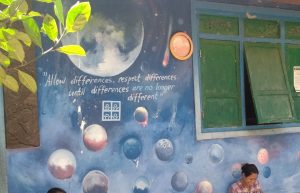
Everywhere I’ve gone, I’ve been reminded of something that was painted on a classroom building at a school where I volunteered in Bali: Allow differences, respect differences, until differences are no longer different. Those words have followed me across the continents, from cobblestoned streets in Europe to the sand dunes of Morocco, all whispering the same truth as Indonesia’s national motto, Bhinneka Tunggal Ika – Unity in Diversity.

Maybe that’s why travel still feels a bit like Neverland to me. I don’t mean the place where I refuse to grow up, but that state of wonder that doesn’t fade. It’s a way of seeing the world with open eyes and an open heart. Its finding familiar in the foreign. The music changes, the spices taste different, the languages take on new rhythms. But I’m in a world that keeps reminding me to believe in a little magic.
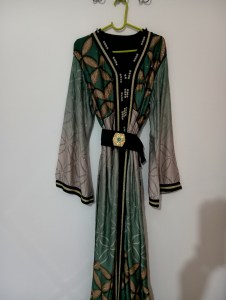
Here in Kelaa, Morocco, I was invited to a wedding. All I knew about Moroccan wedding celebrations was they often start late in the evening and finish at dawn. I also knew I would need a special caftan. Luckily, one of my friends from the school and a relative of the groom, scouted caftans for me and sent photos. All I had to do was go pick it up and pay the rental fee of 100 dirham (10 euro). This includes laundry service. The other amazing thing? They simply placed the caftan in a bag, handed it to me, and off I went. No ID, no paperwork. But I’ve been in Kelaa long enough to know they could easily find me if I didn’t return it.
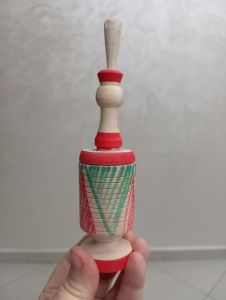
I was told by Khadija, my caftan finder, that we would go to the wedding around 21:30. As I was getting dressed, I realized I had no idea how to fasten the belt. Fortunately my downstairs neighbor who is my landlord, sent his wife up to help. When Khadija arrived she told me I needed more eye makeup. She had gifted me an Amazigh wooden applicator with homemade kohl which is a black powder consisting of sulfur, malachite, galena and animal fats. I had no idea how to put it on, so she applied it to my eyes and we set off for the wedding a little after 22:00.
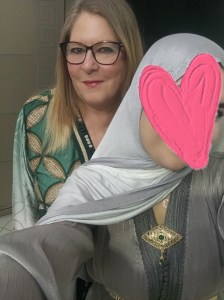

When we arrived we were offered a shot of milk in a small silver cup and a date. This symbolizes wishes for a sweet, pure, and prosperous life. By the time we arrived, we had missed the Amariya procession where the couple makes their entrance on elevated platforms called amariyas, carried by the attendants. This symbolizes their elevated status as king and queen for the night. The bride is attended by a negafa, who helps her with up to seven outfit changes, each representing a different region of Morocco.

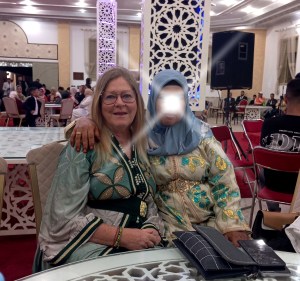
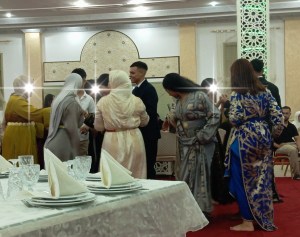
Stepping into the wedding was like stepping into a living kaleidoscope. The female guests were dressed in brilliant caftans in every shade of the rainbow. The room was filled with pulsing music and women dancing. The men lingered mostly outside chatting, until the baskets of khobz (round Moroccan bread) and plates of roasted chicken started arriving. They quickly made their way to the tables.
I sat there surrounded by people I didn’t know (Khadija was at another table) and whose words I couldn’t understand. As I looked around, I realized how much I did understand…the common language of joy, a shared meal, and laughter. A community gathered to celebrate something beautiful. It wasn’t so different from weddings back home in the USA. It was families crowded around tables, friends leaning close to talk over the music, and generations joining together in laughter. The songs and traditions were different, but the sentiment was the same…love, belonging, and the simple happiness of being together.

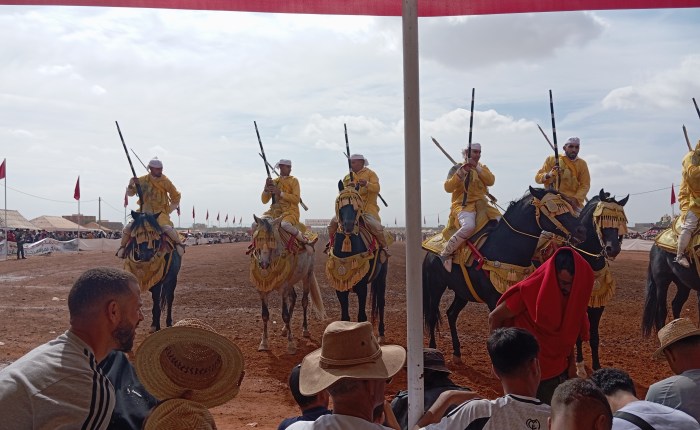
Several days after the wedding I had the opportunity to experience the final day of the four-day Tbourida with some Moroccan friends. Tbourida is a Moroccan equestrian performance dating back to the sixteenth century. It simulates a succession of military parades reconstructed according to ancestral Arab-Amazigh rituals. Riders in their tribal costumes charge toward the crowd, the men fire antique rifles into the air as the horses stop just in front of the crowd. The Tbourida in 2021 was placed on the UNESCO list of Intangible Cultural Heritage of Humanity.
After watching the horses race down the field, we wandered in search of something to eat. We ended up under a small tent where a man was frying sfenj or Moroccan donuts, golden and crisp. We ordered a basket, along with a few hard-boiled eggs, and I soon learned the local trick of smashing the donut into a “boat,” nestle the egg inside, and eat it like a breakfast sandwich. Some women brought us steaming mint tea, and we settled in for what turned out to be a most unexpected yet delightful repas.


Afterward, we drifted through rows of stalls with trinkets and jewelry shiny in the afternoon sun, piles of herbs and spices perfuming the air, and t-shirts swaying in the breeze. We stopped again to watch the next round of riders, their synchronized charge racing down the field. While we stood there, a young boy approached shyly, greeted me in English, and shook my hand as his friends giggled nearby. My friends explained he’d been dared to do it. Just behind me, a man was spinning clouds of pink cotton candy. We ended up buying half a dozen sticks for the boys…a sweet reward for bravery.
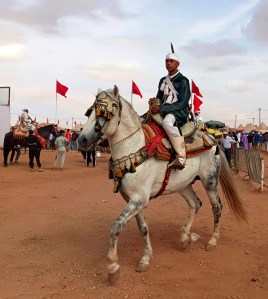
As we made our way back to the car, it struck me how familiar it all felt. Between the dust in the air, the scent of horses and hay, and the laughter of children, I could have been back at the Trumbull County Fair in Ohio. Not in appearance, but in essence. The hum of the crowd, the shared delight in simple pleasures like popcorn, cotton candy, and plastic toys that might not last the day but would certainly be loved for the moment. Whether in Morocco or middle America, people gather for the same reason: to belong, to laugh, and to share joy together. The details changed, but the heartbeat was the same.
Beyond the grand celebrations, it’s the smaller rituals that reveal our shared humanity most clearly. In the local hammam, the communal bathhouse, women gather not just to cleanse, but to connect. They talk, tease, share family stories, and laugh in the steamy warmth.
It reminds me of women’s spa days back home, or long lunches that stretch lazily into afternoon. It’s the same comfort of friendship, the same release of laughter that only comes when you’re surrounded by people who understand you.
Across the world, I’ve found this rhythm in a thousand different forms…over wine in a Paris café, in a Warsaw market, sharing dumplings in China, or at a diner in small-town Ohio. The settings change, but the essence remains unchanged. People coming together to share the simplest and richest parts of life.

After so many places, I’ve stopped searching for the line that separates different from same. In Morocco, at a wedding, laughter floated around tables just like it does at family gatherings back home. At the Tbourida, families cheered while children ran past, sticky-fingered with cotton candy…the same sweetness I remember from summer fairs in Ohio. In Europe, too, I’ve felt it at Sunday picnics along the Seine, in the playful banter of summer camp in Bulgaria, and in the quiet joy of people simply being together.
The settings change, the music, the colors, the customs, but the feeling doesn’t. Everywhere, people want the same simple things: good food, good company, and a place that feels like home. I used to think home was a point on a map, but I’ve learned it’s something more like a familiar heartbeat I recognize wherever kindness and connection live.

Maybe that’s the quiet truth I keep chasing. Unity doesn’t erase difference; it celebrates it. The magic isn’t only in faraway places, but in the way every place holds a reflection of home. The more I travel, the more I understand that the world’s beauty doesn’t lie in how different we are, but in how familiar we can feel, even in the most unfamiliar places.
The world isn’t as divided as it looks. Maybe, if we allow and respect our differences long enough, we’ll start to see they were bridges all along. Maybe that’s the true magic of this Neverland of mine, discovering that no matter how far we wander, the heartbeat of home echoes everywhere.
Allow differences, respect differences, until differences are no longer different.





 Down the Rabbit Hole