

“You will never understand the true meaning of your life until you travel and experience how others are living theirs!”
I don’t know who to credit for this quote, but it sums up my most recent experience in Arusha Tanzania but most especially at Bright English Medium School. I knew I would be spending about 9 weeks of the summer in Bulgaria. 8 working at Zenira Camp in Kiten. I would arrive a few days early and end by visiting friends in Veliko Tarnovo for a few days after. I knew I didn’t want to return directly to Warsaw as the new semester mostly kicks off at the beginning of October. Last year after camp I flew to Cairo to experience the pyramids. Then I decided to head to Casablanca and Marrakech Morocco. Both were exhilarating journeys that fueled my soul. I tossed around a few possibilities, including a return to Egypt for Valley of the Kings or India but I didn’t have a specific destination, and finally Kenya and Tanzania.

In my dreams, I didn’t have visions of sugar plums, not even lions, tigers, and bears, but baobabs, zebras, elephants, giraffes, and epic sunsets behind massive acacia trees. Another visit to Egypt and a trip to India would have to wait, so I narrowed it down to Kenya and Tanzania.
I was soon researching visa requirements for both countries, looking at maps, and what I could do while I was there. Probably one of the most important things to do is check into visa requirements. Many countries have VOA or visa on arrival, some have e-visa and others like China make you have one in advance.
During my research, I remembered I had joined an online community a few years ago called WorkAway. Part of WorkAway’s Mission is “Building a sharing community of global travelers who genuinely want to see the world whilst contributing and giving back to the places they visit. Alongside our welcoming hosts, ready to receive visitors who are able to help out.” It is a community based on learning, sharing, and exploring new ways of life. What makes Workaway work is the spirit and dedication of its members in providing positive cultural exchange experiences. You can sign up as a host or a worker. I reinstated my membership for a $50 fee for one year and was soon researching potential hosts. Joining a community such as WorkAway provided me with an added layer of comfort when agreeing to stay in a foreign country and volunteer. I used a different community when I volunteered at Yayasan Widya Guna in Bali and I plan to use WorkAway when I finally decide to go to India. If I was going to this part of Africa, it had to include a safari. The thing that finally tipped the scales to Bright English Medium School was the quote, “go big or go home”. To me, going big was the Serengeti. BEMS (Bright English Medium School) mentioned their proximity to the Serengeti in their host write-up. Soon I was messaging back and forth with Juliana and Lydia from BEMS and next thing I knew; I pulled the trigger on a one-way plane ticket to Arusha from Sofia Bulgaria.

On August 25th, I boarded a train in Veliko Tarnovo at 07:20 and headed to Sofia to catch a 17:10 flight to Doha Qatar where I would have a 4.5-hour layover before my overnight flight to Zanzibar Island Tanzania where I had a 5-hour layover before a short flight to Arusha on the mainland. At check-in in Sofia, I was assured my luggage would be checked all the way through to Arusha…I’m sure you know where this is headed, and it will end up being a blessing in disguise.
Landing on Zanzibar Island would give me a new stamp in my passport and tick country number 41.
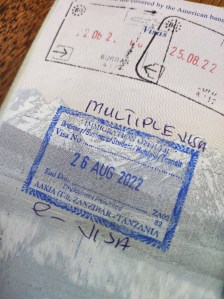
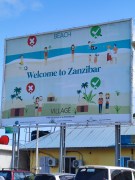
It is an Archipelago in the Indian Ocean, 25–50 kilometers (16–31 mi) off the coast of mainland Tanzania and consists of many small islands and two large ones: Unguja (the main island, referred to informally as Zanzibar) and Pemba Island. The capital is Zanzibar City, located on the island of Unguja. Its historic center, Stone Town, is a World Heritage Site. I got off the plane which was a 787 Dreamliner so you can imagine how many passengers there were.

I followed the crowd to the terminal (a building not much bigger than a lot of homes in the USA). Even though I was aware that I could get a visa on arrival, I took the time online, paid the fee, and had my visa almost two months in advance. Tourist Visa = $100. Watching everyone’s face as you bypass the VOA line = priceless!! I had almost 5 hours of layover, closer to 4.5 after I got through immigration. I found someone who looked official and told them I was a transit passenger and where should I go? They told me I had to leave the airport as they had no transit area, and I couldn’t enter the departure area until 2 hours prior to my flight to Arusha. So off I went in search of coffee and an ATM outside the airport. One thing you quickly learn in Tanzania is that cash is king. Very few places accept credit/debit cards. You can’t help but love the money (shillings) and the elephants on the 10,000 bill.
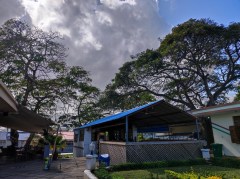


Immediately outside I found several open-air cafes. I chose one and asked for coffee, but ended up having a spiced tea, and something that would be considered a typical breakfast in Zanzibar. It was here I had my first of many chapatis. Chapati is a staple in East Africa influenced by Indian immigrants. It is a thin flatbread similar to, but a bit thicker than crepes. They are usually served with every meal and breakfast ones are slightly different. I also discovered that chapati in Zanzibar differs from the rest of Tanzania as they are crunchier. I also had samosas and fresh pineapple juice. As they say in Swahili…Habari za asubuhi (good morning). After finishing breakfast I still had a lot of time to kill. It seemed a shame to be in Zanzibar and not see the island. There were a bunch of locals in the area, so I chatted it up with a few. Luckily almost everyone spoke some level of English. I asked if I could hire a taxi for an hour or so and get an island tour. Someone called one of the security people over and he said he would take me. We negotiated a price, in hindsight, I could have done better, but it was still a fair price and for 90 minutes he drove me around the island.


He even stopped whenever I wished to let me get out and take photos. Then he delivered me back to the airport and I was able to enter the departure area as it was less than 2 hours until my flight. Outside the door to enter the departure area sat 2 ladies who looked at my boarding pass, I told them my luggage was checked through to Arusha and they said, “well go on in and have a seat.” There was a small shop but since I was going to be in Tanzania for the next 3 weeks, I looked around but didn’t make any purchases.

I was on an airline called Precision Air. I soon saw a prop plane pull up and about 20 people stood up and sure enough, that was my plane. We walked out onto the runway and boarded the plane for the mainland and Arusha. Taking off the shades of blue of the Indian Ocean were indescribable.
 No sooner than we were up, we started our descent. If the smallness of the airport in Zanzibar was surprising, well the airport in Arusha was practically non-existent. The only way to describe it is “open-air”. The main building is under construction, and I kid you not, there were just seats set up out in the open with people waiting for their flights. I had chatted it up with a man and his wife on the plane and was thankful I did. After getting off the plane, I saw some men setting up tables…I soon discovered this was where they were putting the luggage.
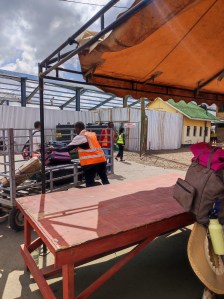
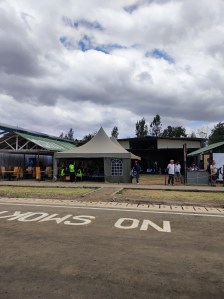
Lo and behold and I’m sure you aren’t shocked, but no purple suitcase for me. Godfrey ( the man from the plane) could see me looking confused and came to see if he could assist me. I explained that I didn’t see my luggage and not only that, but I didn’t see my name on a nice little placard which meant my driver from the hotel was waiting. He talked to one of the guys unloading the plane and he assured him that that was all the luggage that had been onboard. Godfrey told me to look again for my driver and he would find some airport personnel to help me find my luggage.
A bit more backstory, while I knew I would eventually be traveling to Loliondo and Bright English Medium School, I had discovered during my research a place that intrigued me. It was Maasai Eco Giraffe Lodge. Lydia from BEMS had told me that I would need to take a local bus for about 8 or 9 hours to reach the school. It appeared that the lodge was about at the halfway point. I contacted the lodge and indeed, the bus passed by, and I could get off and spend a few days there before heading to the school. They would arrange for a bus ticket to make sure I had a seat. That comment went right over my head, but I soon discovered why that was important, but more on the bus journey in a minute.
I’m still at the airport without luggage or a driver. It was recommended that I stay at the Natron Palace which is a hotel within walking distance of the bus station. Again, I needed to be at the bus station at 05:30 the next morning. At this point, I am about 34 hours into my journey since I left Bulgaria. I have not located my driver, but Godfrey has located someone to help me. I also need to add that the owner of the lodge had messaged me with the name and WhatsApp number of a contact to help me once I arrived in Arusha. He was going to accompany me to a mobile phone store so I could get a sim card for my phone and my portable router as there was limited Wi-Fi at the lodge and at the school. Godfrey then offered to call Nginina (my contact from the Lodge). Nginina told me to just stay put at the airport and he would come to get me as soon as possible. Godfrey also informed him that my luggage was still in Zanzibar and no more planes were arriving on the mainland until the next day around 09:00….remember, I have a bus to catch at 05:30. Nginina said don’t worry he would sort that out when he arrived. So, I thanked Godfrey and his wife and told them to please go ahead and leave, they didn’t need to stay with me until Nginina arrived. These beautiful people checked on me that evening and the next day to make sure everything was sorted out. I pulled up a chair and waited for Nginina. A bit about Nginina, he is from the Maasai tribe near the Giraffe Lodge. He works part-time for the lodge and is studying tourism at a university in Arusha.
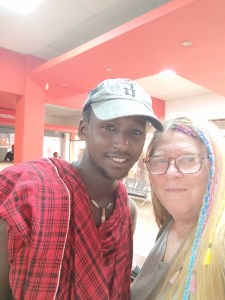
Nginina arrived about 30 minutes later with a driver. He spoke with the airport personnel and explained he would return to the airport the next day and retrieve the purple suitcase on my behalf. That’s all fine and dandy but I will be long gone by the time it arrives. He said don’t worry, there are always cars going that direction and I will make sure it gets sent to the lodge. All I could do was trust him as I had no other option. All I really wanted was a hot shower and a bed…but…we had things to do. The first stop he said was the phone store because they were closing soon. This is when I really discovered that cash is king. The phone store wouldn’t even take a card. While they were setting up my sim cards, Nginina escorted me to an ATM. It wasn’t that it wasn’t safe, it is just easier to have a local to get around. Cash in hand, that is as much as I could get at one time on my card. I knew I had to pay cash for the sim, but I still had to pay for the hotel, which luckily took a credit card and I also needed to buy at least a new shirt to be somewhat fresh to travel the next day. Sim taken care of, Nginina informed me the next stop was the bus station to get my ticket and so I would know where to go in the morning because he couldn’t accompany me. I’m also starting to realize there is not a lot of infrastructure here and the roads are mostly dirt or cinder. At the bus station, we discovered that my ticket had not been reserved, but luckily they had one seat available. The word seat is important. I paid 23,000 shillings and they gave me my ticket and the next stop was the hotel. I got settled in and thanked Nginina for his help and said goodbye. As much as I wanted a nice long hot shower, I decided it was best to go back out into the hot, dusty streets and buy a t-shirt. Mission accomplished.

Shower and then down to the restaurant in the hotel, I didn’t want to go out again, for a yummy bowl of carrot ginger soup and a gin and tonic. Then it was off to bed…lala salama (sleep safely in Swahili).

04:45 came quickly and soon I was off to the bus station with my backpack. Even though it was only about an 8-10 minute walk, I was thankful I didn’t have to drag my suitcase in the pitch dark down the dirt, stone-filled road.
So, the bus trip was an experience. I had to be at the bus station at 05:30. Now I understand why Nginina took me yesterday to make sure I had a ticket, or more importantly a seat. To say the bus was crowded is an understatement. Of course, I thought it was crowded before we even pulled out promptly at 6am.

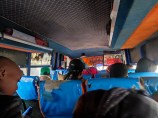


I was in the middle seat. On one side of the bus, there are three seats where we would normally expect two. The other side has two seats. I also learned that seat position is important. A lovely young lady was in the window seat next to me and explained the dynamics. Window seats from the middle forward are the best. The aisle seats on the entire bus are bad. Why you ask? Because as you stop in small villages, just when you think no one else can get on, 10 more people do. Which means they and their belongings are standing and piled up and down the aisle. Kids sitting on buckets, a lady with a live chicken in a box. I can’t even describe it and the pictures don’t tell the story. Sometimes we had to stop to let goats, sheep, or cattle cross the road.

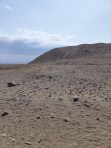

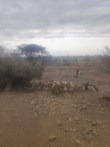
Next, the terrain is rocky and sandy. There is no real road. A few times the girl said, I hope we don’t get stuck in the sand and need to get out and push. There were also times it felt as if the bus could tip over. Despite the crowded, hot, dusty circumstances (I was covered in a light layer of dirt/sand when I got off the bus) most everyone is pleasant, and I got a lot of big smiles. The girl sitting by me said it doesn’t get more real than this. I think I even managed to catch a wink or two, of sleep that is.

The area we were traveling to is inside a national park, a protected area and there is a border gate. The girl told me they don’t make the people on the bus pay the park fee because they are usually traveling between villages, etc., and are residents. I knew that I would have to pay a park fee because I was staying at a lodge within the area which I figured was part of the cost of my stay. Of course, we go through the gate, and they pull the bus over. Someone got on the bus, walked to me, and said I needed to get off the bus. That in itself was a feat. I had to stand on my seat and then walk on the armrests of several seats until I could put my feet on the floor and climb out. Thank goodness I took my backpack with me because it was people from the lodge picking me up so I wouldn’t need to go to the next bus stop for them to get me. Again I was thankful I didn’t have that purple suitcase to deal with. I had to pay the “local government” fee of $35 in Tanzanian shilling. I also had to pay a lodging fee of $25 per day and I didn’t have enough cash because I thought it was paid at the lodge. All the fees are in cash. The gentleman was very kind and said he would come to the lodge later with a credit card machine and I could pay then.

Anyway, at least my life isn’t boring. I made it to the lodge in a little motorized vehicle with Joel and Timan. Timan would be my Maasai guide for my entire stay at the lodge. I was just happy to get to my home for the next 3 nights. That’s my story of how I arrived at the lodge. My stay at the lodge was every bit as interesting and will be the next chapter. Seeing the Baobab trees along the way was awesome. Not to mention glancing out the window and seeing zebras and giraffes roaming freely.

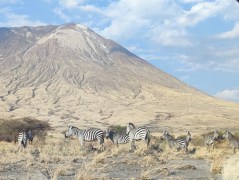
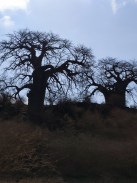

Part 2 – My Stay at Maasai Eco Giraffe Lodge next…





 Down the Rabbit Hole