Bali ~ Island of the Gods ~ A Brief Journey into Balinese Hinduism, Part 3 The Ngaben Ceremony

Bali ~ Island of the Gods ~ A Brief Journey into Balinese Hinduism, Part 3 The Ngaben Ceremony

“The body is only an encasing for the soul which is eternal”.

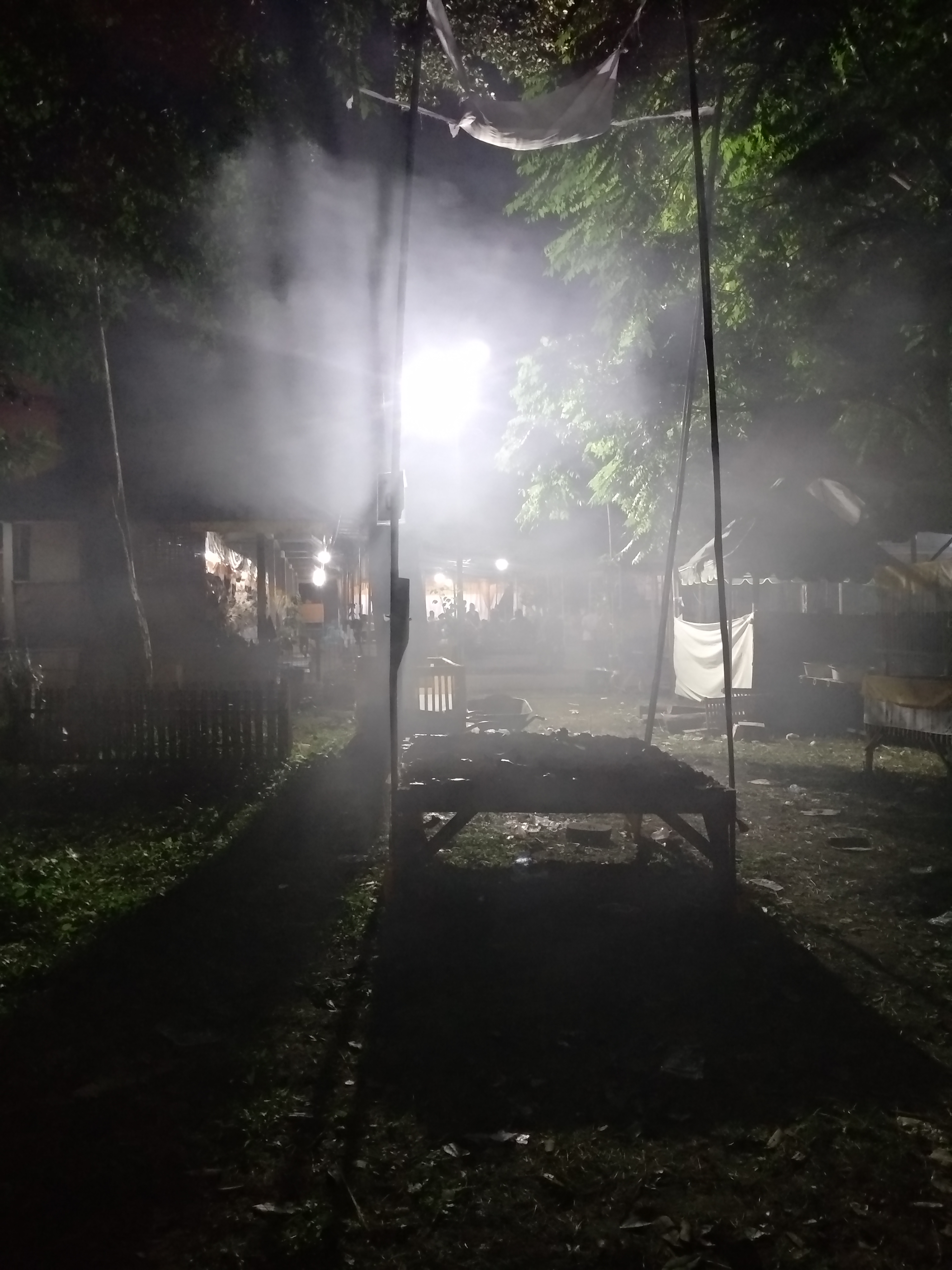
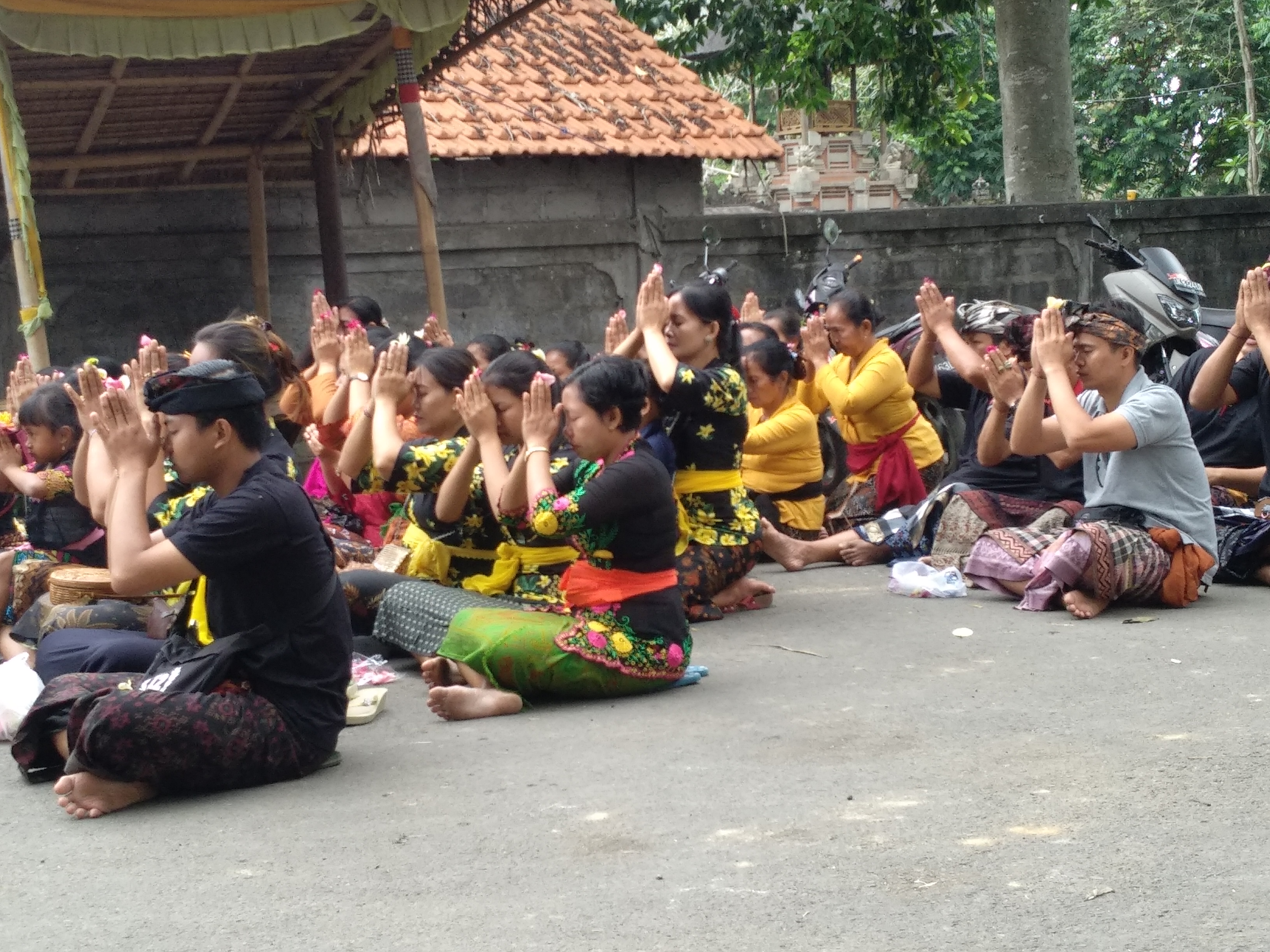
2:30 am……my alarm sounds…..darkness surrounds me and I listen to the night sounds. I let my mind drift to the Kuburan or cremation grounds. I am about to participate in the “awakening of the dead” or ngagah.  We will be exhuming the body of Ketut’s mother to prepare it for the Ngaben or cremation ceremony. In Balinese, ngaben means turn to ash. I do nothing for several minutes but allow myself to reflect on the lives and deaths in my own life. Next, I do my best to properly attire myself in my kamen, kebaya and anteng and then make my way downstairs to wait for Koming and Ketut.

IMG_20180816_044127_HHT.jpg
Exhuming the body.

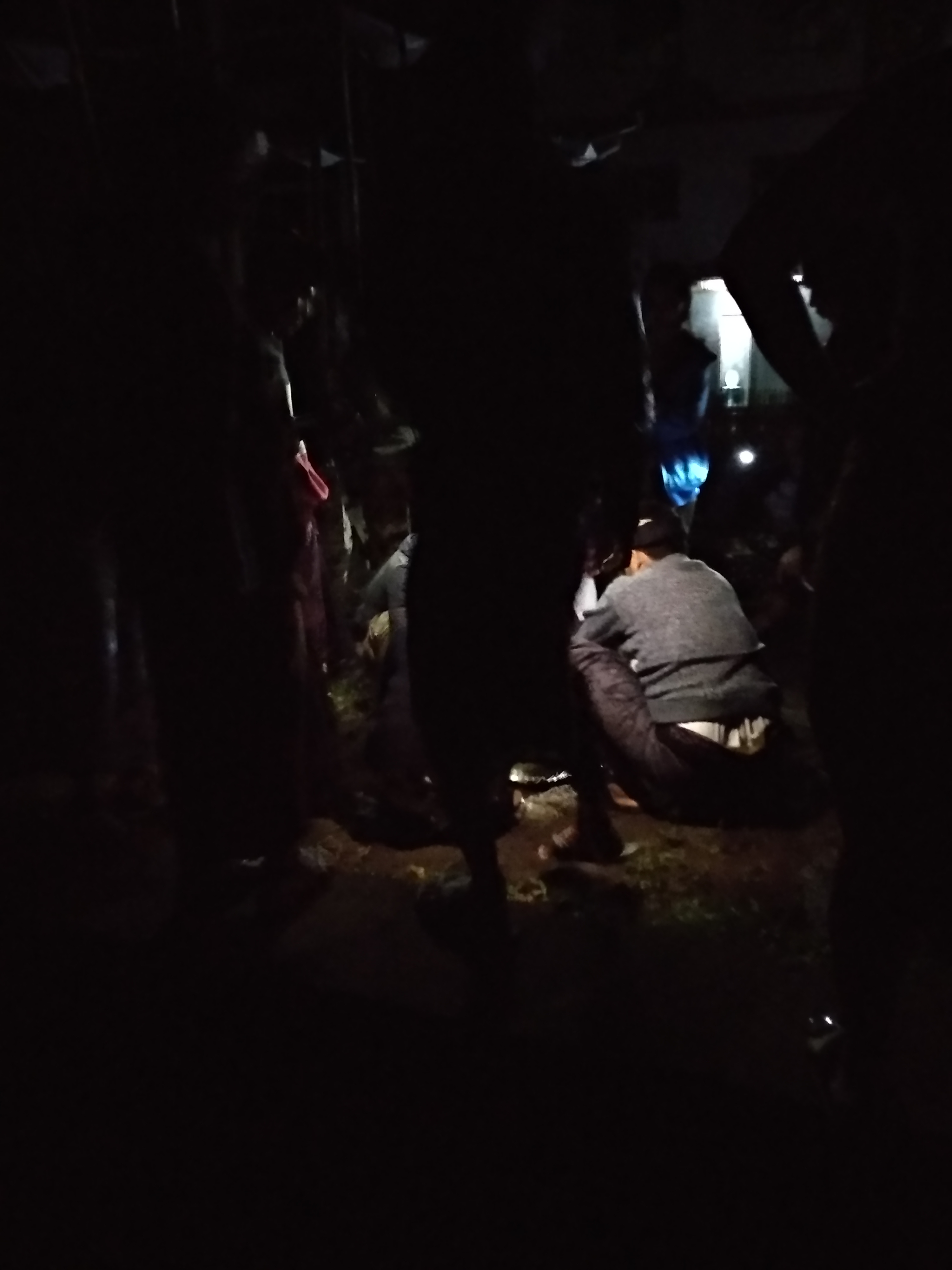
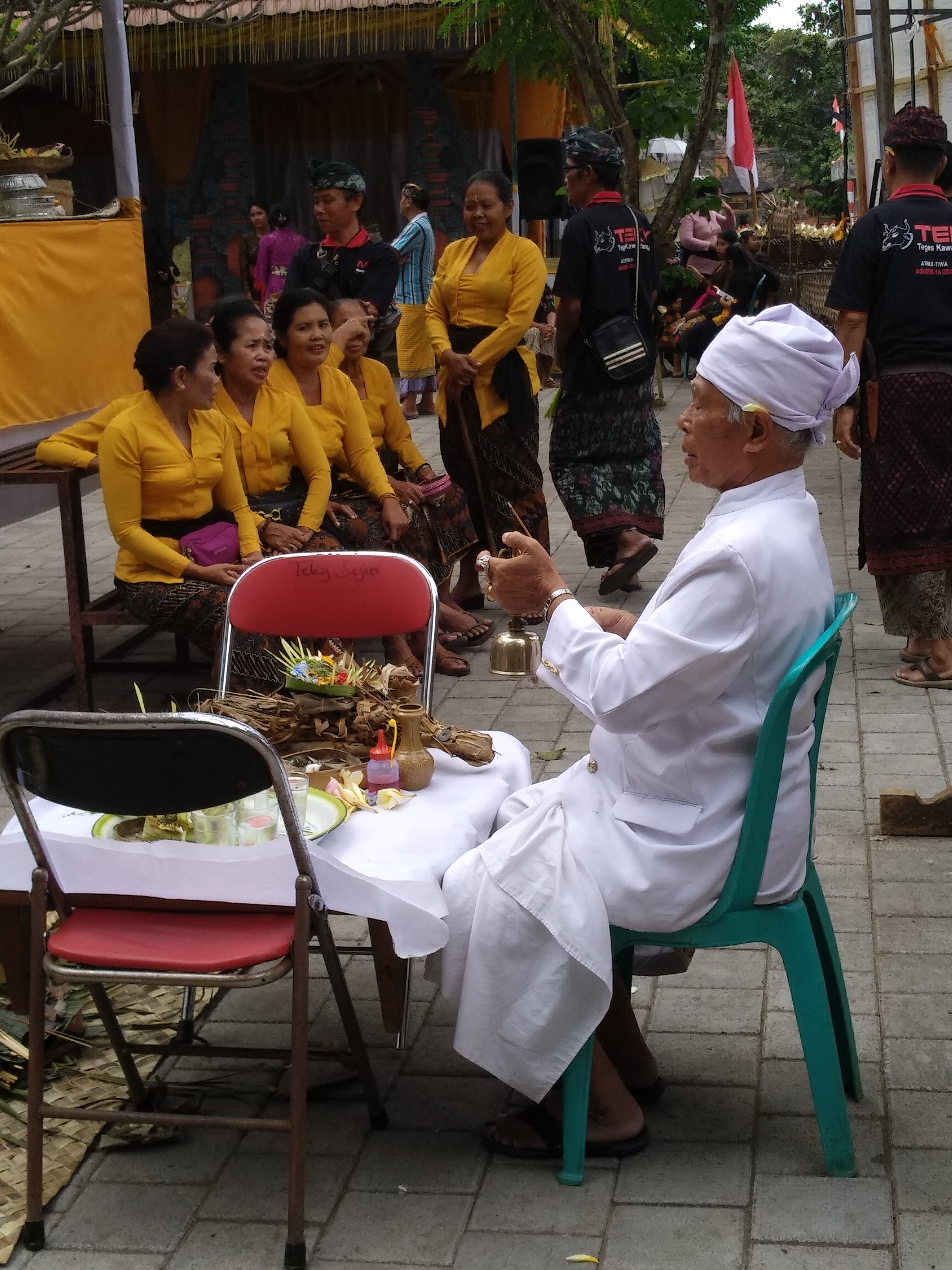
It’s a crisp, clear August night/morning as I travel to the Kuburan on the back of Ketut’s motorcycle.  We arrive at the Peyadnyan and I make my way to the Petak.  Family members are preparing the tools and supplies needed for exhuming and then cleansing the body/remains.  I follow the family to the Kuburan where some members of the family have already begun the exhumation process.  A solemnness hangs in the cool night air as young and old look on. No one is openly mourning as even this, “the awakening of the dead”, is the beginning of a celebration; a celebration of life.  A time to celebrate helping the soul of the deceased move on from their previous life.  Koming’s flashlight goes out, so I use the light on my phone to assist the young men digging at the gravesite.  A yell of joy comes from in front of me.  They have reached the body.  Some of the men now drop their tools and pull the dirt away with their hands until a once white sheet is lifted from the grave.  I brace myself as this is the first time I have seen a body that has been exhumed.

Screenshot_2018-09-25-18-24-05-355_com-1.duokan.reader.png
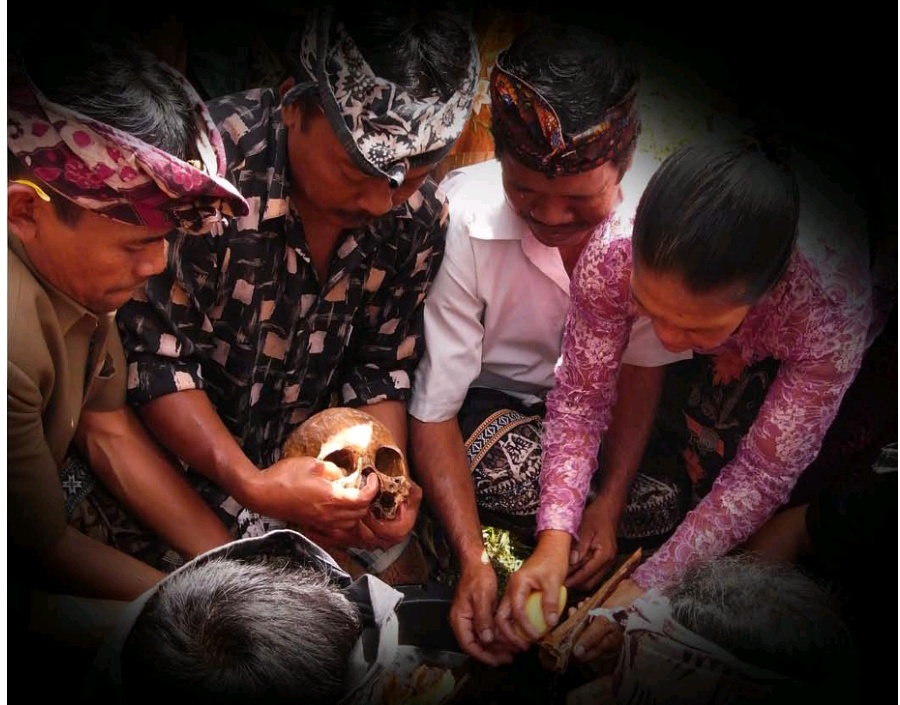
Photo Credit to Elemental Productions.  Out of respect for the family, I did not photograph Ketut’s mother’s remains.  This is an unrelated exhumation.

First, I see the skull, then a torso still wrapped in funeral cloth and finally smaller bones of arms, legs, hands, and feet are added to the pile.  Water, water with flowers and coconut water are used as we wash the “body”.  The torso is placed on a fresh white sheet and the skull and other bones are placed as if a whole body.  It is a sight I will never forget, forever etched into my mind’s eye. It was not a morbid sight. The way the remains were so gently cleansed and lovingly cared for touched my soul.  Today, after all, is about the soul which will first be purified by fire which represents earth. Tomorrow it will be purified by water so it may return to heaven.  After the cleansed remains are wrapped in the white sheet, they are then placed and wrapped on a rattan mat, wrapped and moved to the burning area.  Before the grave is re-filled with dirt a pengiber iber or chicken representing the happiness of the Ngaben is released as we say masuryak or horray.  In the old tradition, the chicken was released into the grave and buried. New traditions allow the pengiber iber to be released free outside of the grave although it still represents replacing one soul with another.

IMG_20180816_050104-2.jpg

IMG_20180816_052519.jpg


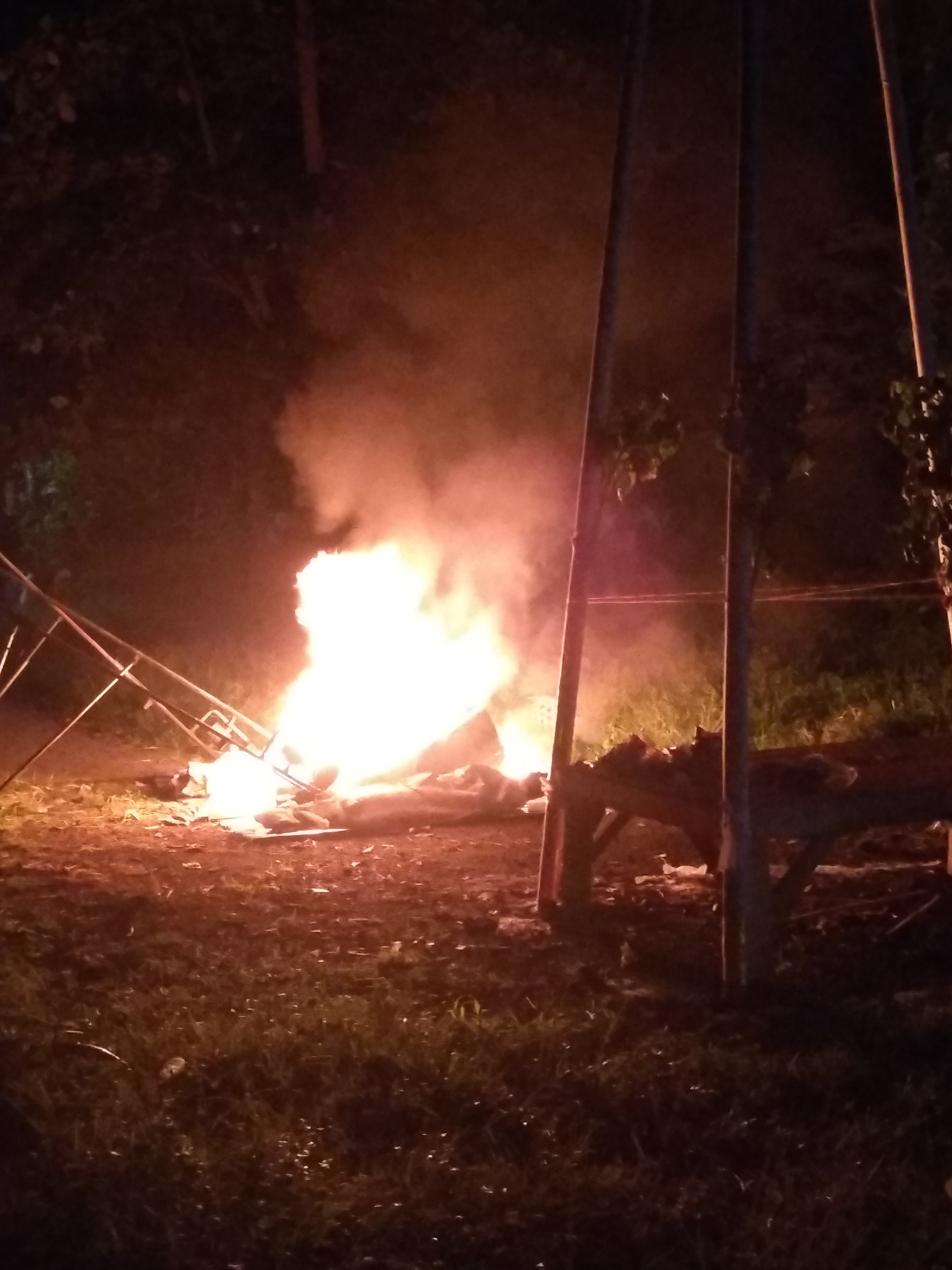
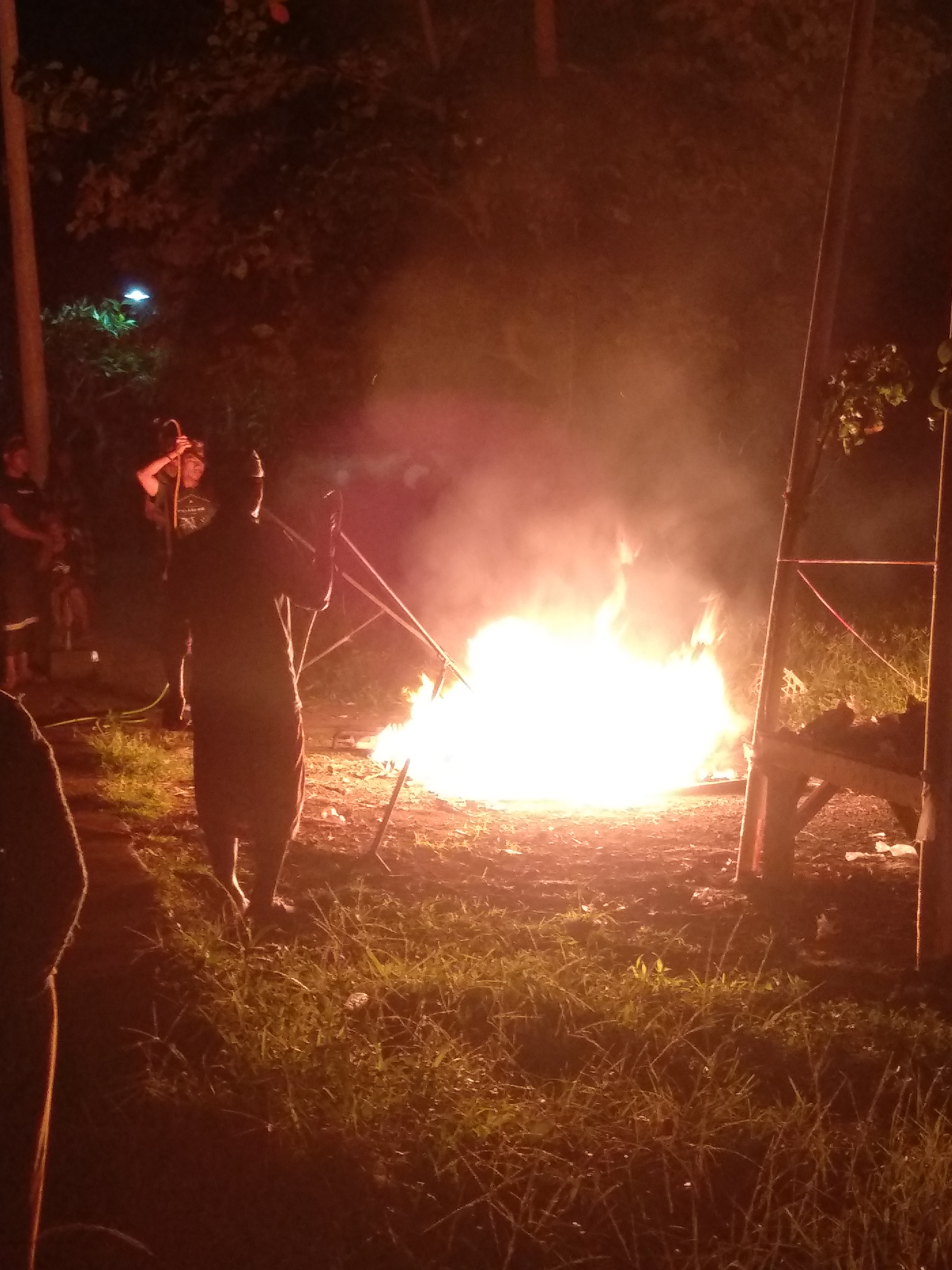
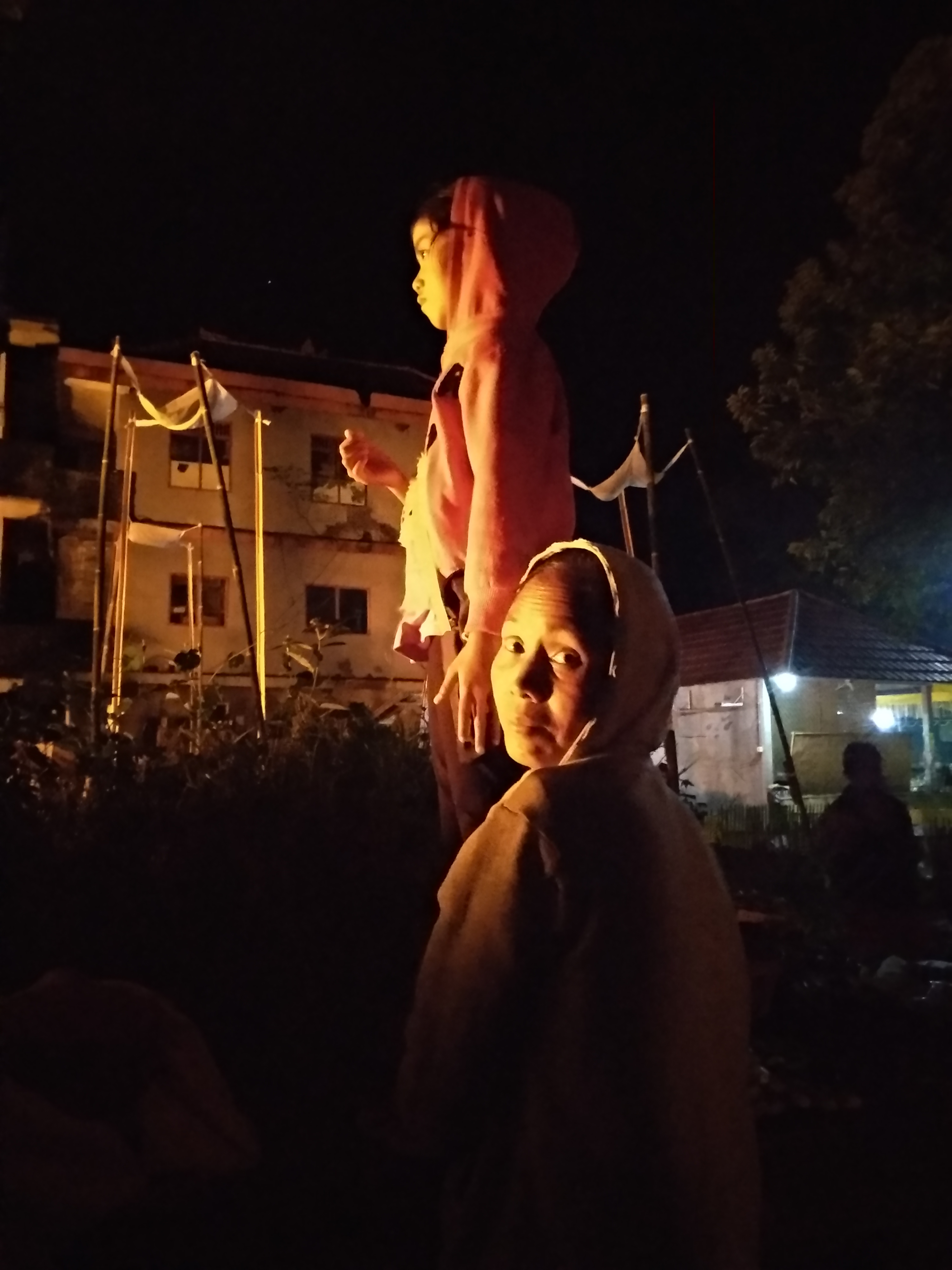
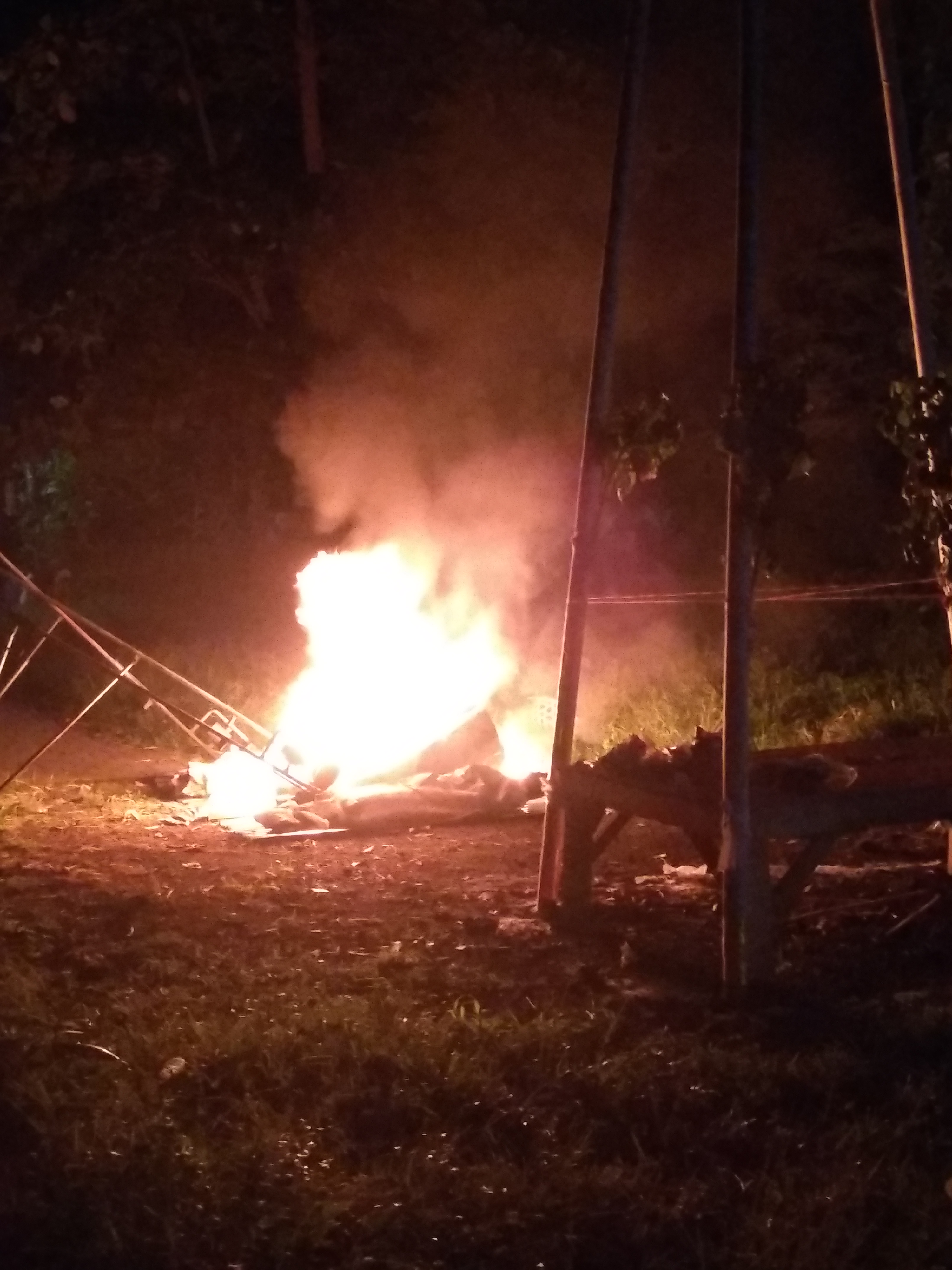
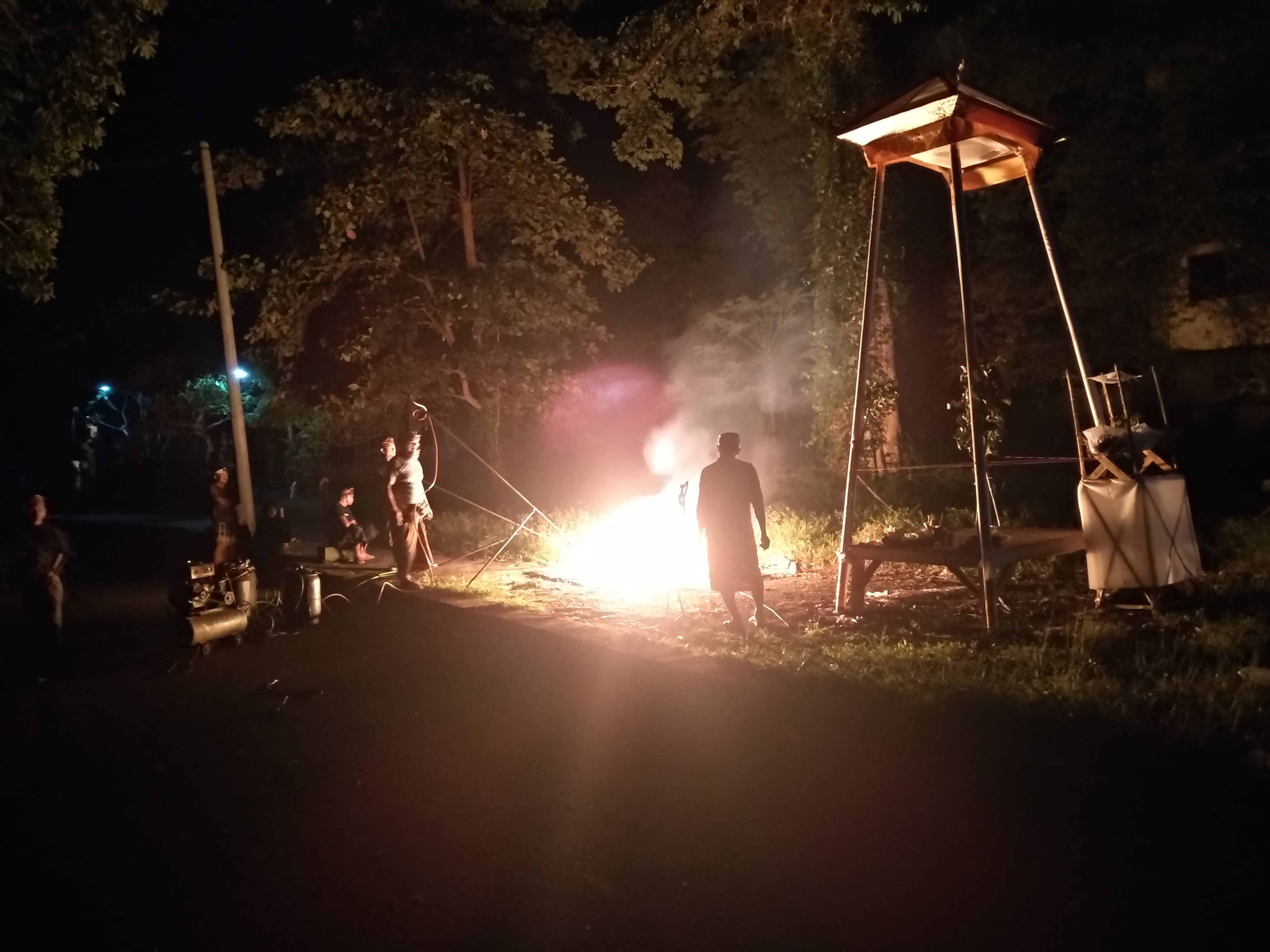
Around me, more shouts of masuryak went up. Soon all the remains of the 18 souls were in the burning area.  Time for the Ngaben to begin…..the “turning to ash”. As the community looked on, the black of the night took on an orange glow.  I looked around at the faces of those watching friends and loved ones’ physical body beginning the journey to return to the panca maha bhuta or 5 elements; pertiwi, apah, teja, bayu and akasa (earth, water, fire, air, and ether).  Pensive faces lit in the glow of the fire, young children looking on with wondering eyes, me filled with emotions, questions, and a sense of peace.

IMG_20180816_050647_HHT-1.jpg

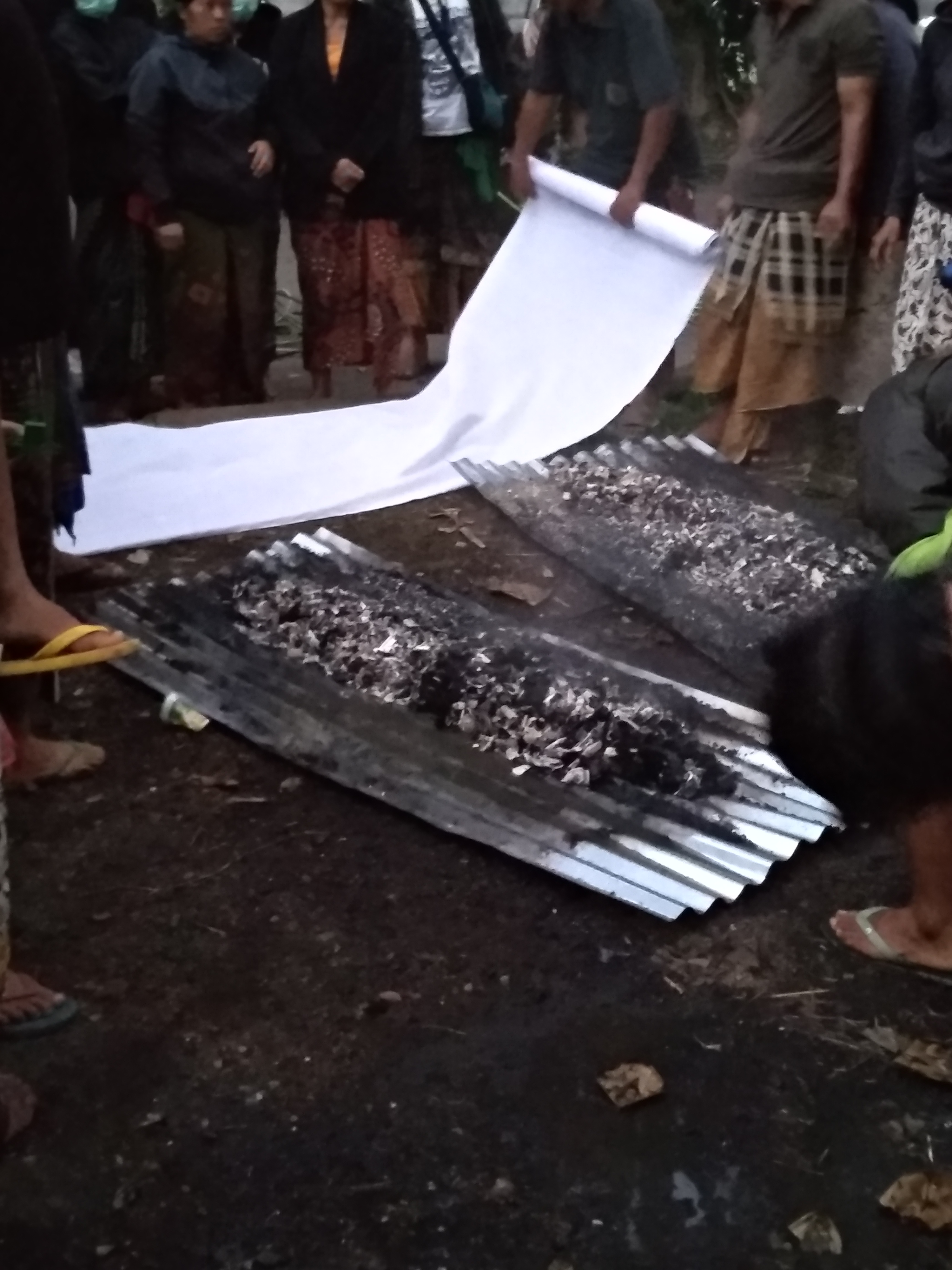
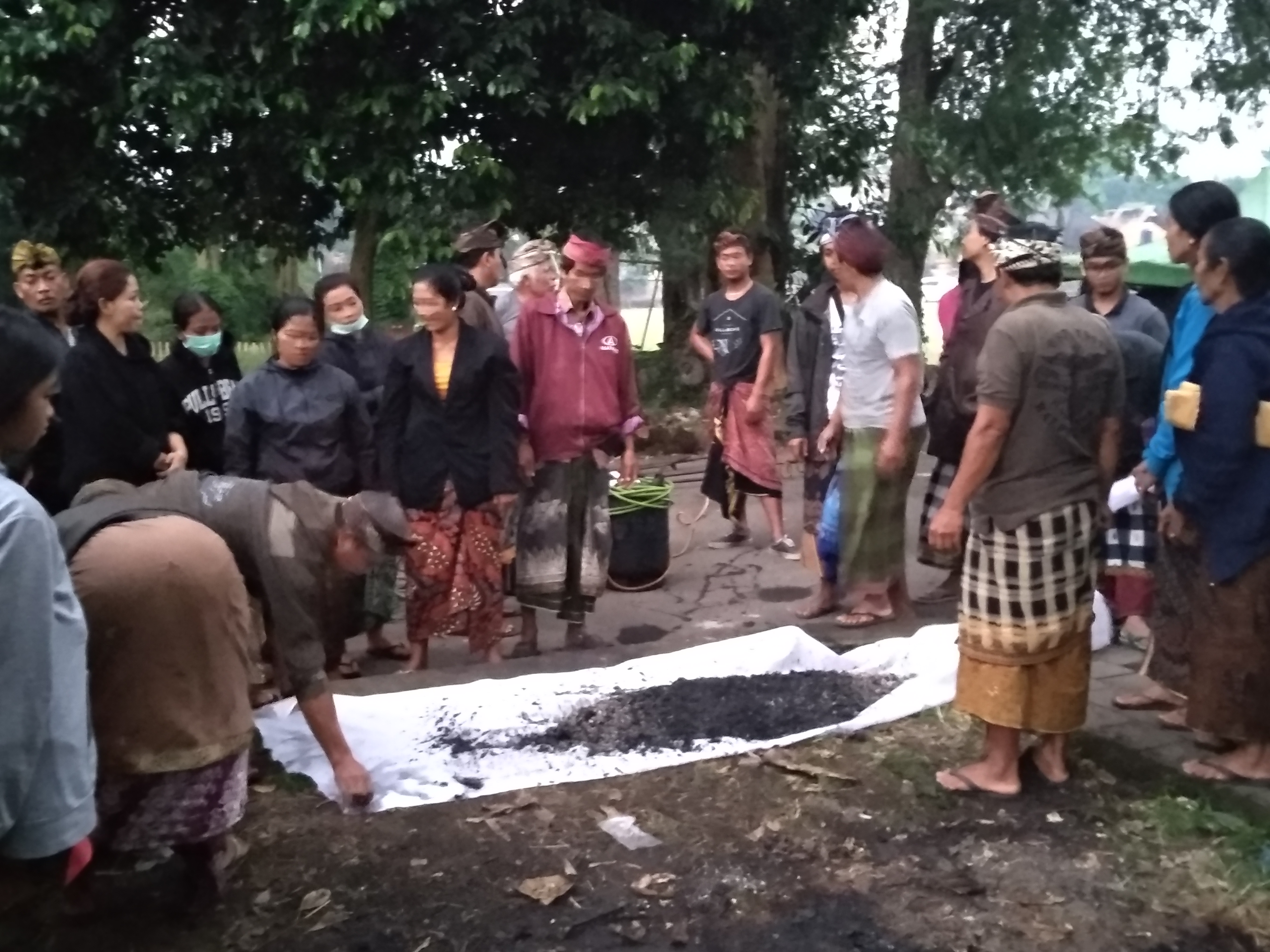
We all stood quietly in the still of the morning and as the glowing embers were dying, the sun made its dramatic entrance.  Next, the ashes were gathered and placed on white sheets.  They would later be distributed to the families for the next steps in the ceremony.

IMG_20180816_061723_HHT.jpgIMG_20180816_052333_HHT.jpg

IMG_20180816_062012_HHT.jpg

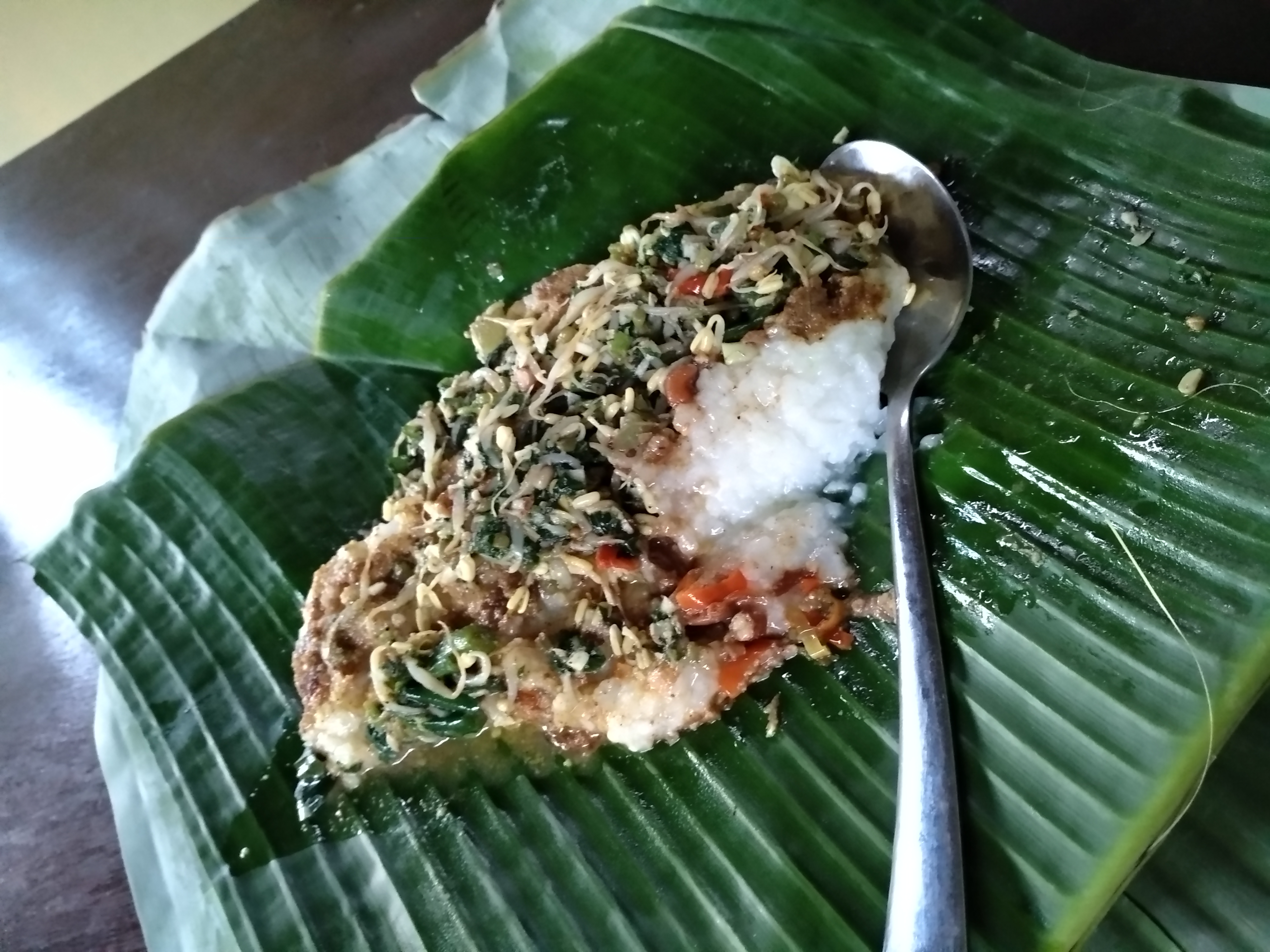
Koming informed me we were finished for now.  I could join her at the market and then we would go home to have breakfast, shower and prepare for the next activities.  After the market, we stopped by a street vendor to get breakfast.  We picked up bubuh to take back to Kenari House. Bubuh is made with a rice congee base with various toppings added. It can be made spicy or not and is served in a banana leaf.   Tear off a piece of the leaf and make yourself a spoon if eating on the go. After breakfast, we showered and changed and headed back to the Kuburan.


IMG_20180816_070559_HHT.jpg
bubuh


IMG_20180816_091017-1.jpg


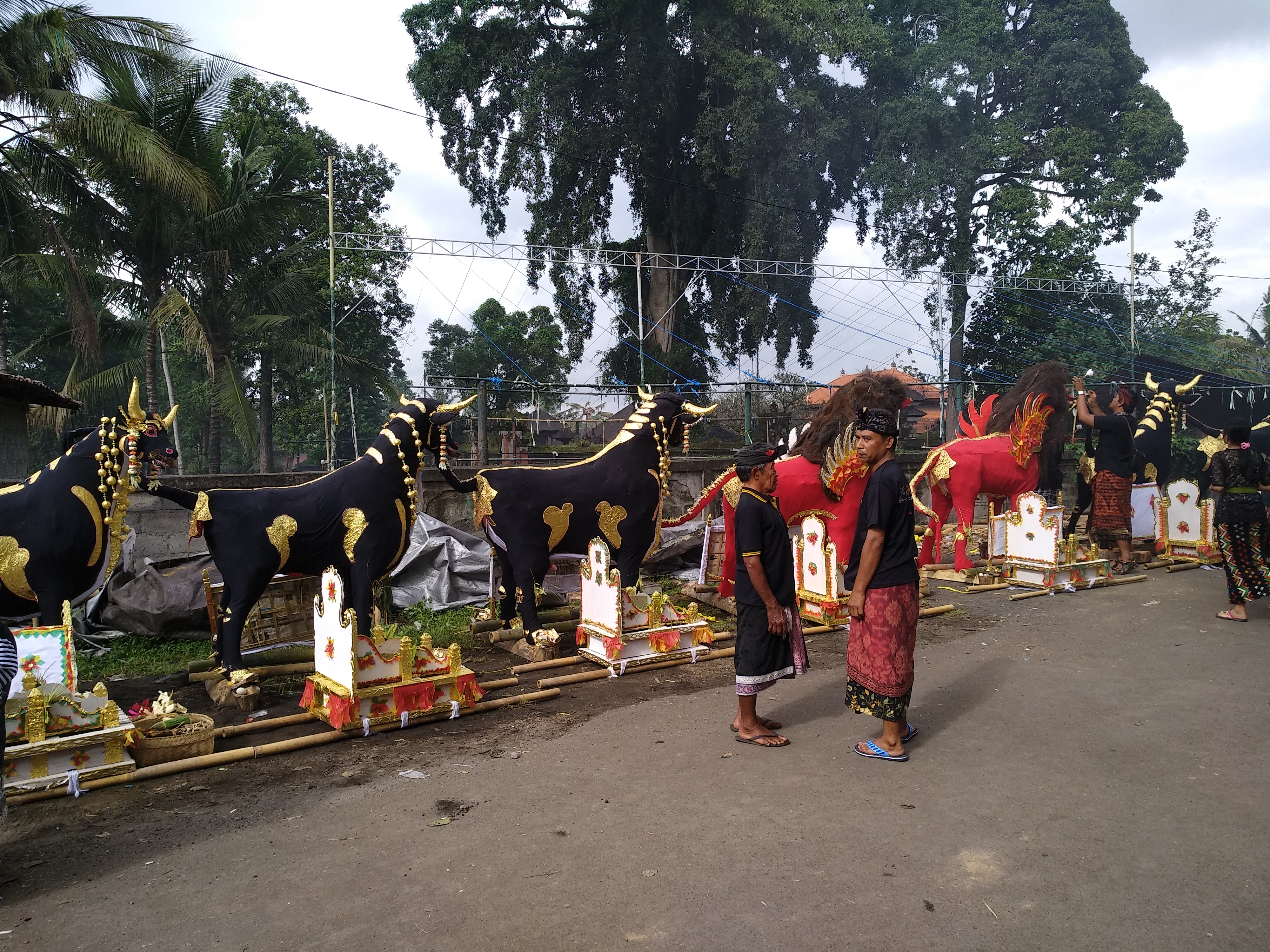
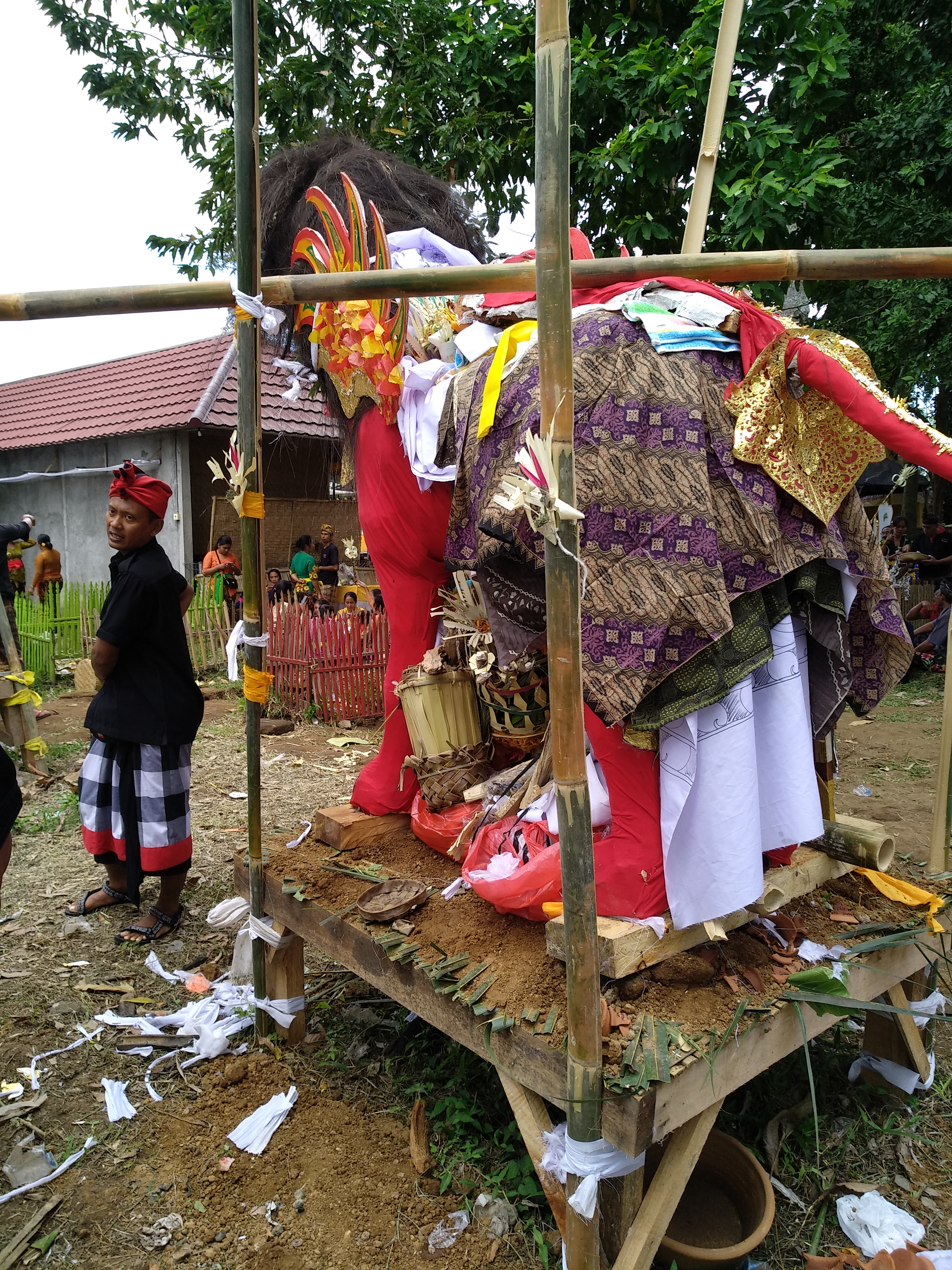
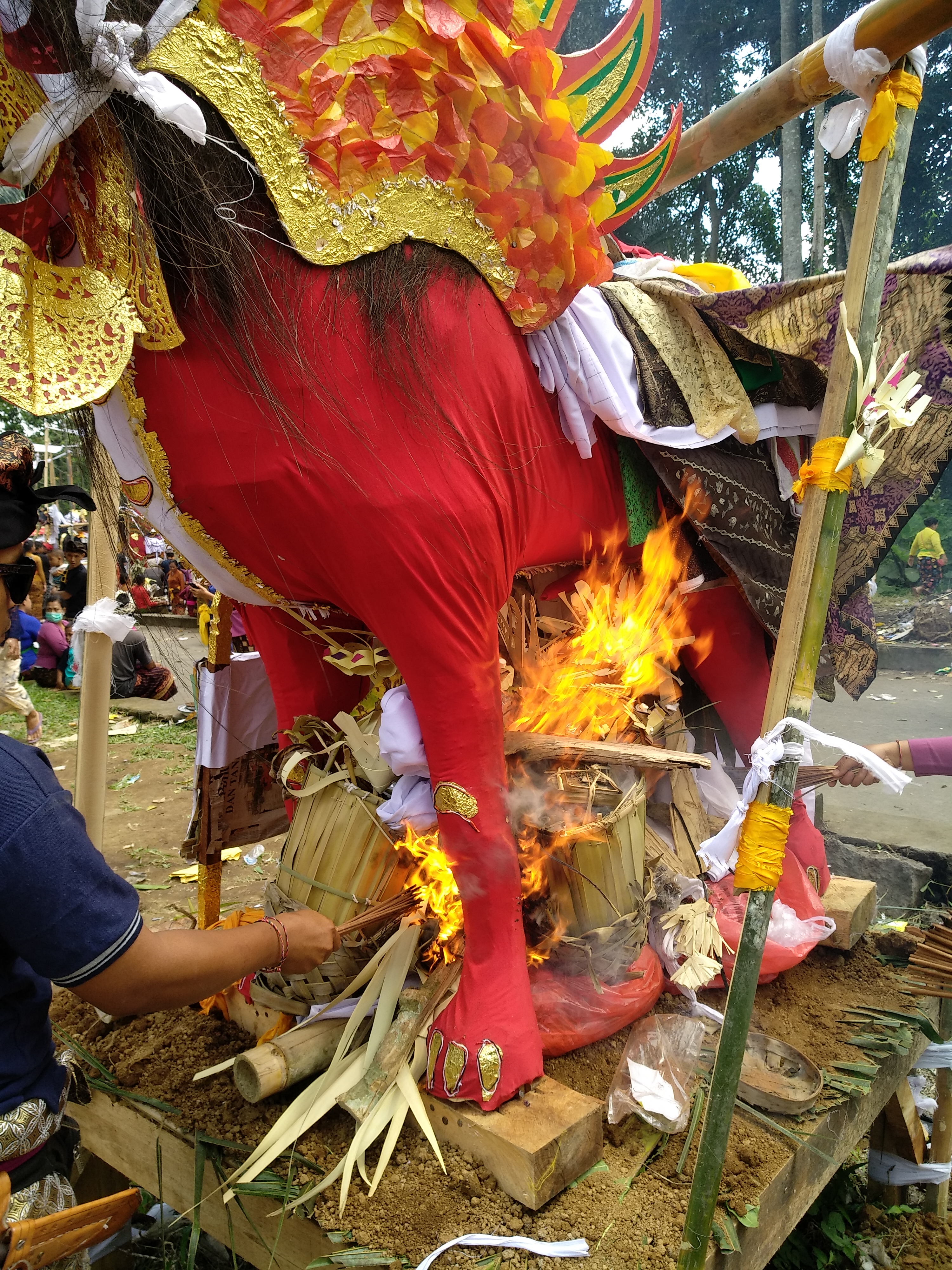
Upon returning to the ceremony grounds the sarcophagi were uncovered and ready for the next part of the ceremony.  A sarcophagus could be a lembu or bull or a singa mangaraja, a lion with wings.  The animals would be taken to the community of the deceased in celebration and then returned to the cremation grounds and placed on the wadah or structure for burning.


IMG_20180816_103143-1.jpg

IMG_20180816_101656.jpg

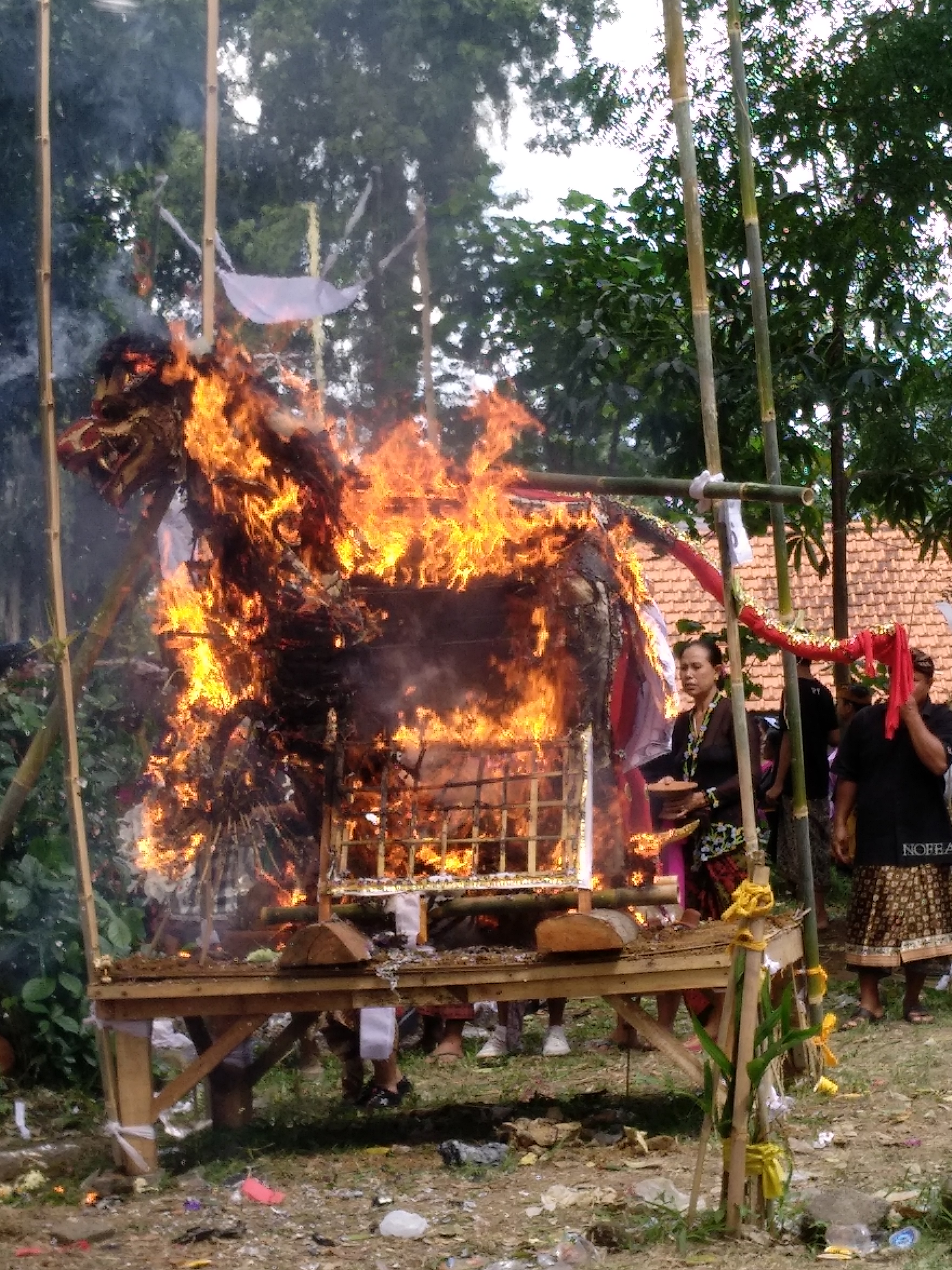
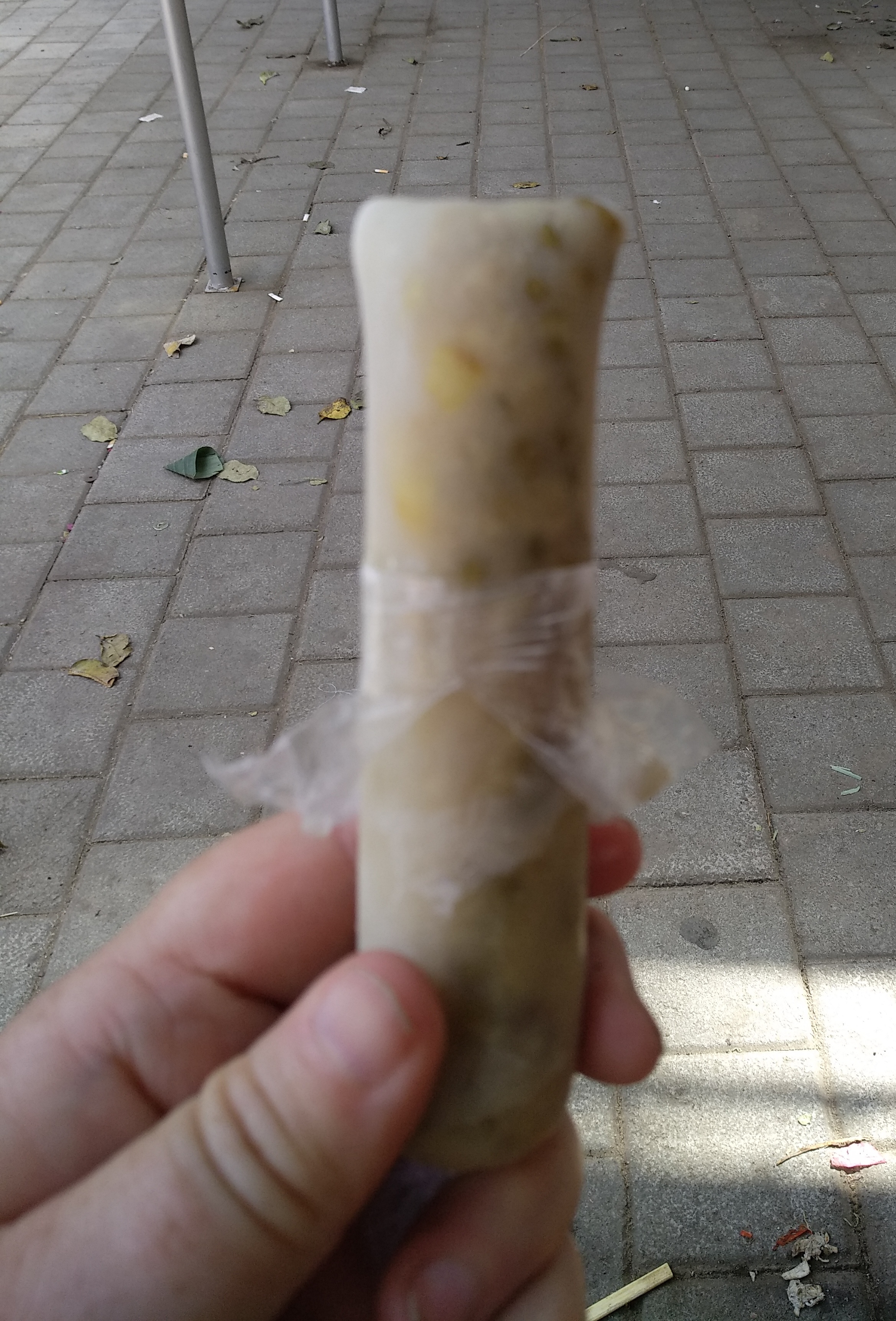
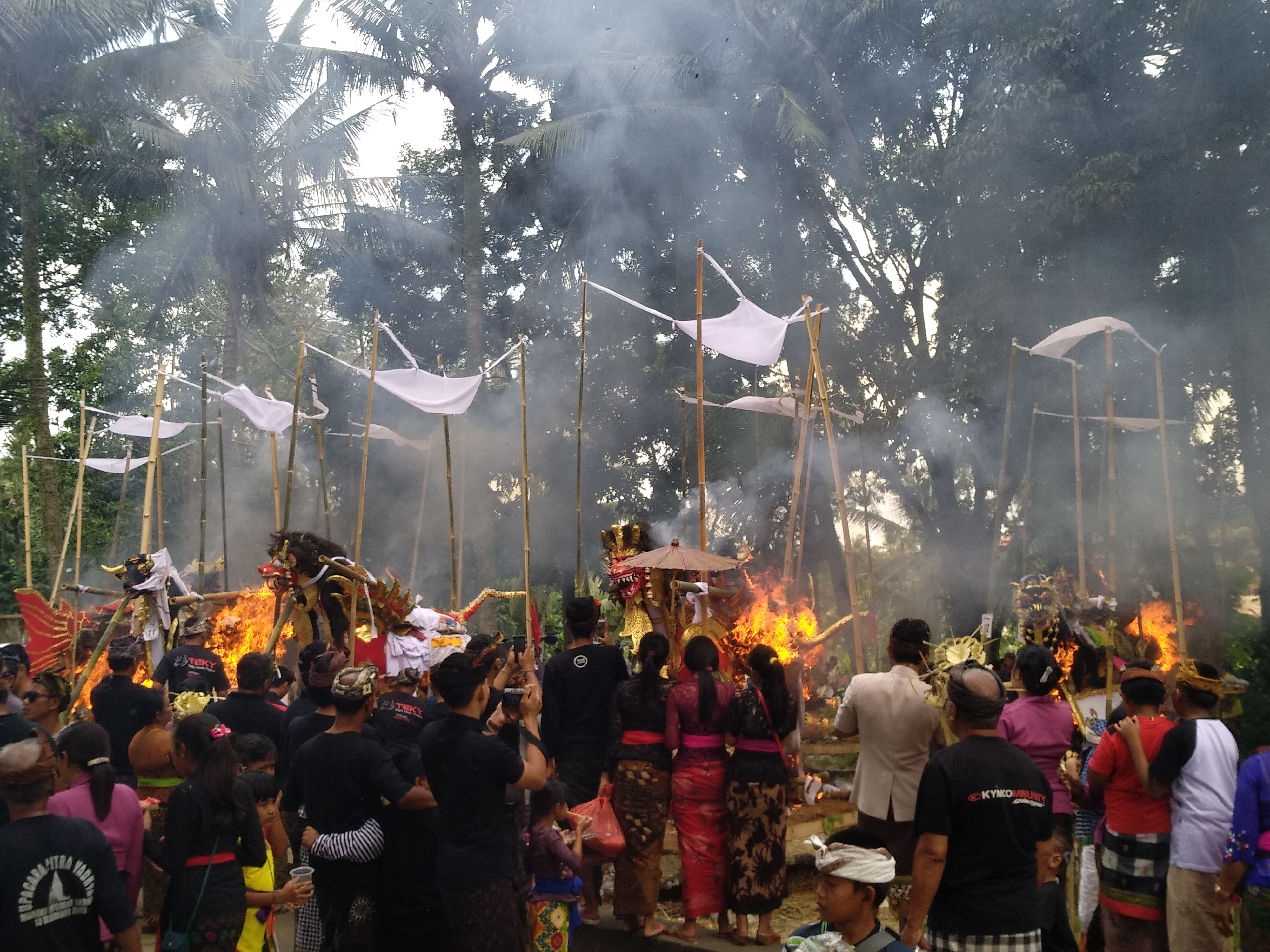
Before the start of this part of the ceremony, there was a short service blessing the sarcophagi/animals.  As the animals were taken to the respective communities/compounds, I sat near the petak and watched and listened.  Friends and families, visiting, laughing and celebrating.  The gamelan played.  Soon, the sarcophaguses were making their way back.  They were taken to the Kuburan and placed on wadahs.  The family now filled the animals with items needed in the next life.  Once prepared, the priest checked and blessed with holy water.  The family gathered around with more offerings and circled the sarcophagus.  Finally, Ketut and Koming using incense sticks, lit the animal on fire.  Again, we all watched as flames engulfed the sarcophagus.  As the flames died down, we went back to the petak, had a lunch of nasi campur and satay followed by a frozen bean curd pop called es lilin.

IMG_20180816_131540-1.jpg


IMG_20180816_133622.jpg


IMG_20180816_133807.jpg


IMG_20180816_134013-1.jpg

IMG_20180925_180126.jpg
Enter a caption


IMG_20180816_134047.jpg


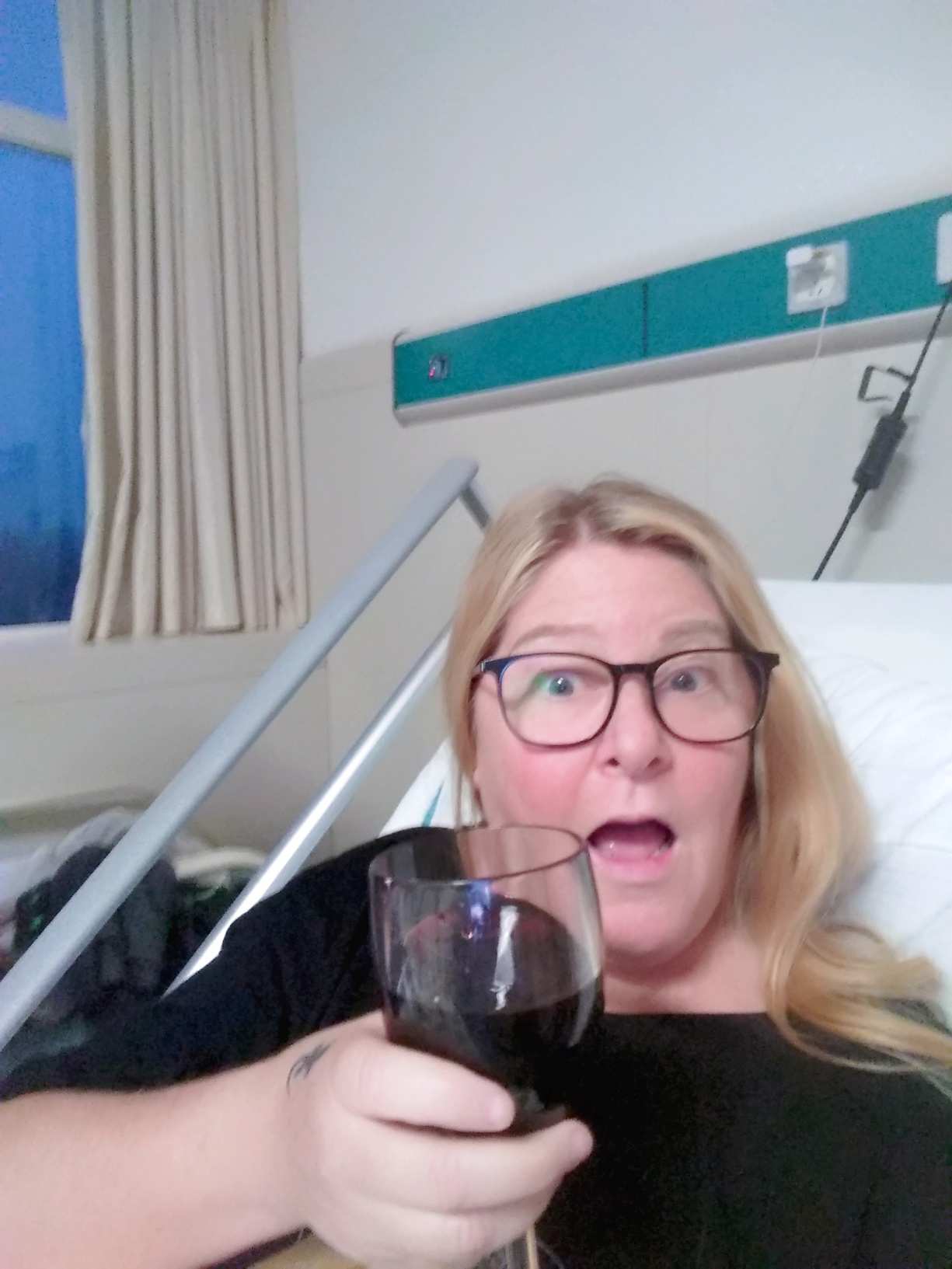
Around 3 pm, after what had been a long and emotional day, Koming said we were finished and I could return to Kenari House.  She wasn’t able to take me, so I took a leisurely stroll home where I enjoyed a glass of rose’ on my patio and thought about all I had experienced in this circle of life.

Next post-Nyekah and Nganyut

Ashes to ashes….dust to dust!


Bali ~ Island of the Gods A Brief Journey in Balinese Hinduism, Part 2 Ngening Ceremony

Bali ~ Island of the Gods                                  A Brief Journey in Balinese Hinduism, Part 2 Ngening Ceremony

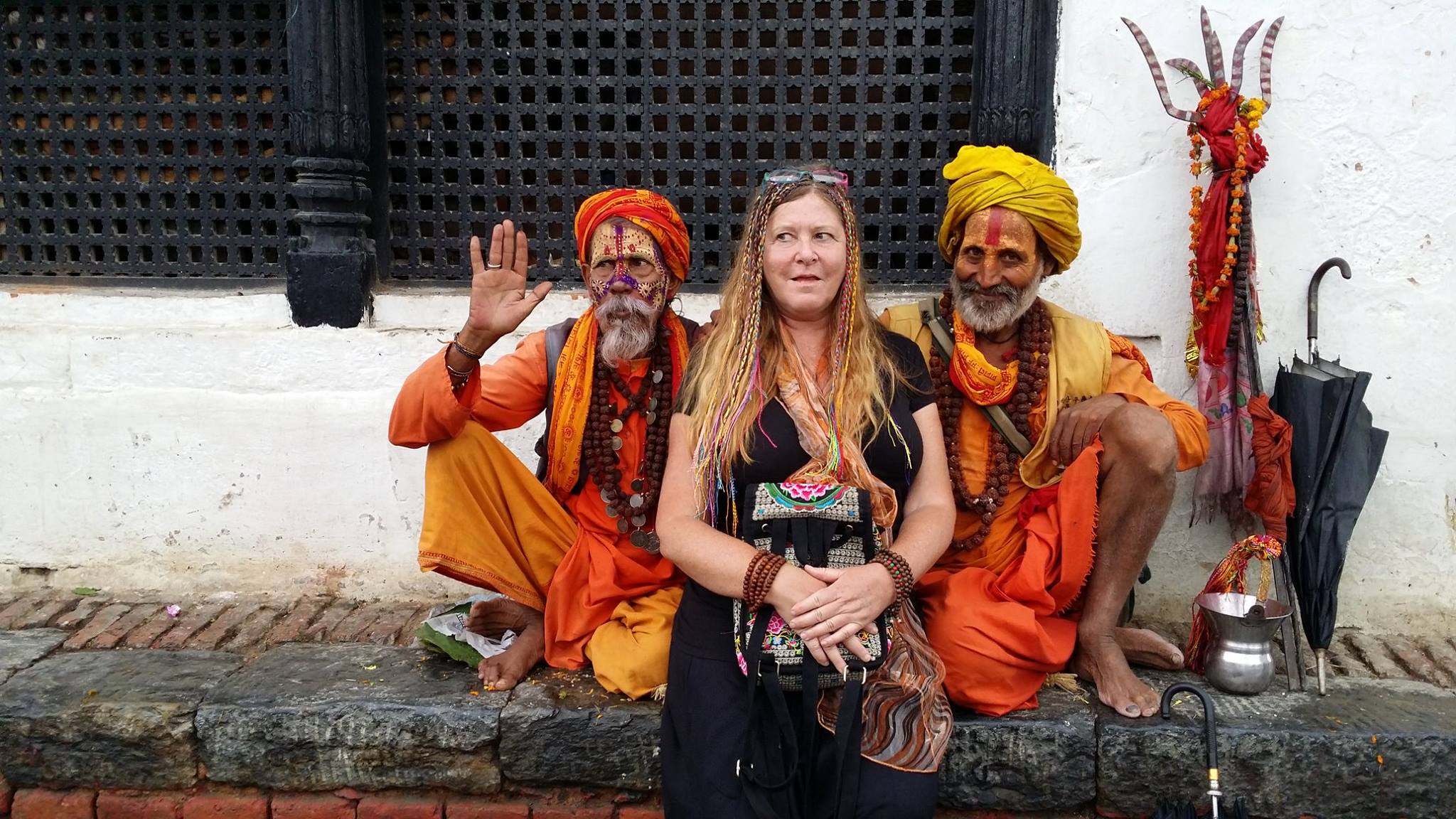
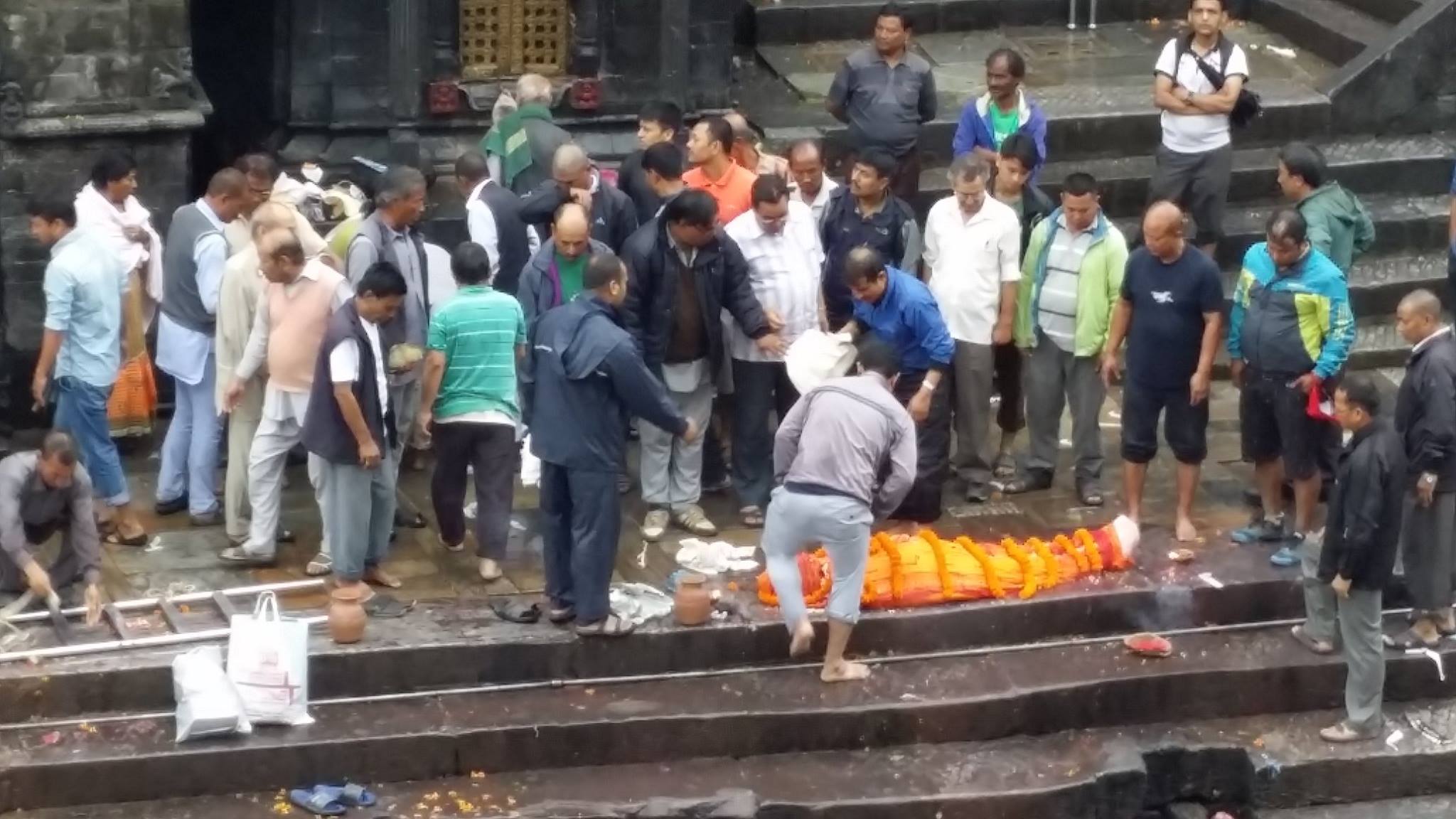
I attended my first cremation in June of 2016 in Kathmandu, Nepal.  Although also Hindu, it was somewhat different from my experience with the Balinese Cremation.  It was here that I met a couple of Sadhus or wandering yogis.  I was able to take a photo, but for a price.

13735034_10208404647728393_8375794384976263656_o
Sadhus in Kathmandu

I was never pressured on Bali for money for taking a photo.  In Kathmandu, the body being cremated was recently deceased. Whereas on Bali, Ketut’s mother had died 2 years prior and had to exhumed.  The time factor is because the extensive cremation ceremonies on Bali are expensive and go on for several days.  Therefore, once every three years, the entire Banjar or community comes together for one mass cremation or Masal which saves money for the all the families involved.  Both ceremonies prepare the body or remains for cremation which includes cleansing, dressing, and wrapping.  Many flowers are used during this portion of the process.

13668929_10208404692209505_9173116211190525954_o
Preparing the body in Kathmandu
13708316_10208404600967224_5587404149969062495_o
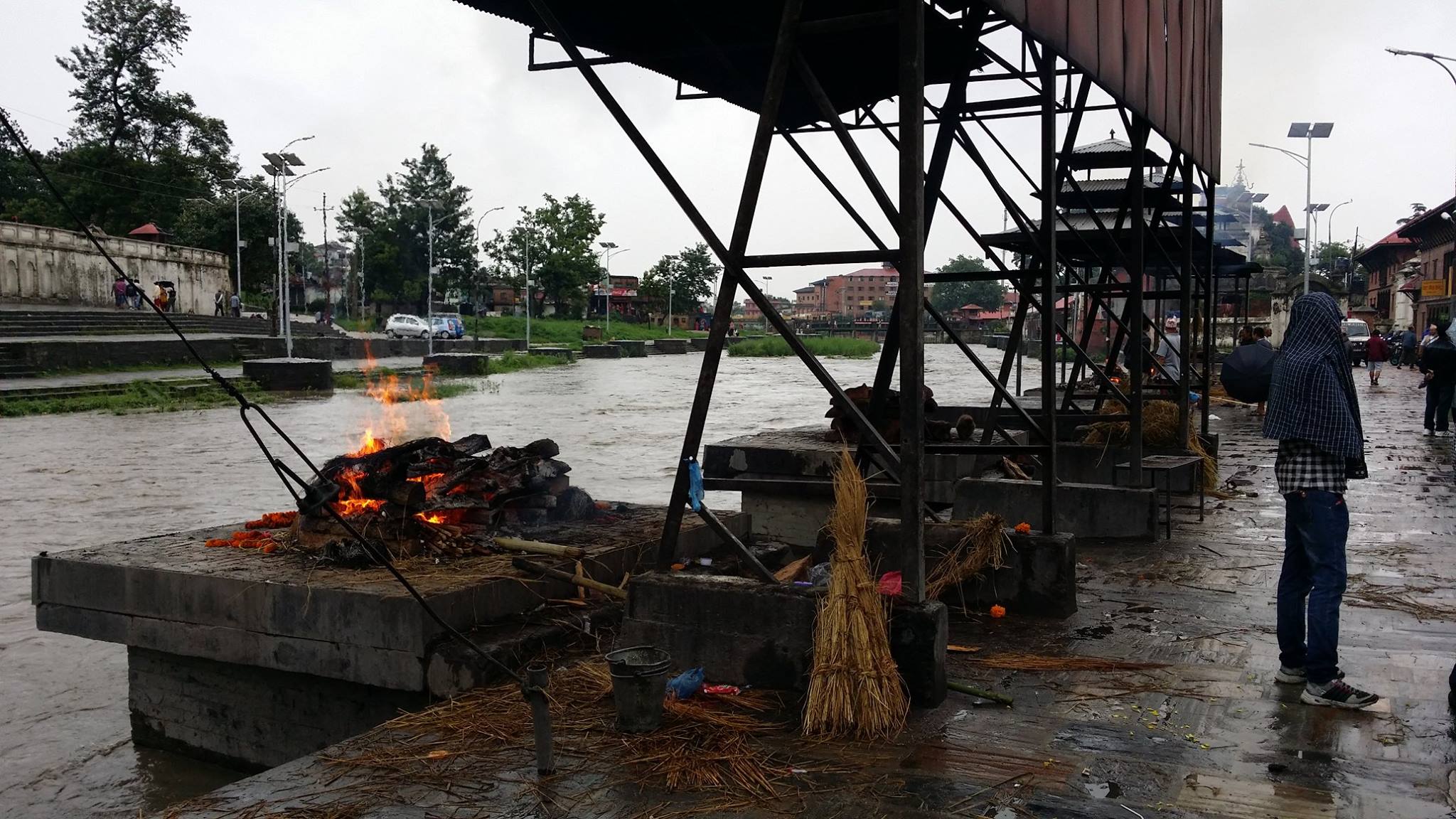
Funeral Pyre in Kathmandu


In Kathmandu, after the body is prepared it is moved to Funeral Pyres of the banks of the sacred river Bagmati which later meets the holy river Ganges and set on fire.  After the cremation, the ashes are sent off down the river. I did not have the opportunity to learn as much about the cremation in Kathmandu as I did in Bali.  My experience with the Balinese was that there are specific parts to the cremation ceremony, of which the Ngaben is just one.  These ceremonies take place over many days.  I will begin with the Ngening Ceremony which is the first part I attended.

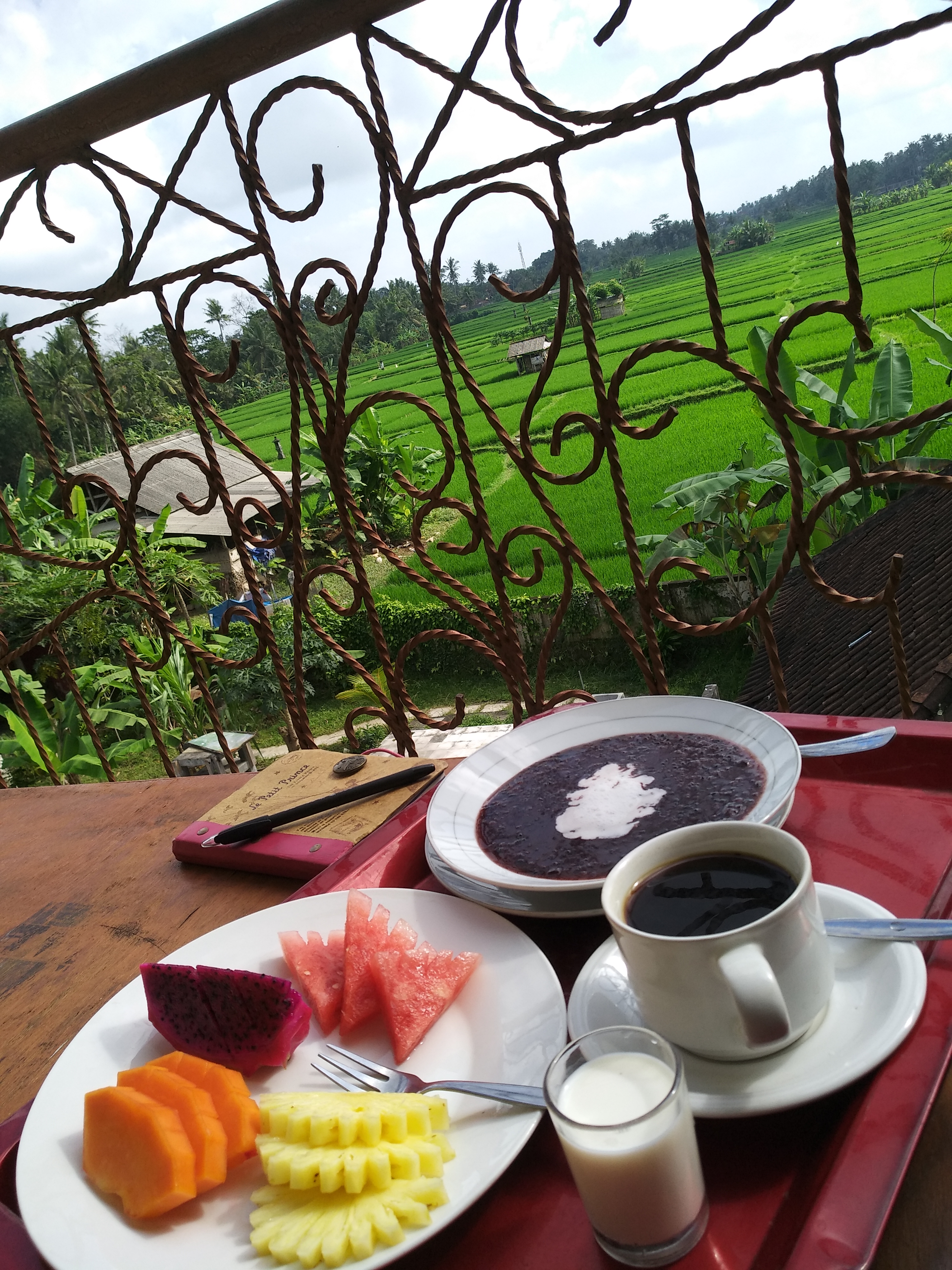
I arrived on Bali late Monday evening August 13th.  Planning on attending the Ngaben (cremation) Ceremony on the 16th, I woke up at a leisurely pace on Tuesday. I enjoyed a breakfast of bubur injin (black rice pudding with coconut milk), fresh fruit and Balinese coffee.

IMG_20180814_093354.jpg
My bubur injin

It was a beautiful morning on my balcony followed by a walk into Ubud.  After a trip to the supermarket, I returned late afternoon and enjoyed a G&T with some cheese and crackers again on my balcony.  Upon ordering Ayam Panggang (chicken and vegetables with red curry sauce) for dinner, I discovered the ceremony was not just one day.  Koming asked what I was doing Wednesday.  I told her I had no specific plans.  She suggested I go to the Ngening Ceremony with the family.  I questioned the Ngening Ceremony as I thought the ceremony was on Thursday.  She explained that that before the Ngaben Ceremony which is the actual burning, we had to collect the Holy Water or Tirta for use in the cremation and this ceremony is called Ngening.

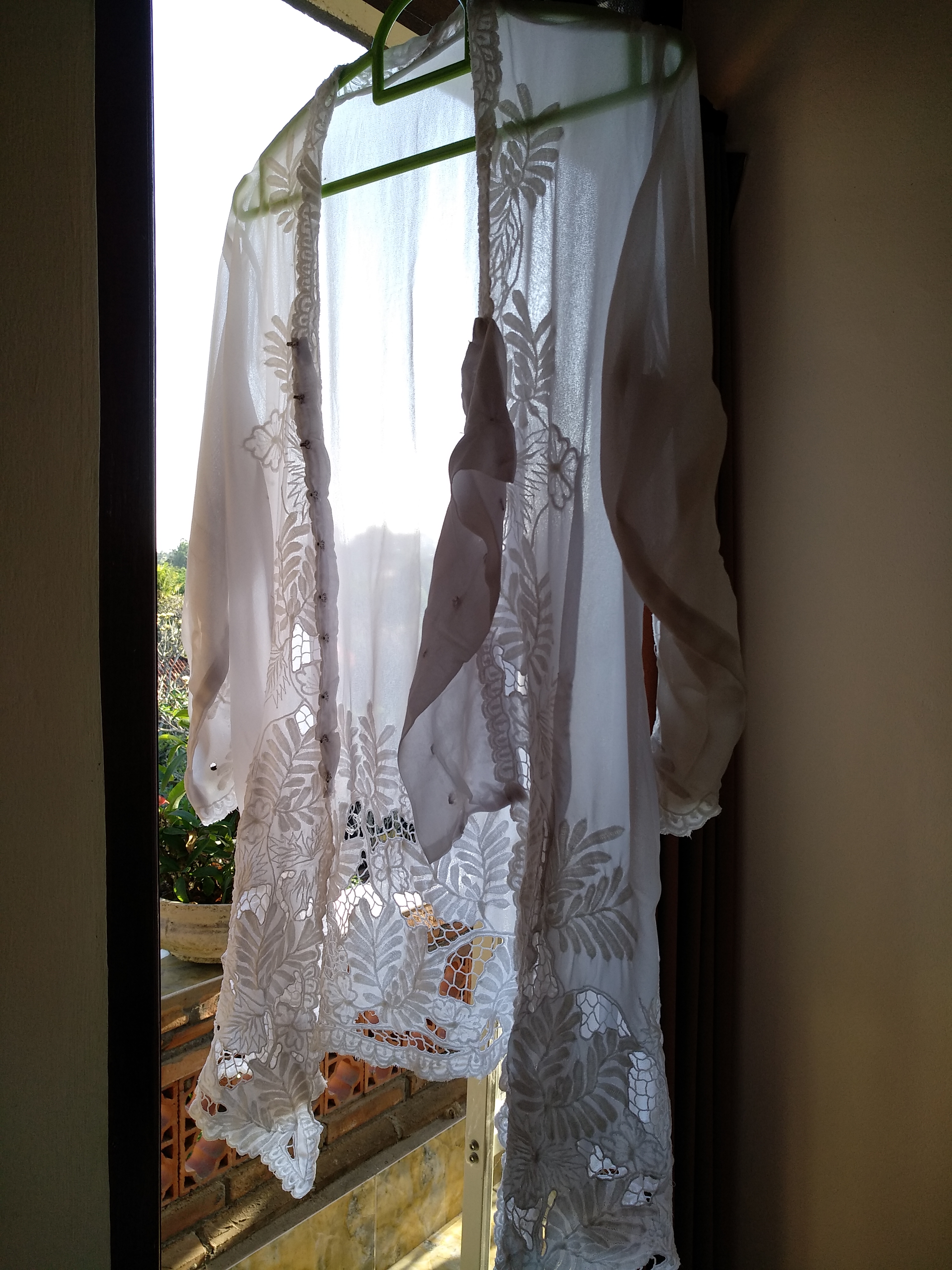
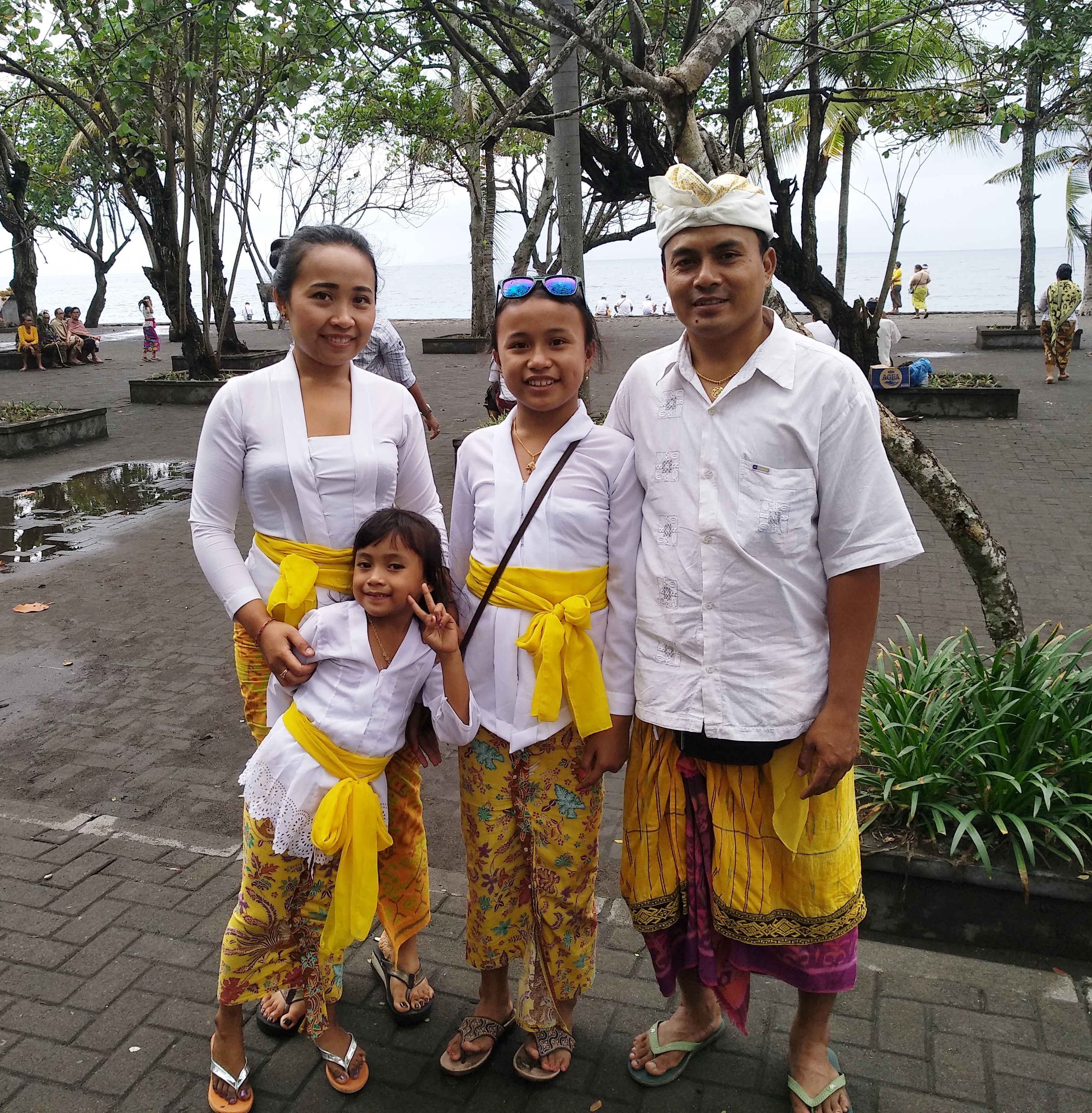
Koming arrived at my room early Wednesday morning to “dress” me for the day’s events.  To participate I needed to be in traditional Balinese attire.  She provided me a Kamen (sarong/skirt), Kebaya (lace jacket) and an Anteng (sash).

IMG_20180815_171952.jpg
Kebaya

Her being quite a bit smaller than me, the jacket was a bit snug across my breasts. She suggested we not fasten it.  The kebaya was white because white signifies mourning. Although the color signifies mourning, the ceremony itself will be a joyous occasion, a celebration.


The death ritual is a time to celebrate and help the deceased move on from their previous life.  It is believed that everything in the universe, including the human body, is made up of “five great elements” or Pancha Mahabhuta.  These elements are as follows:


  1. Pertiwi (soil/earth)
  2. Apah (water)
  3. Teja (fire)
  4. Bayu (air)
  5. Akasa (space/ether)

Each of the Pancha Mahabhuta are made up of 5 Pancha Tanmatra or elements of the senses. They are as follows:

  1. Ganda (from the nose/smell)
  2. Rasa (from the tongue/taste)
  3. Rupa (from the eyes/vision)
  4. Sparsa (from the skin/touch)
  5. Sabda (from the ears/sound)

It is through these ceremonies/rituals over the next several days that the body is returned to its Pancha Mahabhuta.

Koming explained to me that she would not be able to be with me while at the Peyadnyan (ceremony area).  Ketut, being son number 4, it is his duty to ensure that a proper cremation ceremony is carried out for his mother. Koming, his wife would be there to assist.  She told me I was free to walk around and take photos. Fed and dressed, Koming put me on the back of her motorcycle and off we went to the Peyadnyan.

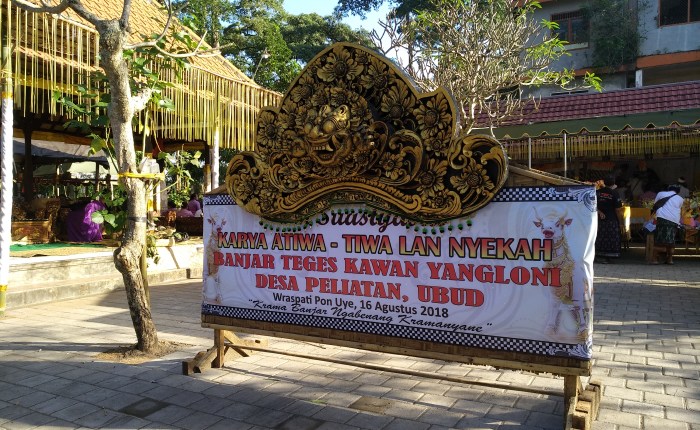
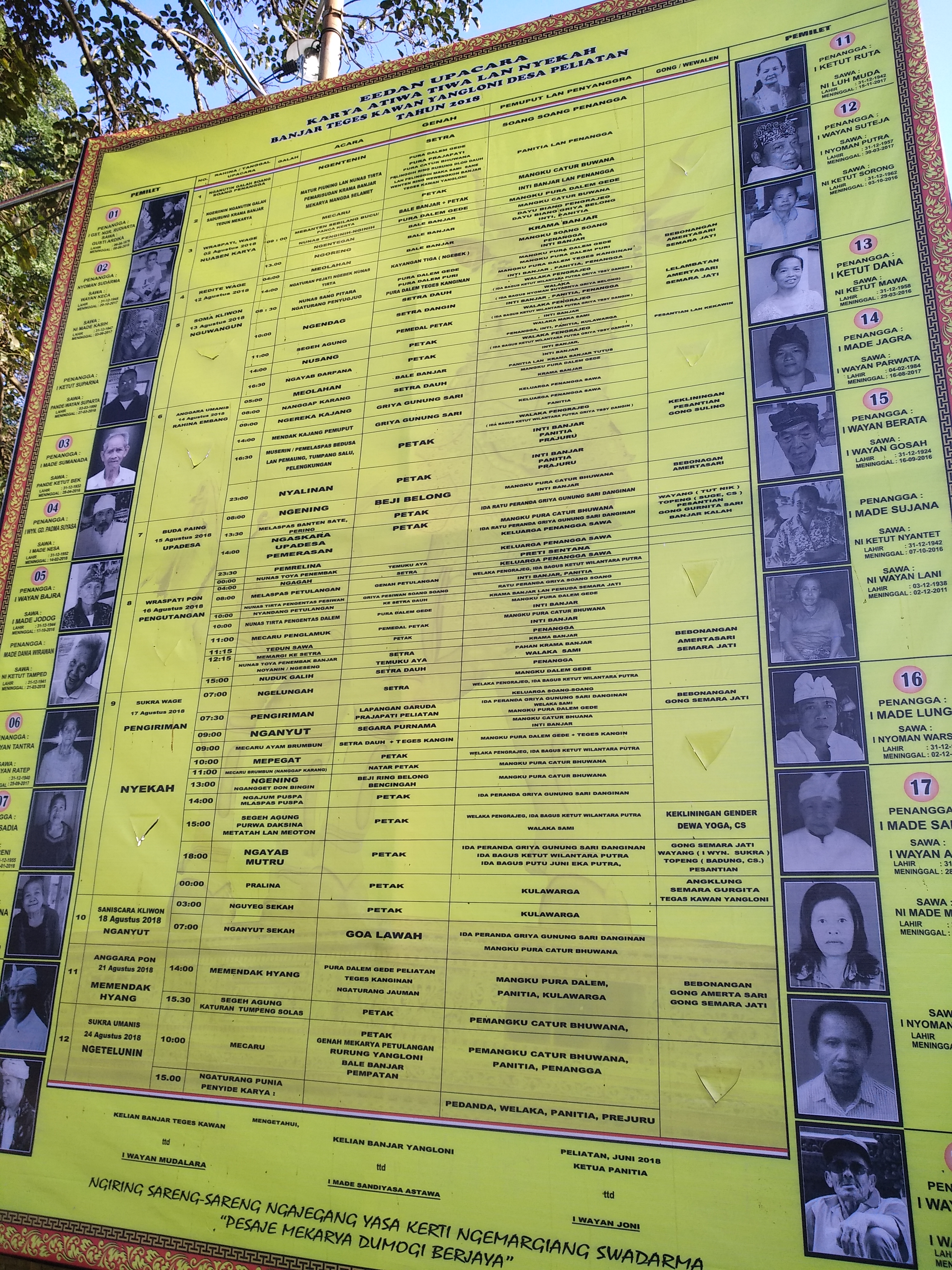
The first thing I noticed when we arrived was a giant sign/billboard.  It had the names and photos of 18 people/groups of people who would be cremated and a schedule of “events”. IMG_20180815_081111.jpg

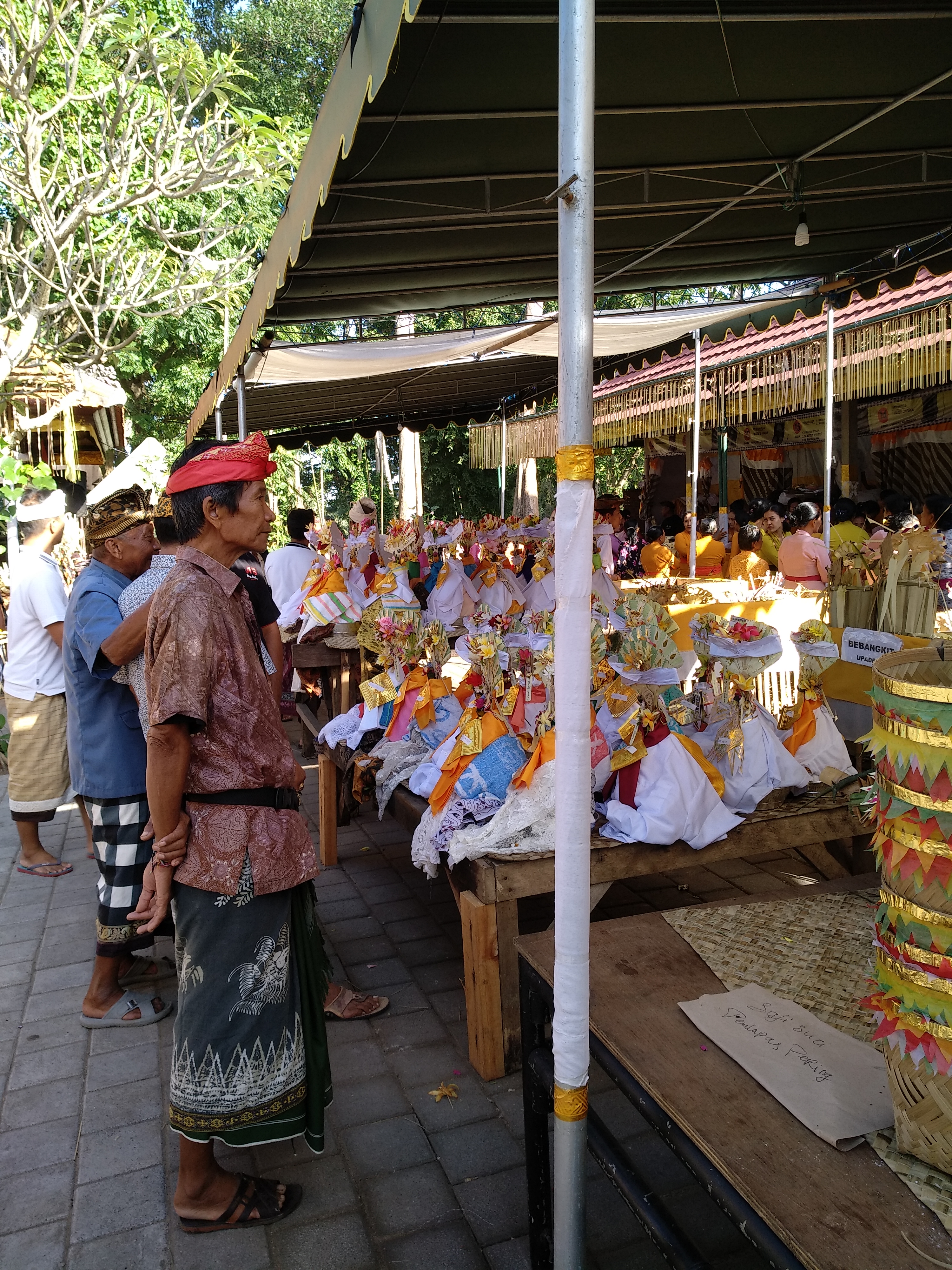
Koming left me here and went about her duties. I took a moment and viewed the souls we would be celebrating, then made my way inside.  This was my first visit to the Peyadnyan, it was a feast for the senses.  Colorful offerings were everywhere, music was playing, the scent of flowers and incense filled the air, children were laughing and playing, the clothing of the women from the Banjar (community) who were helping was lively and colorful. Indeed, it had an air of celebration.  As I wandered around taking everything in, I was greeted with smiles and hellos from everyone.

IMG_20180815_083445.jpg


IMG_20180815_084011.jpg


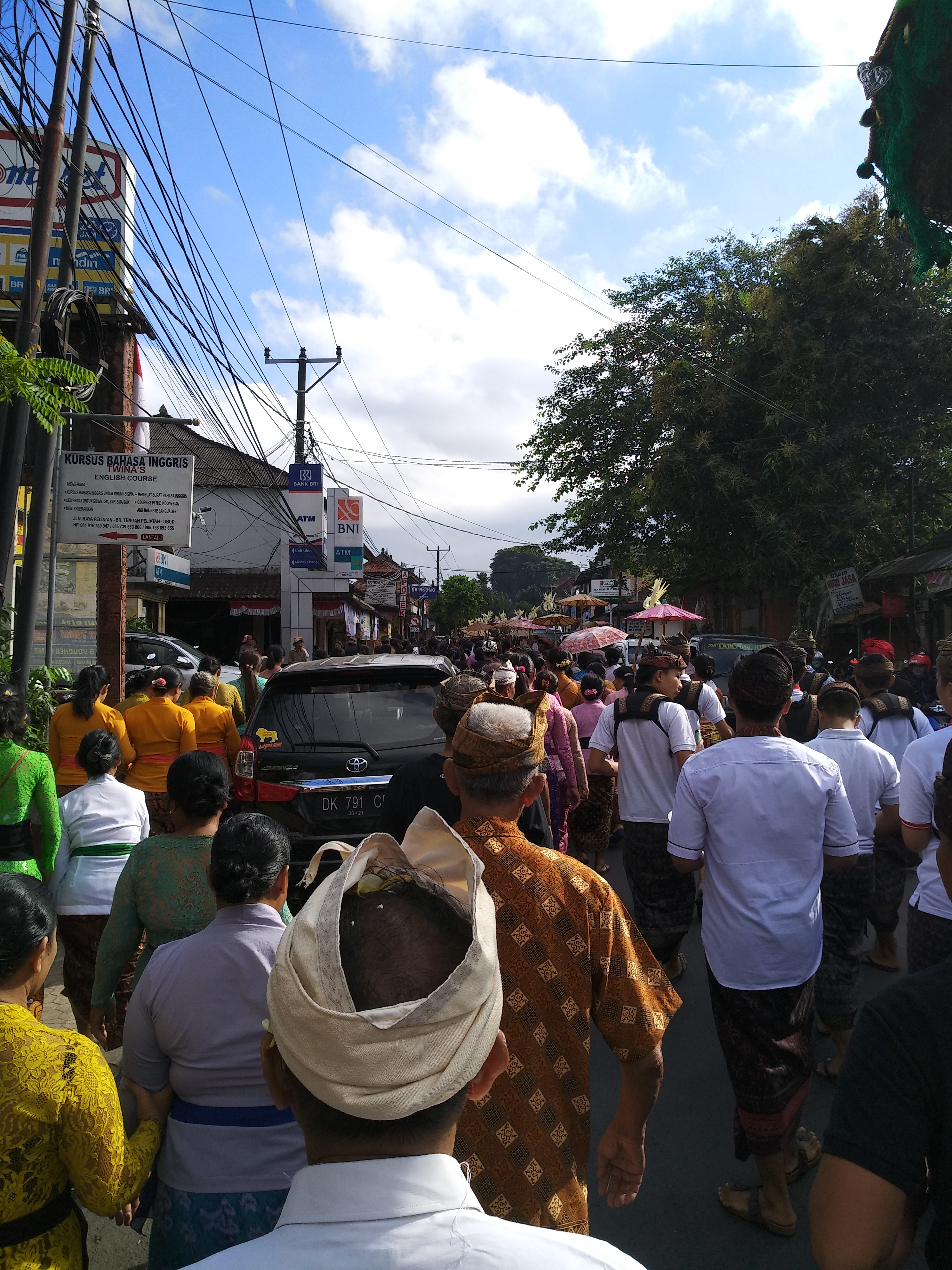
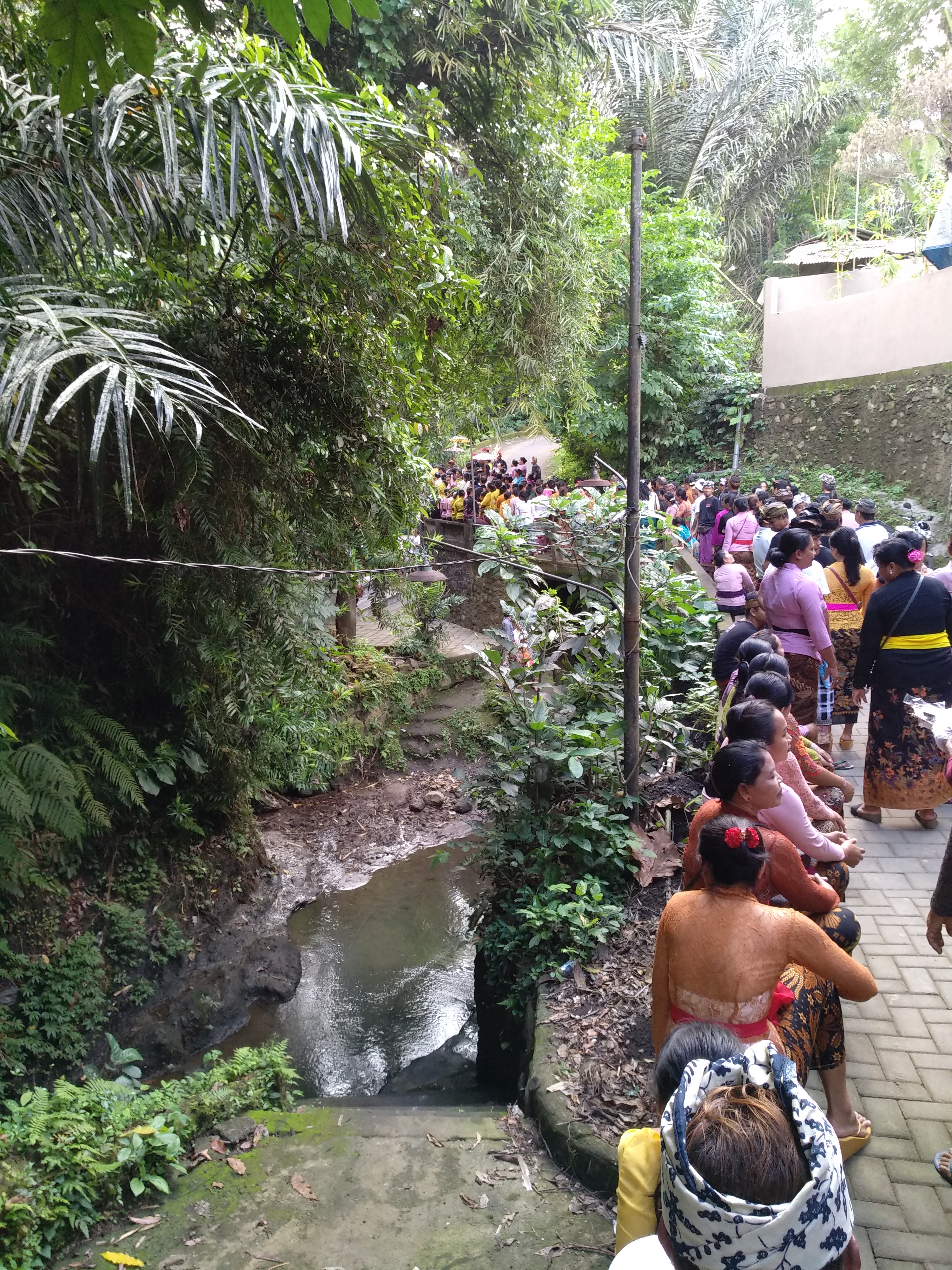
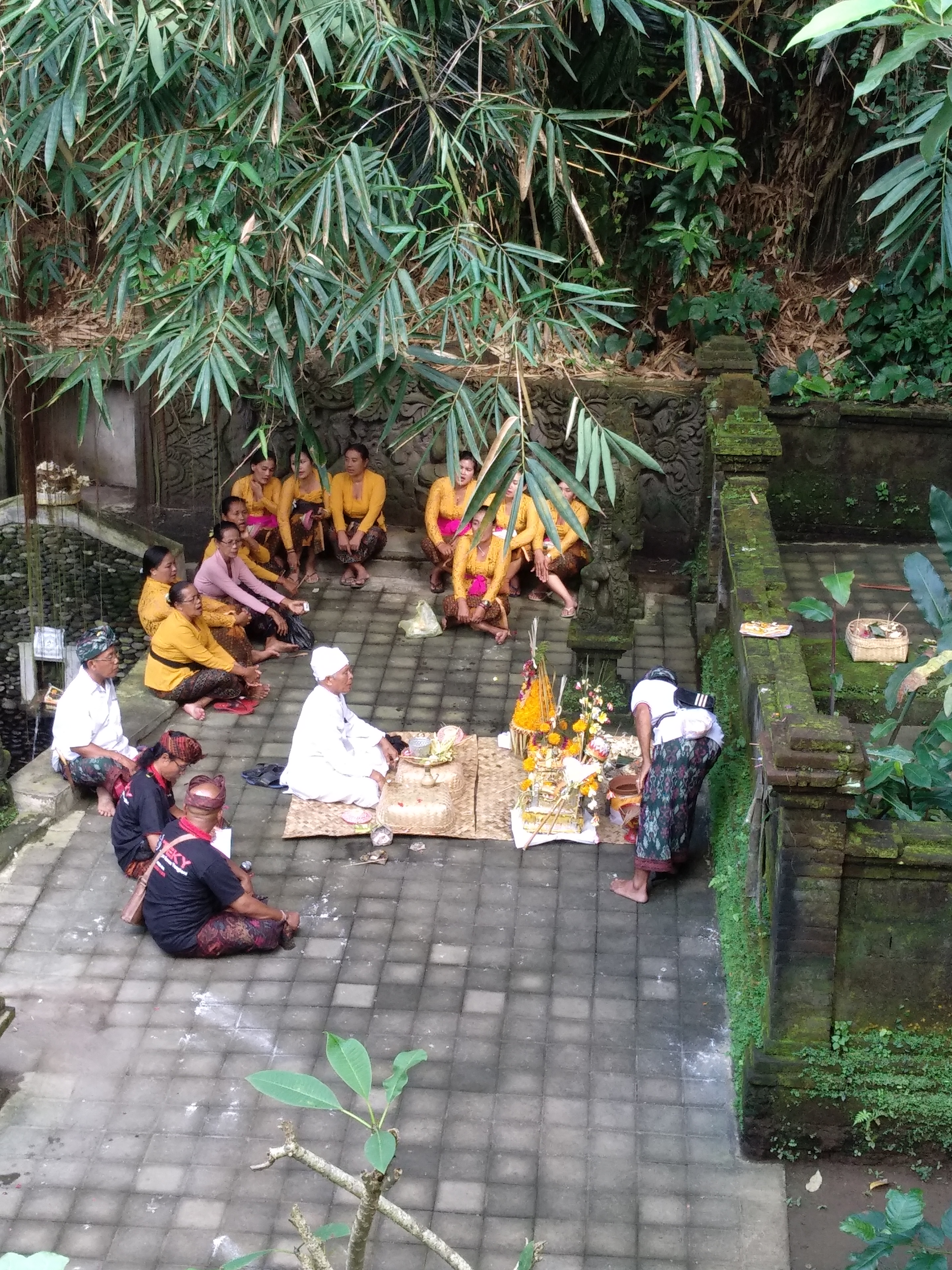
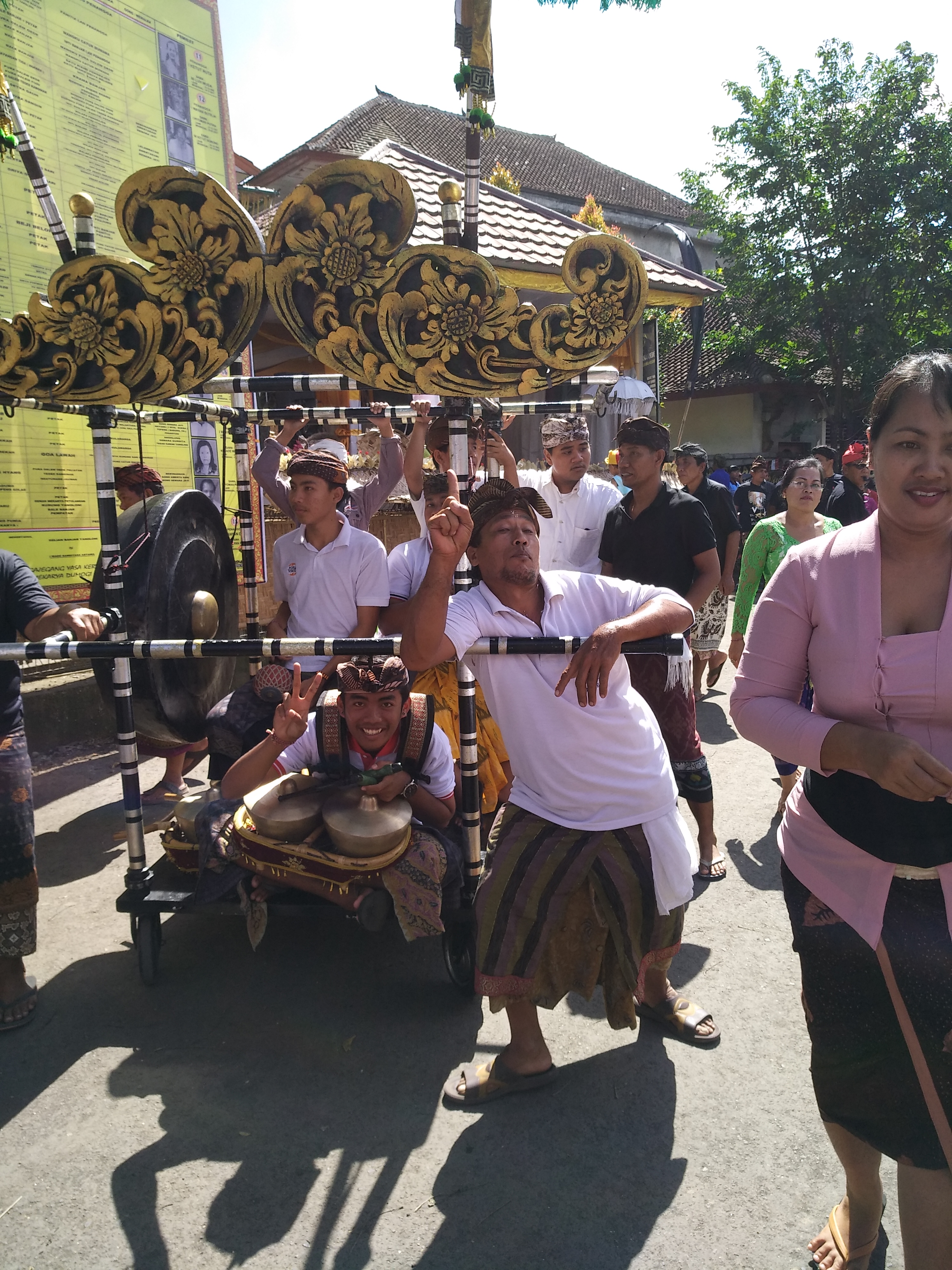
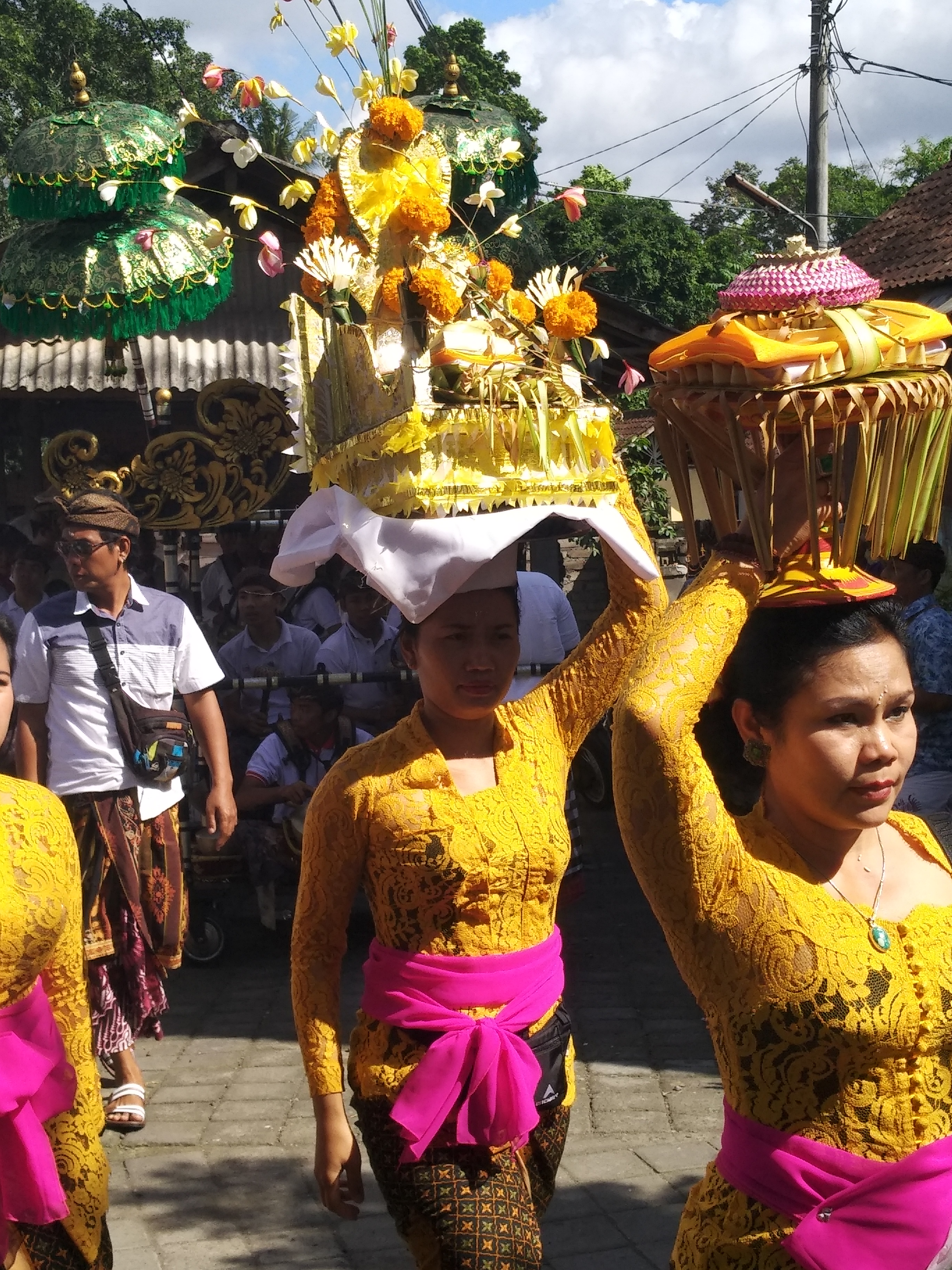
Soon, Koming messaged me and told me the procession was about to begin.  She instructed me to just walk with the crowd, but not in the line with the families carrying the offerings.  The guys in the band or Gamelan (traditional instrumental ensemble of Indonesia) seemed rather jovial so I fell in step with them. During Balinese death rituals, music is considered a form of offering.   With a police escort at the front, we left the Peyadnyan and the procession started down the main street.  We, the entire community, walked through the streets for about 20 minutes.  We ended at a riverbank and the priest conducted a short ceremony.  The procession then regrouped and walked back to the Peyadnyan.  The Gamelan music, again playing along the route, gave a festive atmosphere.

IMG_20180815_085814.jpg
The procession heading down the main street
IMG_20180815_091603.jpg
Arriving at the river


IMG_20180815_092118.jpg
The priest giving the service


IMG_20180815_092055.jpg
At the river, the Ngening Ceremony
IMG_20180815_101802.jpg
My buddies in the band aka gamelan
IMG_20180815_100058.jpg
Carrying offering in the procession


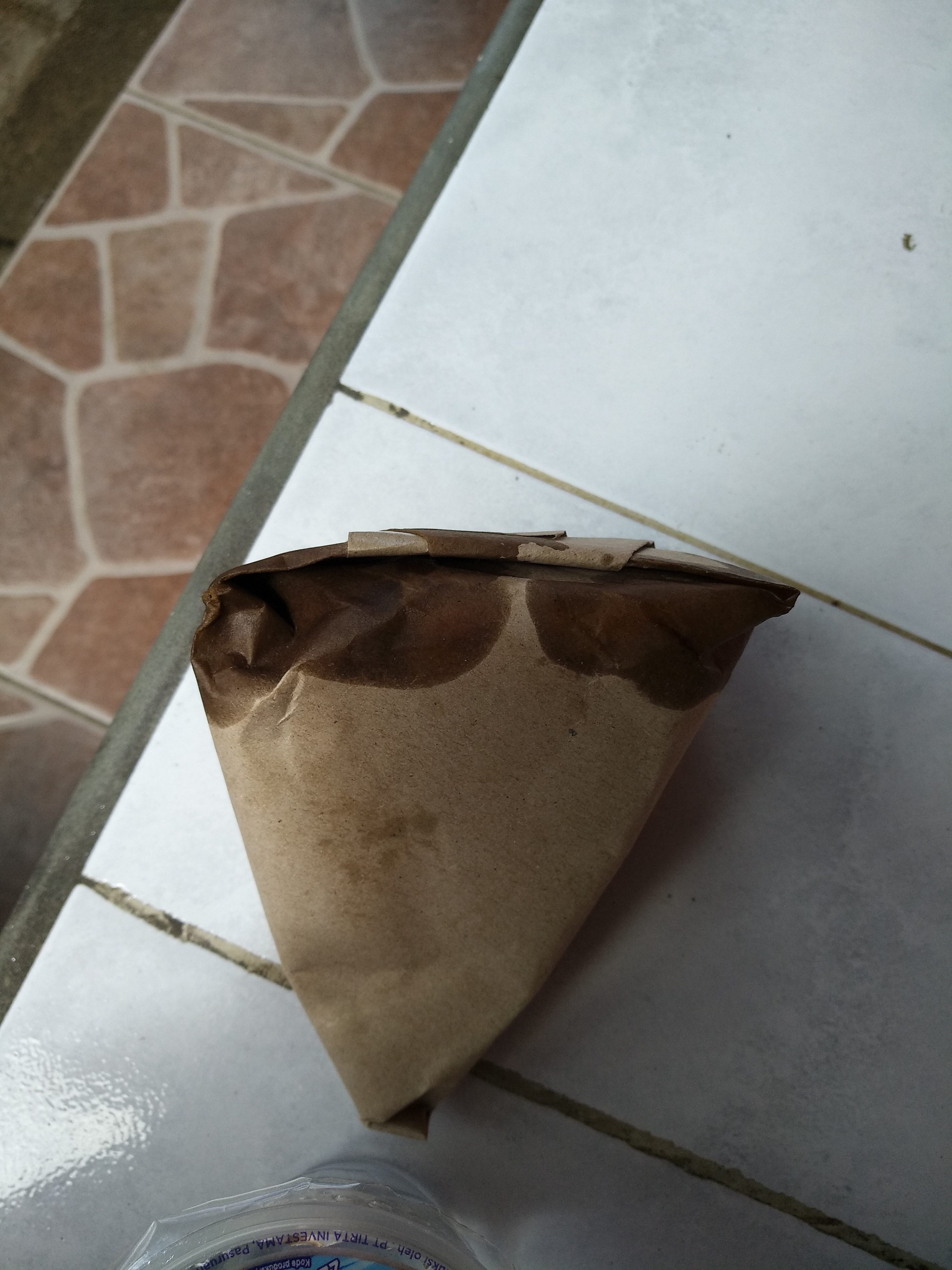
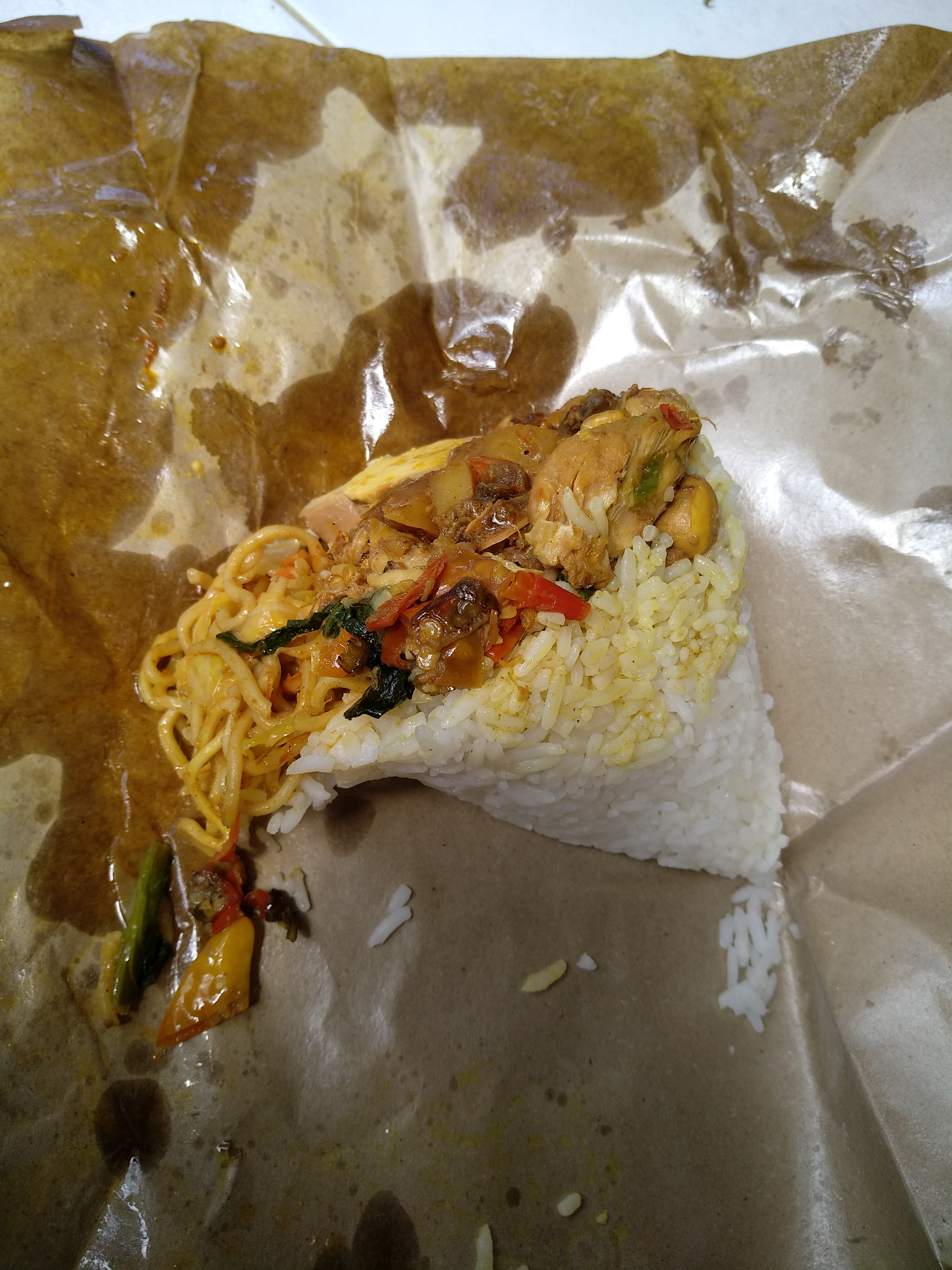
Upon returning to the Peyadnyan there was a flurry of activity setting up for the afternoon’s activities.  I sat down and was mesmerized as I took it all in.  Koming came to me and handed me a brown paper wrapped package.  “Lunch”, she told me.  Lunch was Nasi Campur. Nasi campur is a spicy street food consisting of a scoop of white rice, noodles, peanuts, an egg, vegetables and small pieces of meat. Eaten with the fingers, it is quite delicious.  Side note, when eating, the left hand is NEVER used to eat or pass food.

IMG_20180815_114720.jpg
Lunch
IMG_20180815_114828.jpg
Nasi Campur


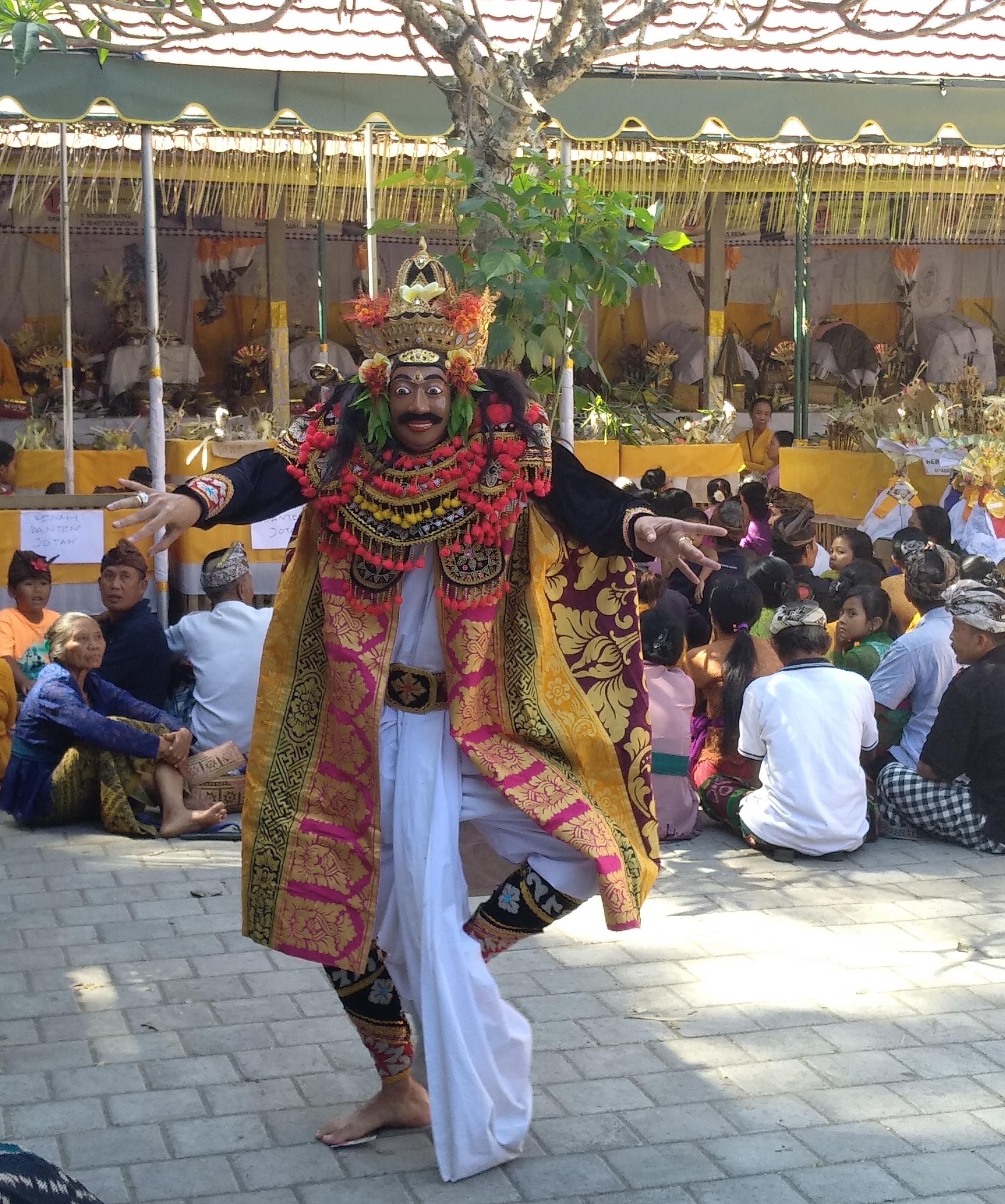
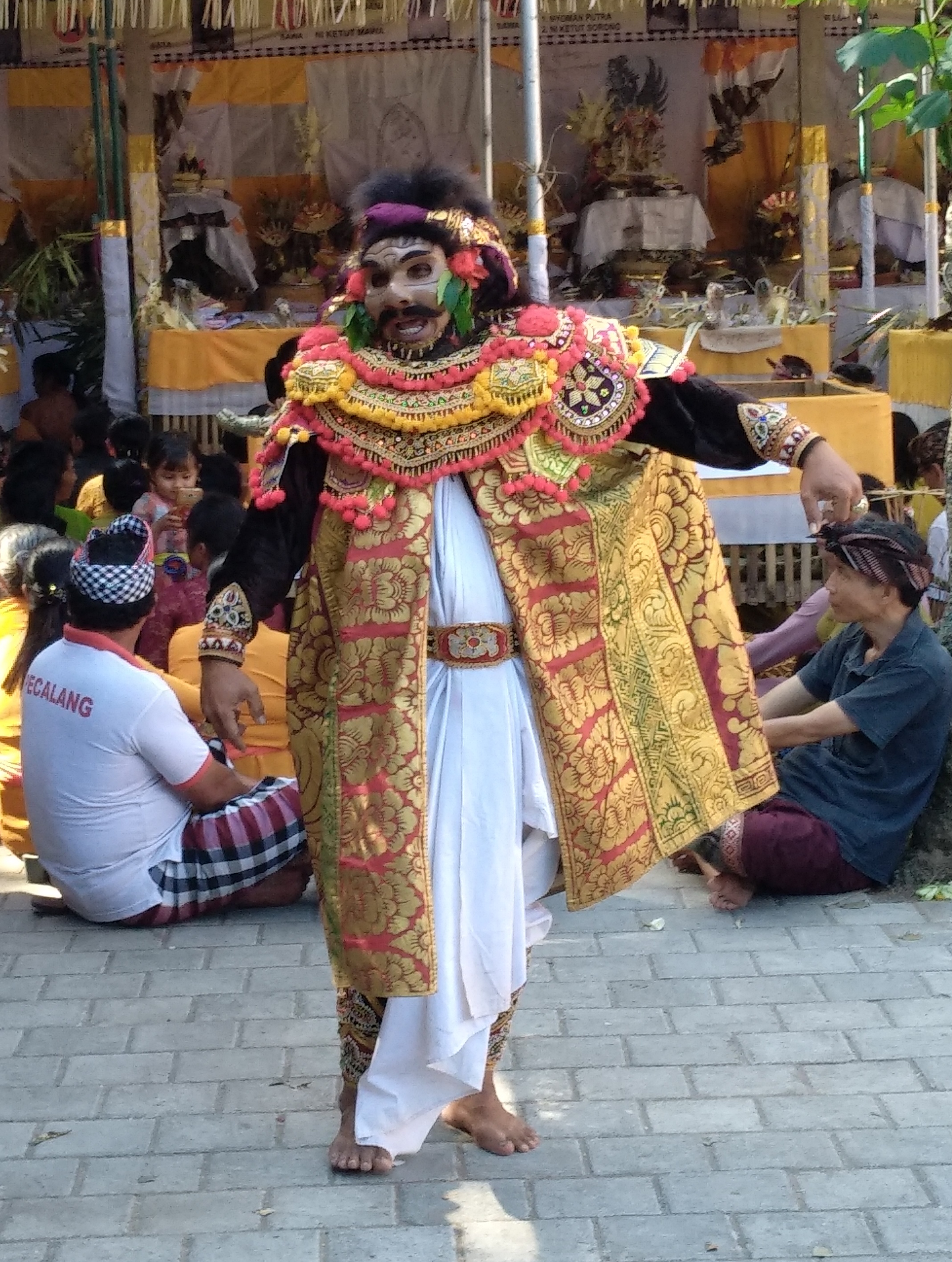
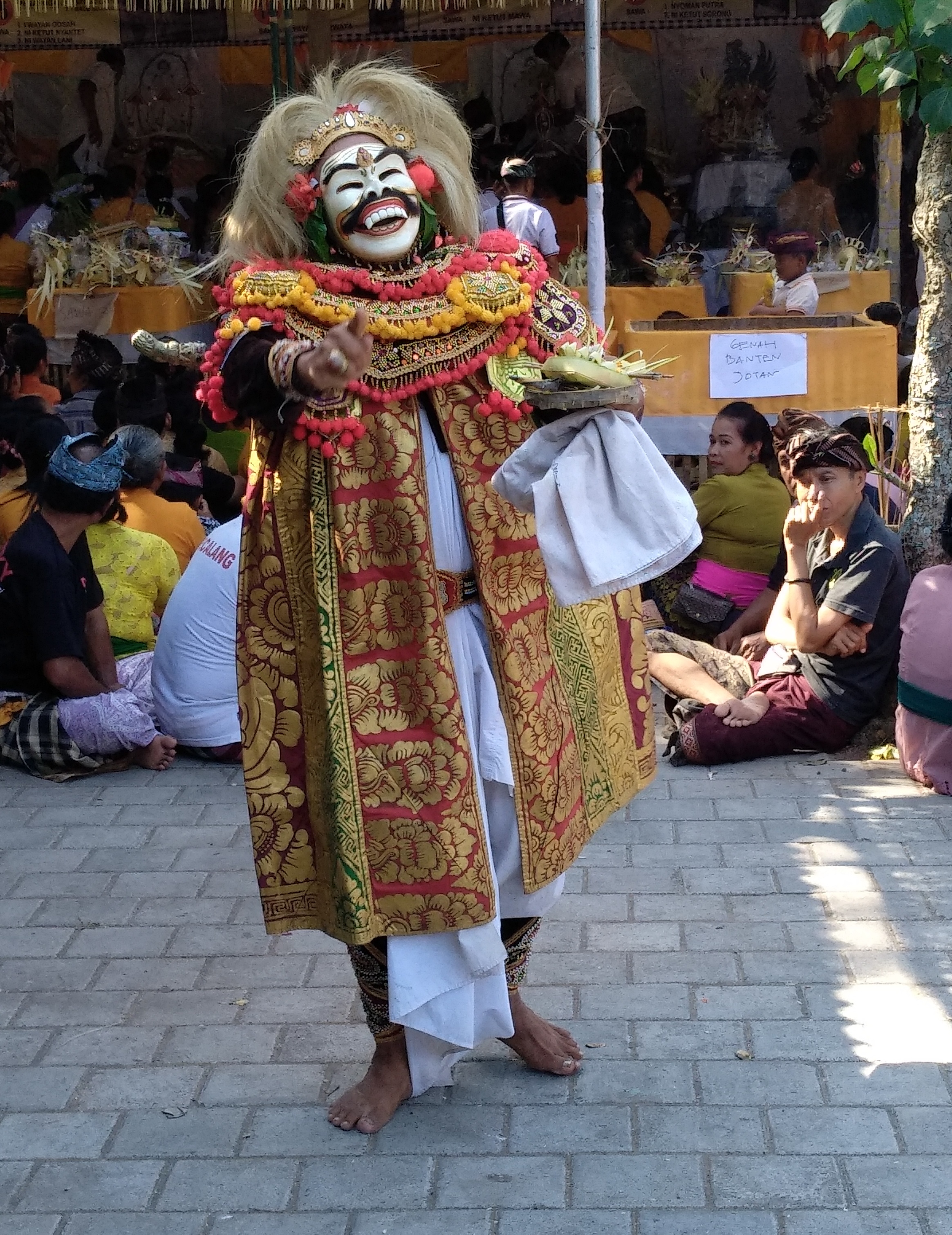
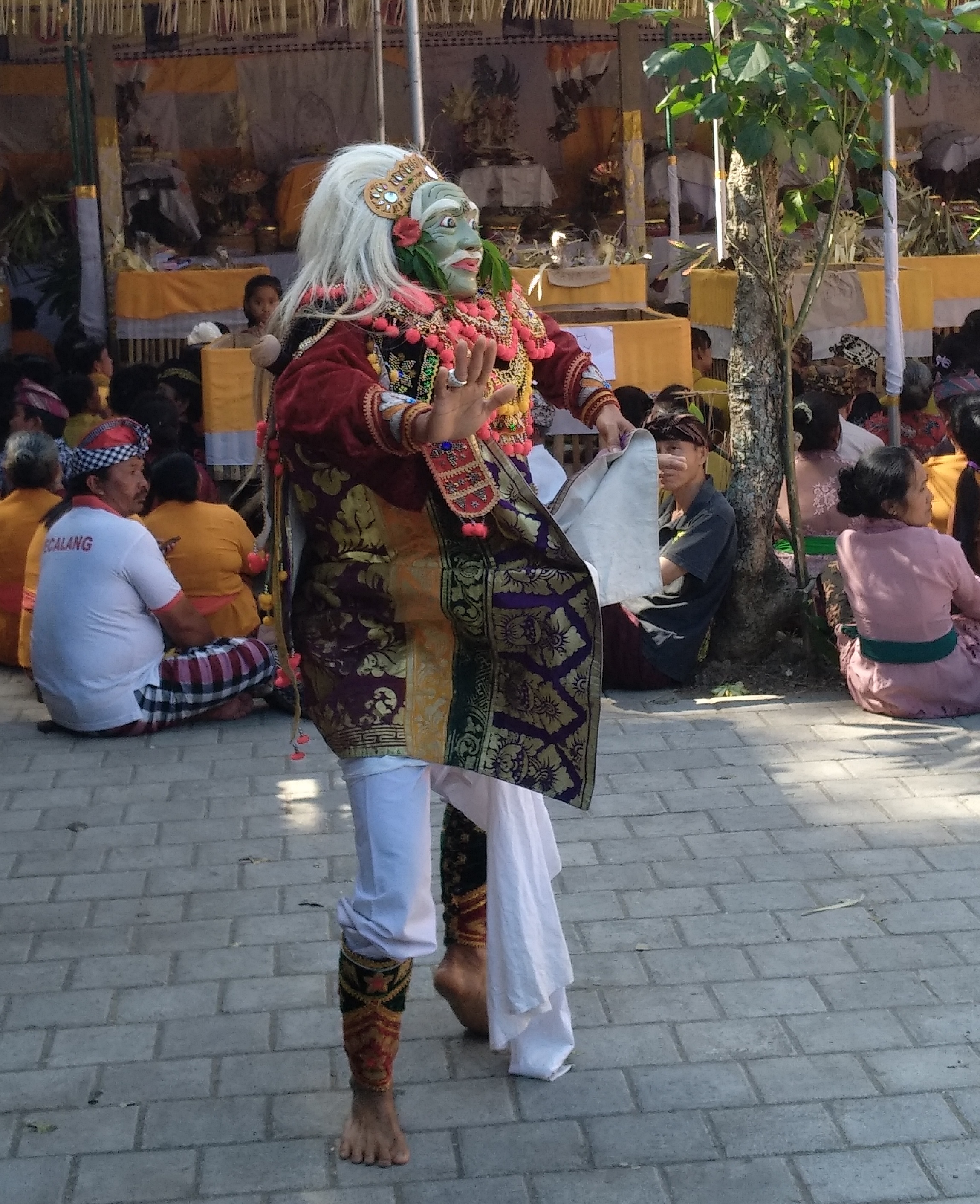
After lunch, another flurry of activity to finish setting up for the afternoon.  The afternoon would consist of the Topeng and Corong Corong.  I walked around a bit looking at the beautiful offerings and listening to the gamelan music.  Soon, Koming told me to move toward the entrance to the Peyadnyan the topeng dance was about to begin.  Topeng means mask in Indonesian.  The dance has several masked actors who perform, dance and tell ancient stories concerning ancient or mythical kings and heroes. The actors are adorned in colorful costumes and accompanied by lively gamelan music.

IMG_20180905_212045.jpg

IMG_20180905_212230.jpg

IMG_20180905_212426.jpgIMG_20180905_212152.jpg


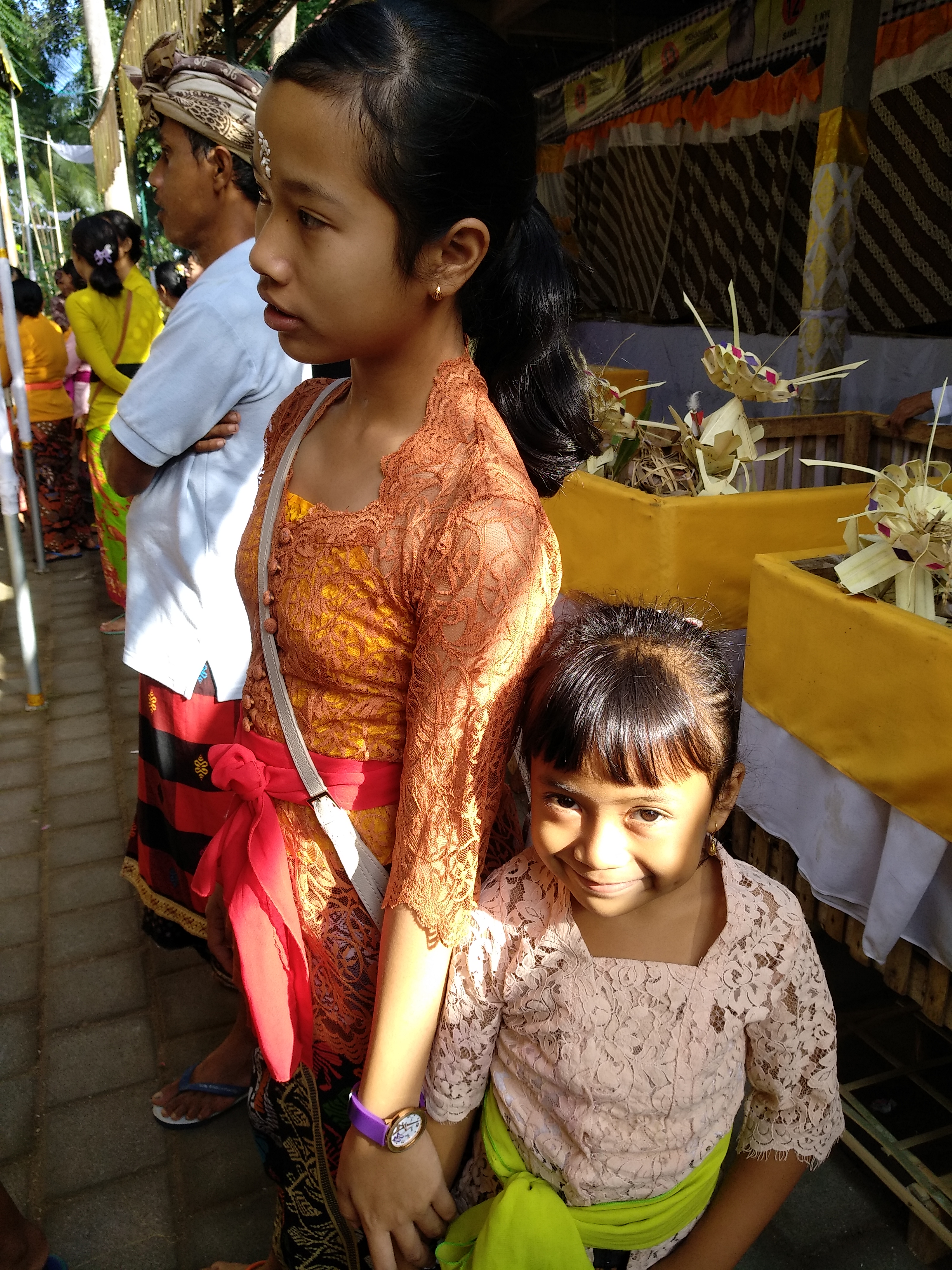
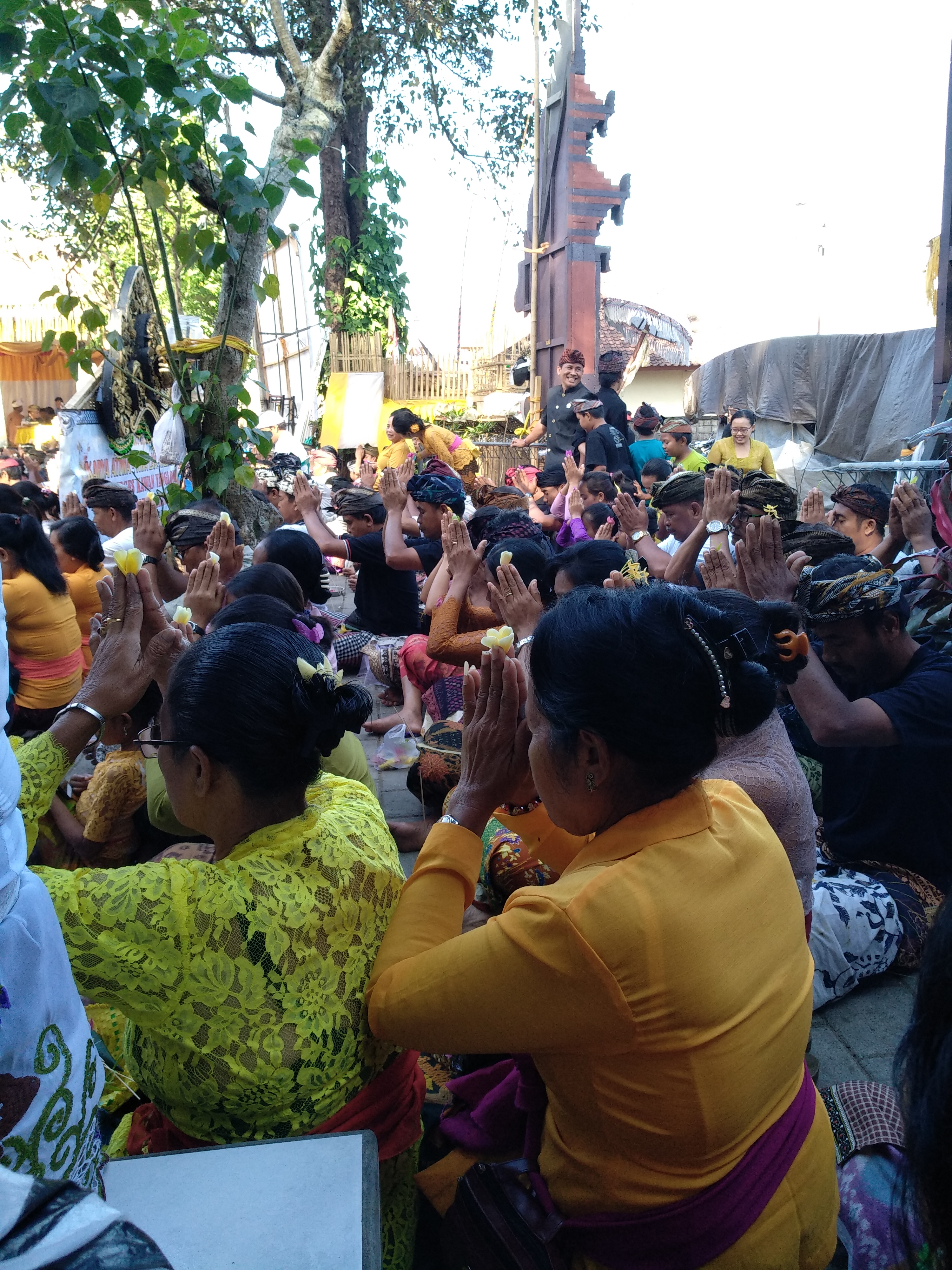
Next was the Corong Corong also called Peras Perasan.  This is the ceremony for the grandchildren. One thing I noticed during the day’s events, the children actively participate in the ceremonies.  They understand this is a celebration and they are helping the deceased move on from their previous life.  During the corong corong a large basket filled with offerings is in front of the specific Petak (shrine/altar) for the deceased person. In this basket are things the deceased will need for the afterlife.  The family members, including the grandchildren of the deceased, form a procession and as the gamelan play, they walk around the offering box and in front of the petak.  In general, the symbolism of the corong corong is that the deceased spirit is going on a far journey like sailing the ocean. This spirit will return reincarnated to the grandchildren who live in the house and give them the inheritance of all they had.

IMG_20180815_162055.jpg
Koming


IMG_20180815_153959.jpg

IMG_20180815_152304.jpg
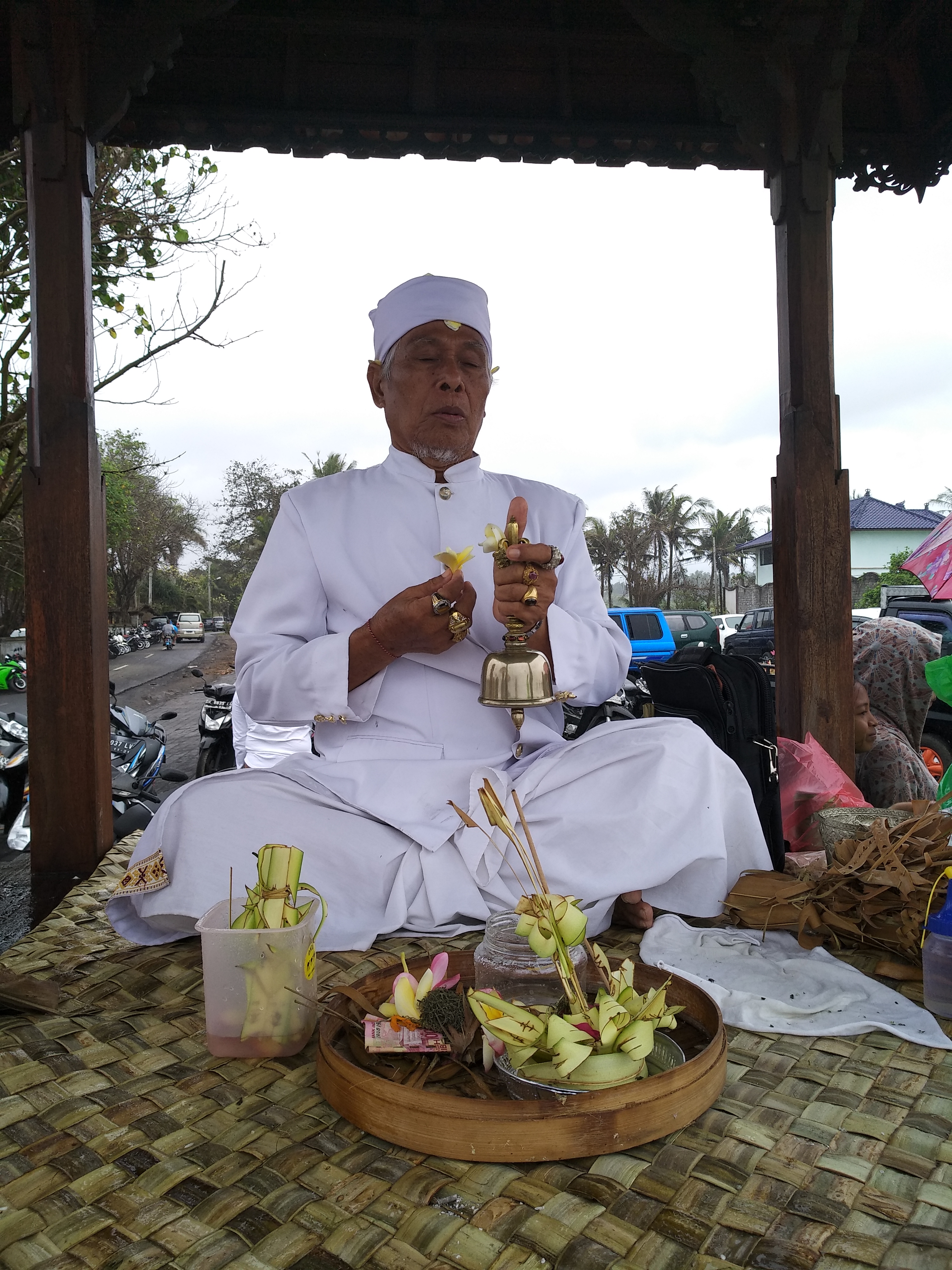
The Priest


Around 5:00 pm, Koming told me the ceremony was finished and Ketut would take me home. She also asked if I still planned to attend the Ngaben (cremation) Ceremony tomorrow. My answer was yes, of course.  This meant a 2:30 am wake up to go to the Kuburan or cremation grounds. Ketut and Koming would sleep at the Peyadnyan and would come to Kenari House at 3:00 am to get me.  With me on the back and his older daughter on the front of his motorcycle, Ketut took us both home.

IMG_20180815_163320.jpg
Ketut and Kiara

I can’t begin to tell you how grateful I am to Ketut and Koming for so graciously including me in every aspect of these most important ceremonies. It was an amazing day and I was physically and mentally exhausted.  What an honor.  Tomorrow we start with Ngagah or “awakening of the dead”, the exhumation of the deceased.

“The body is only an encasing for the soul which is eternal”.


3 short videos follow

Gamelan Music


Topeng Dance


Procession during the Corong Corong

Bali ~ Island of the Gods A Brief Journey into Balinese Hinduism, Part 1

Bali ~ Island of the Gods                                  A Brief Journey into Balinese Hinduism, Part 1

Before we tumble Down the Rabbit Hole directly to the Balinese Ngaben (cremation) Ceremony, I want to give a little history of how I ended up being invited to this ceremony and a little history of Bali and Hinduism.

IMG_20180817_112211.jpg


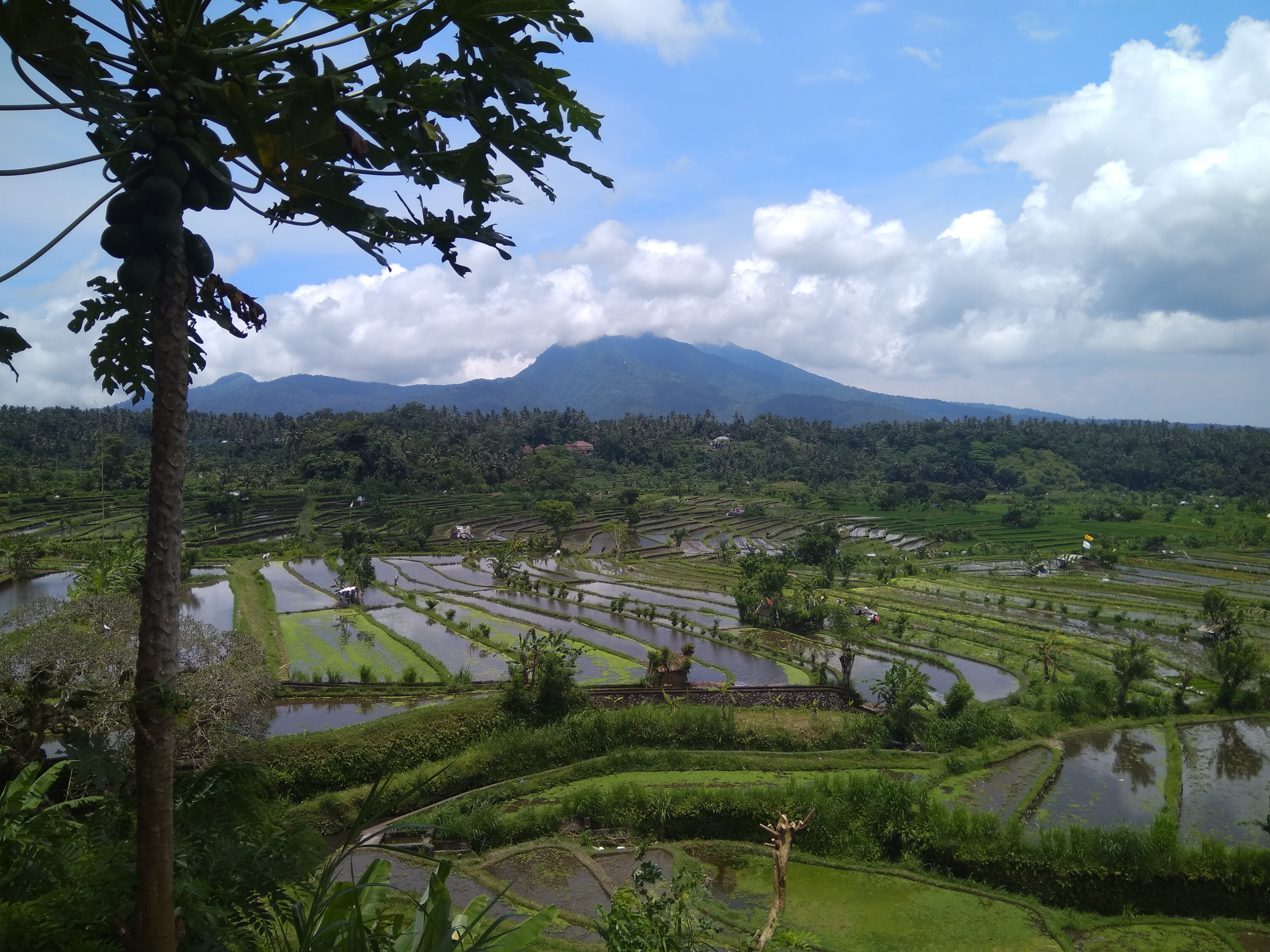
IMG_20180830_095100.jpgBali, Island of the Gods, is one of 17,000 islands in the Indonesian archipelago.  A small island 95 miles east to west and 70 miles north to south, it is located 8°south of the equator and is inhabited by approximately 4 million people. Unlike the majority of Indonesian Islands which are Muslim, Bali is 85% Hindu.  So how did I end up visiting this island paradise?  We must travel back to Paris 2014……..
IMG_20180223_125350.jpg

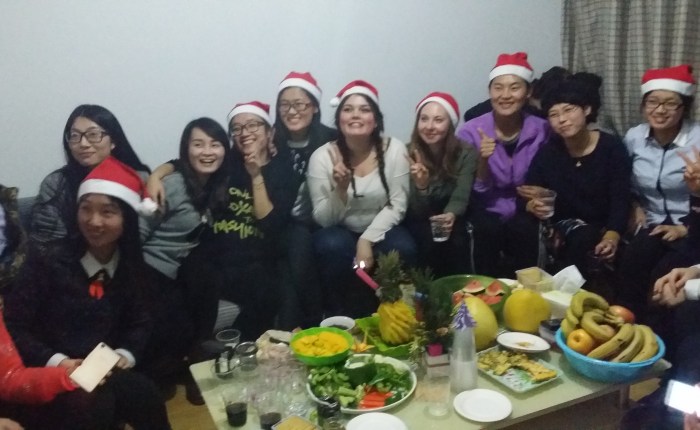
As you may or may not know, I spent a period of 2014/15 living in Paris, France.  I fell in love with Montmartre and in Montmartre at the foot of Sacre Coeur had my “go to” café.  I became a regular and the staff got to know me and my “usual’s”.  Since I normally stopped by at least once a day for “un café” or “verre de vin rosé”, I often chatted with a waitress named Julie.  She talked to me about her desire to move to Bali. I left Paris to return to the States in February of 2015 and we said we would keep in touch via FB. I happened to return to Paris for a 2-week holiday in July of 2015 and of course one of my first stops was Café Chappe.  Lo and behold, Julie was there.  She had indeed gone to Bali, but had returned to Paris because of her youngest son, they planned to go back to Bali at the end of the summer and suggested I should visit her there.  In August of that same year, my adventures in the Middle Kingdom began.  I moved to China to teach English. Julie and I kept in touch over the next few years and finally in February of this year, 2018, I planned a trip to Bali.  Travel to Bali is quite convenient and relatively inexpensive from the Middle Kingdom. Julie was living in Seminyak which is a seaside community and was teaching yoga.  The first part of my holiday I planned to stay in Ubud, which is more north and inland, as there were several things I wanted to experience in that area.  The end of my holiday I would go to Canggu and finally meet up with my friend from Paris.  That my friends is how I ended up going to Bali for the first time.  The second part of the story is how I was invited to the Ngaben Ceremony.

IMG_20180227_161922.jpg
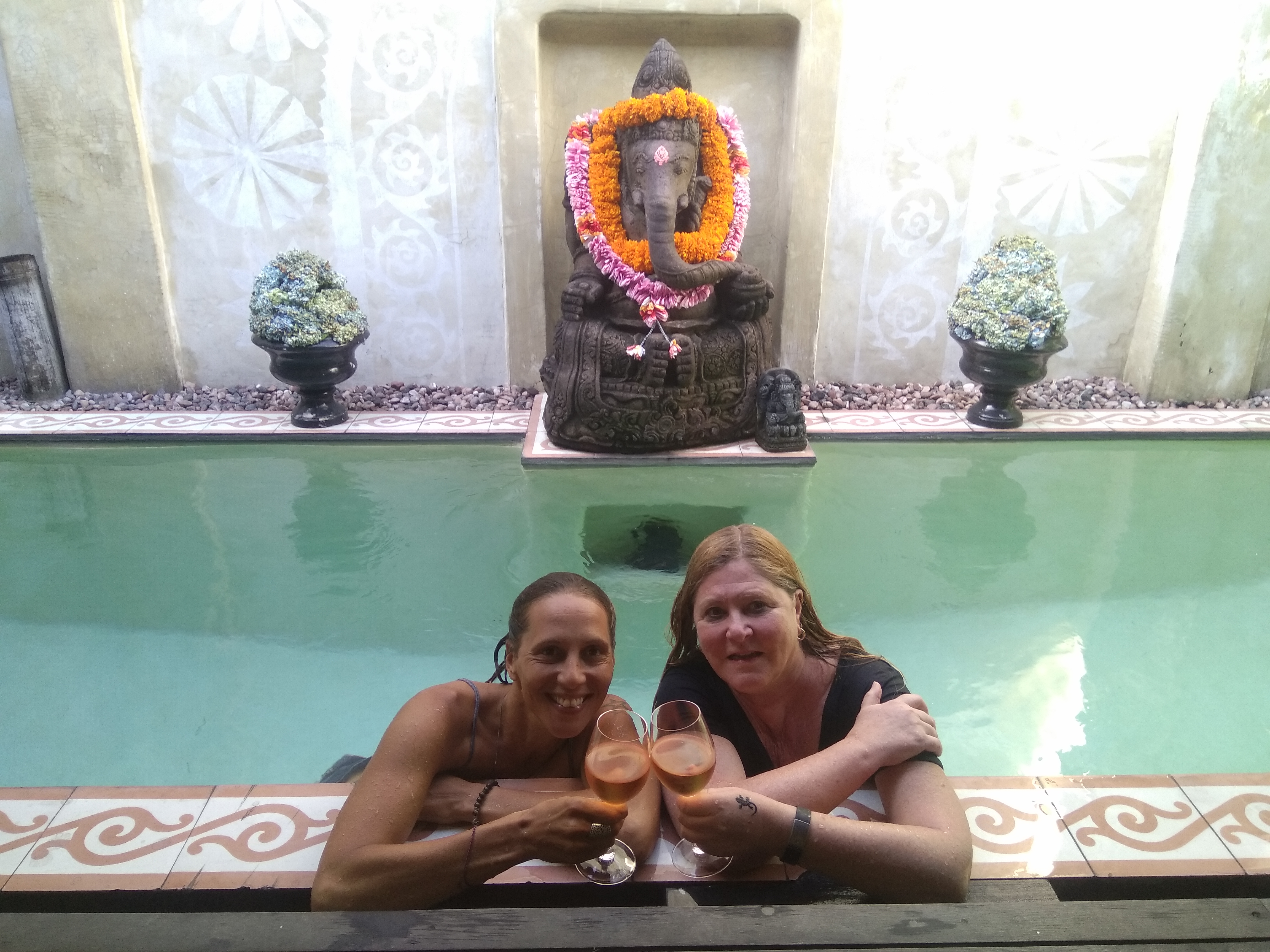
Drinking rose’ with Julie.  Sometimes you need to take a dip in the restaurant’s decorative pool……in your clothes.

In February, I had a homestay about a 20-30-minute walk from Central Ubud.  During my homestay, I had a room with a private bathroom in a family compound.  I say compound, because in Bali families usually live together.  Together meaning there are several free-standing homes often with a central kitchen in what is called a compound.  There is also always a family temple shared by all the households.  These compounds make up a tight-knit community.  The communities, in turn, make up a village.  Kenari House, my homestay was in the community or Banjar, Teges Yangloni the village of Peliatan.  My hosts, Ketut and Koming and their two young daughters immediately made me feel like part of the family.  Ketut, trained as a chef, would let me join him in the kitchen when he prepared my meals, explaining Balinese cooking and teaching me how to use traditional herbs and spices.  Finding them so open, I always seemed to have a dozen questions about Bali and Hinduism whenever I was with them.

IMG_20180818_115004.jpg
My Kenari House homestay family

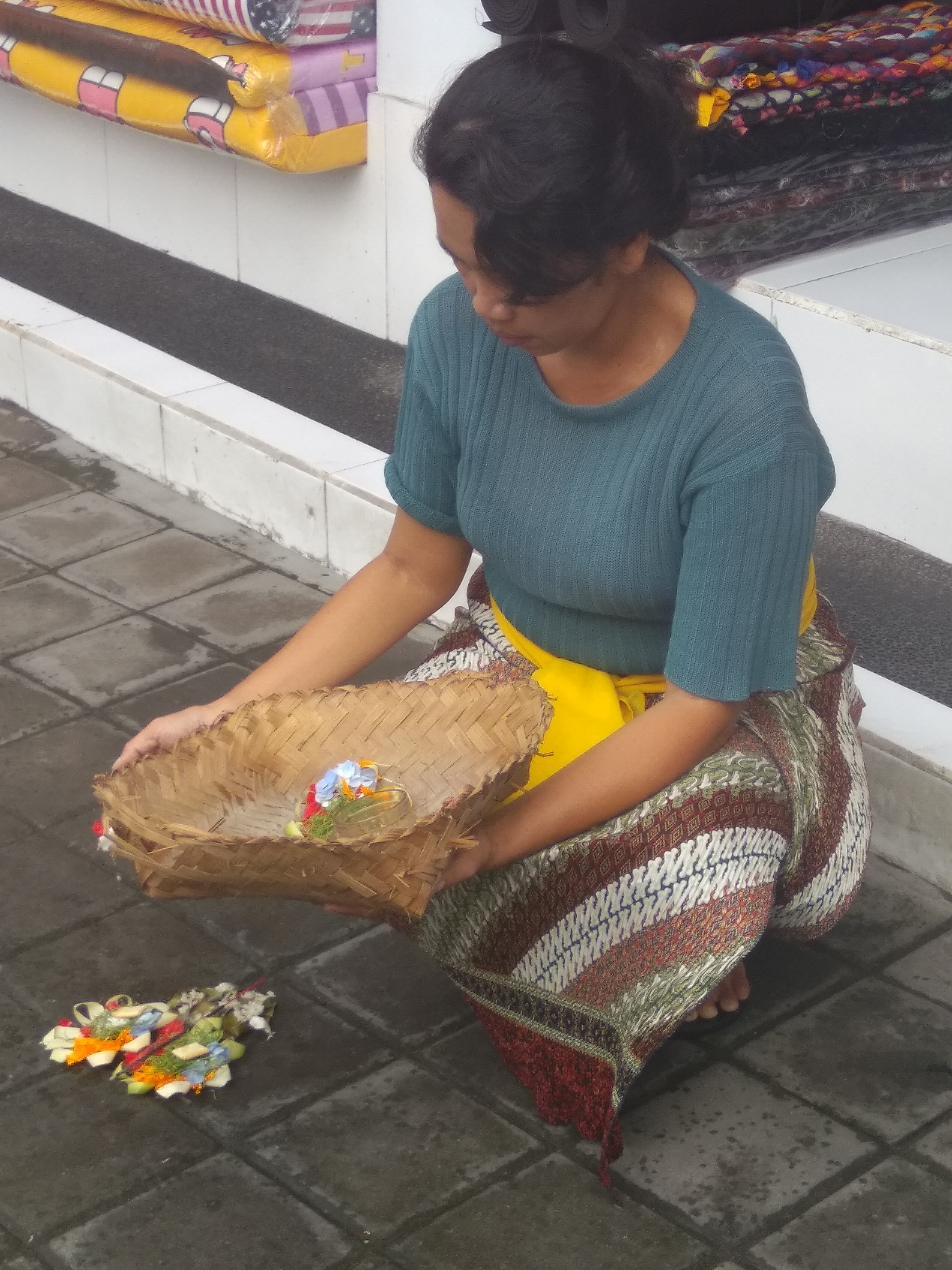
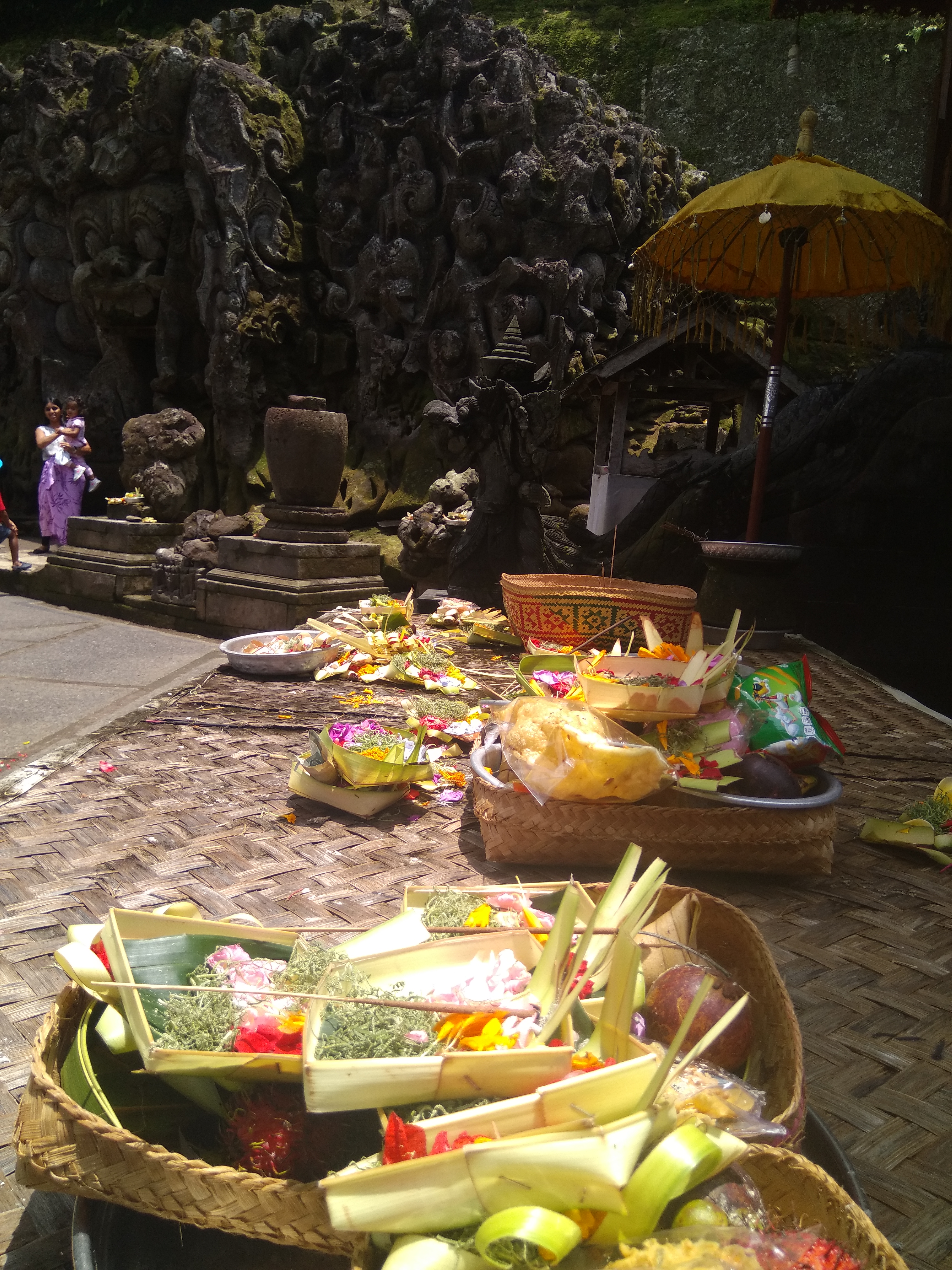
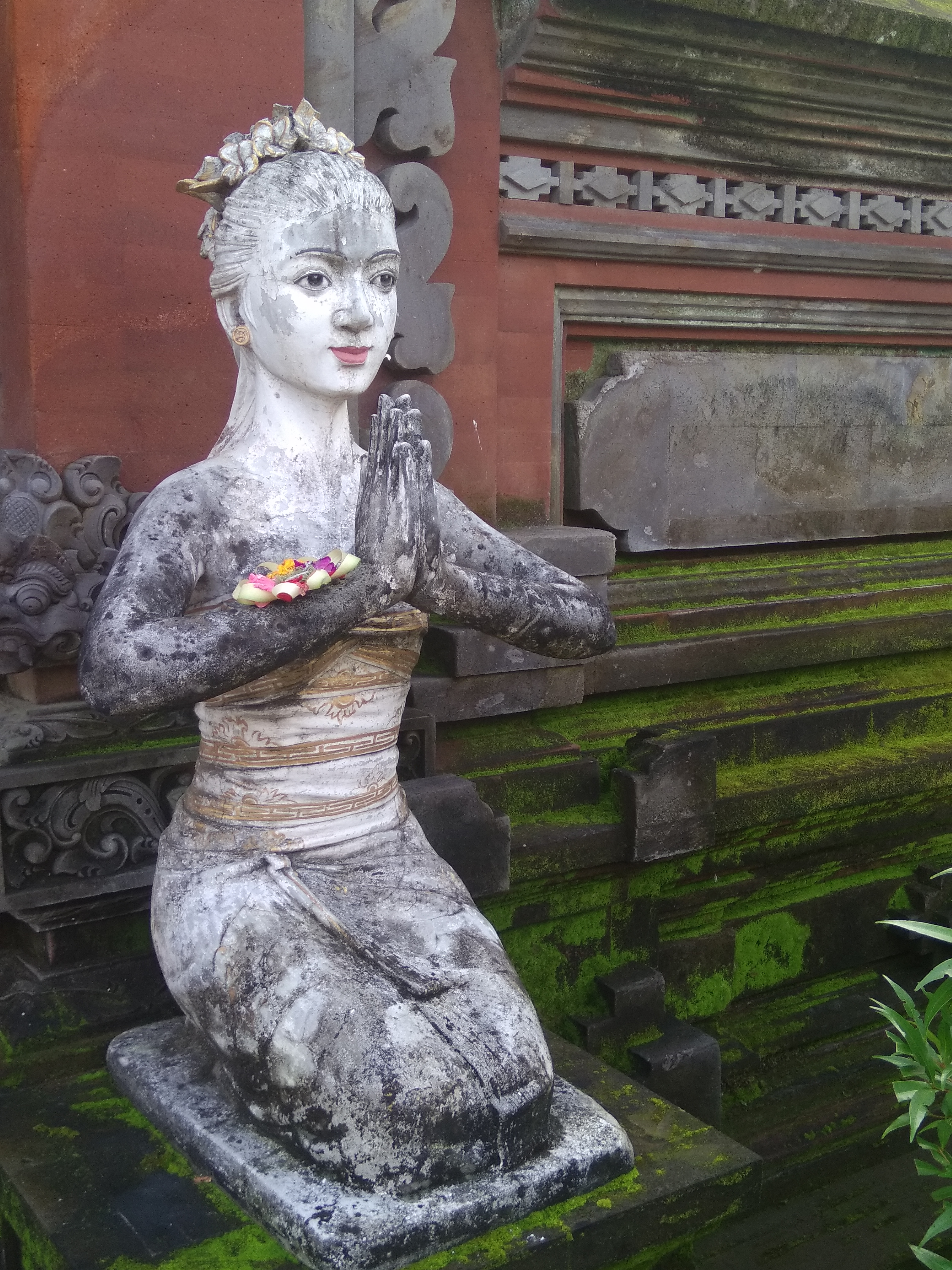
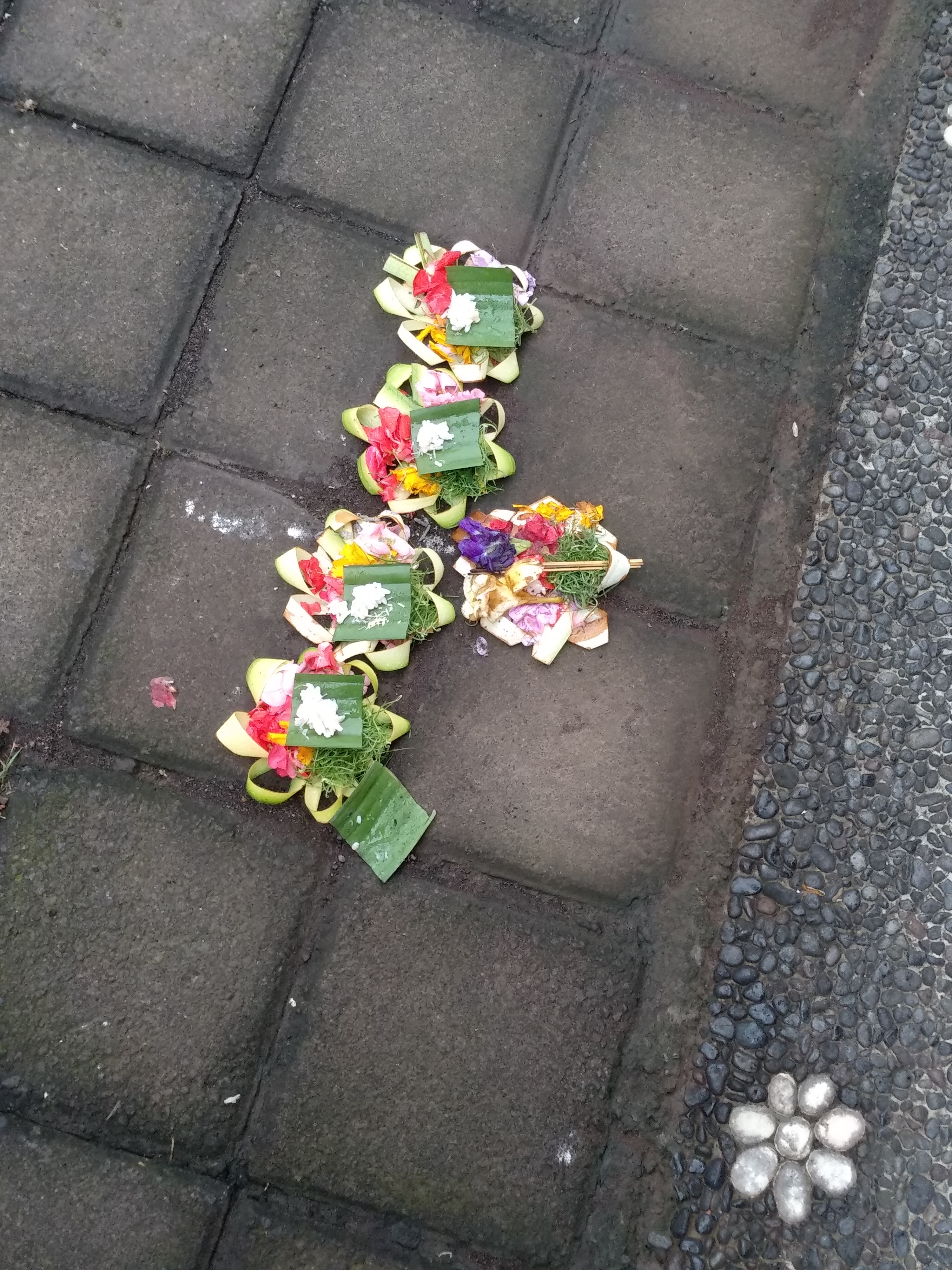
Bali is an assault on your senses, vivid colors, temple music, fragrant flowers, and incense await you at every turn.  One of the first things you notice in Bali are small baskets with various flowers placed everywhere. They are on statues, bridges, steps, and in doorways.  I asked Koming about these colorful baskets with incense.  She told me they are canang sari or daily offerings.  Canang is a small woven basket from palm leaves and sari means essence.  Broken down further can = beauty (like you feel the view) nang = purpose and sari = source.  Typically, a family places about 15 offerings per day, more on special ceremony days.  The canang sari is handmade daily and it is considered self-sacrifice with the time it takes to make the offerings.

IMG_20180224_105914.jpg


IMG_20180224_121503.jpg


The offering must have certain elements representing the Trimurti or 3 major Hindu gods; white lime for Shiva, red betel nut for Vishnu and green gambier plant for Brahma.  On top of these are placed petals. White petals facing East for Iswara, red petals facing South for Brahma, yellow petals facing West for Mahadeva and blue or green facing North for Vishnu. The offerings also can contain food items, rice, crackers small cakes, etc. Along with an incense stick, these offerings are placed with a prayer ritual to deliver the sari (essence) of the canang to heaven.  A flower dipped in holy water is sprinkled over the canang along with a spoken prayer as in a symbolic merging of earth, fire, wind, and water.  The smoke from the incense carries the essence of the offering to the gods.  These offerings are to maintain balance and peace on earth amidst good and evil and between heaven and hell.  Within this ritual is an understanding that both positive and negative energies exist in the world.  It is up to us to seek balance and harmony in our personal lives, in our community, and in the world. What appeared to be a simple basket of flowers was my first taste of Balinese Hindu rituals.

IMG_20180224_104714.jpg


IMG_20180817_172954.jpg


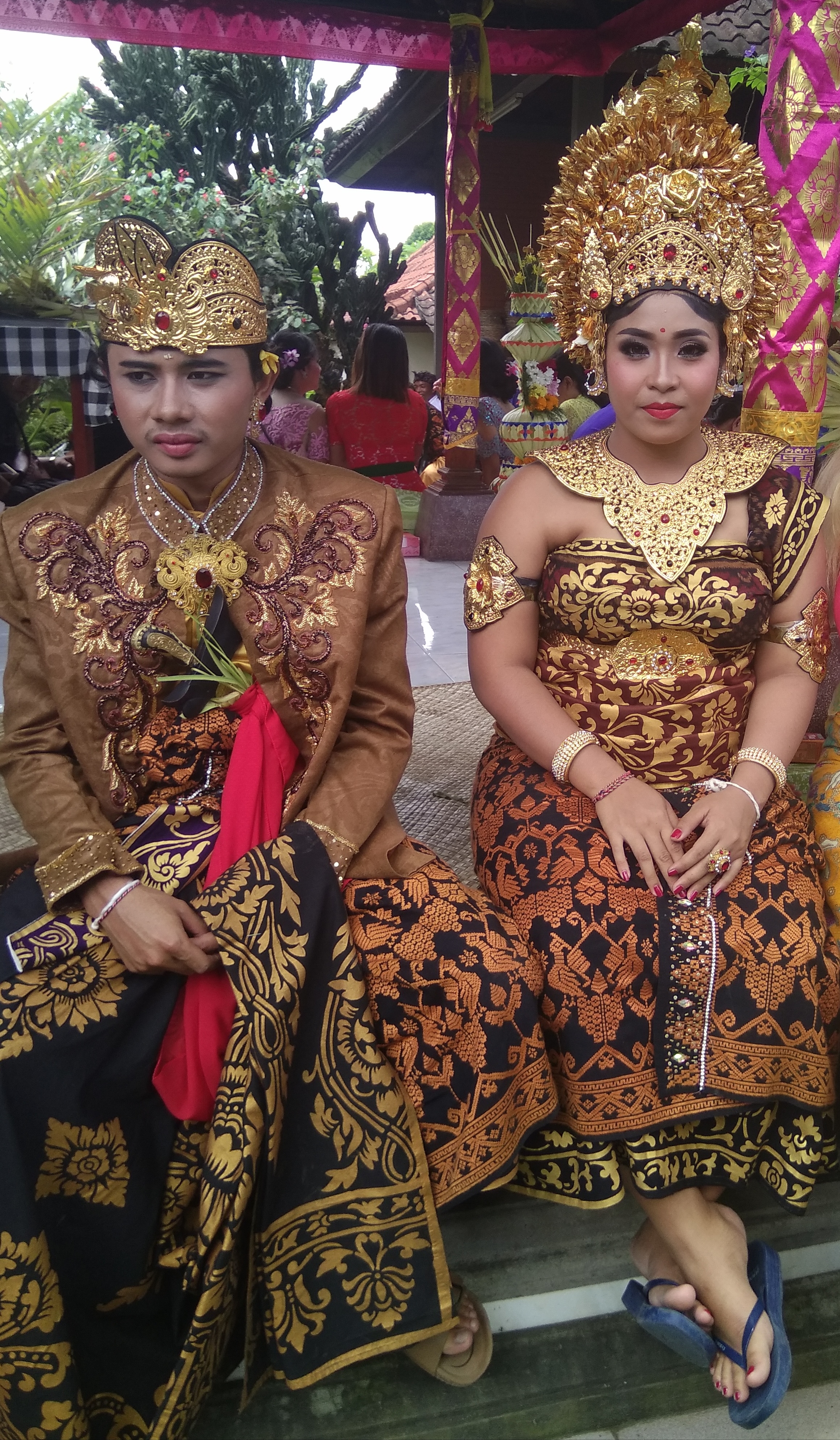
As my time at Kenari House was nearing the end, I wasn’t quite ready to leave.  I extended my stay by one day before heading south to Canggu.  Staying this extra day turned into my first experience with a Balinese Ceremony.  There was a wedding in the community.  Koming invited me to attend with her family.  What a privilege to have this opportunity.  Koming loaned me a Kamen (sarong/skirt) so I would be appropriately dressed.  It seemed the entire community was there, and they welcomed me with open arms.  I didn’t get to learn much about the wedding ceremony as I was leaving that afternoon.  As I was saying my goodbyes to Ketut and Koming, she told me since I enjoyed the wedding so much, I should return in August.  She explained that Ketut’s mother had died in 2016 and every 3 years the community held a Ngaben or Cremation Ceremony.  She would be part of the ceremony this August.  Would I like to come back for the ceremony?  I told her I would be honored to return and would do my best to make it happen.

IMG_20180226_150310.jpg
The Bride and Groom

Indeed, I made my way back to Bali and the Ngaben Ceremony.  I always thought my experience camping at EBC (Everest Base Camp) and watching the sun set and rise on the mighty mountain couldn’t be topped.  My experience with this beautiful Balinese ritual, the emotion of first hand exhuming a corpse, washing it and preparing it for cremation, witnessing the burning, understanding each step of the ceremony, and returning the ashes to the sea was truly overwhelming and something I will never forget.  I was included like family every step of the way.  I only hope I can put the sights, sounds, smells, and emotions into words as I next write about the Ngaben.

A couple of preview pictures from the Ngaben Ceremony

IMG_20180816_050104.jpg

IMG_20180816_054715_HHT.jpg


Until my next post……The Ngaben Ceremony reminds the living to always create good karma in life. It shows us that Balinese Hinduism is not necessarily about getting to heaven but how to become one with Brahman or God.

IMG_20180223_120953.jpge67fcee6d9fe7632fcf92c36ac8dc292.jpg

Mind Over Matter…..Did I Heal Myself or Was It the Balian?

Mind Over Matter…..Did I Heal Myself or Was It the Balian?

“Dad, I’m cold”, I said as I watched him shovel snow in shorts, a t-shirt, and a wool vest.  “It’s mind over matter”, he told me.  Mind over matter, a phrase if I heard it once, I heard it a thousand times from my father, along with “the mind is a powerful thing”.  Even as he lay dying of bone cancer, he tried to control his pain with his mind.  Does it work?  Eventually, he gave into the morphine drip.  I remember as a girl in Junior High on the gymnastics team struggling with a move on the uneven bars.  Mind over matter, mind over matter……I lay in bed visualizing myself doing the move.  Over and over, I pictured it.  Does it work?  Sure enough, the next day at practice, I nailed it.  Two totally different scenarios, but it is a phrase that still often lingers in the back of my thoughts.

images (9).jpeg

What you may ask does this have to do with my visit to Cok Rai, Balian, Master Healer?  Or you may be saying, she did this because of Eat, Pray, Love…….yes, I saw the movie, more than once…..yes, I loved it…..no influence whatsoever on my going to Bali or visiting the Balian.  My motivation for visiting Bali, I met a woman in Paris who worked at a café…..she moved to Bali…..she invited me to visit…..I did, in February.  I met a wonderful Balinese family at my homestay…..we became friends…..they invited me to return in August for the cremation ceremony for his mother…..I did this month.  The Ngaben (cremation) Ceremony took place over 6 days of which I attended 4 and I will address in a future blog.  Long days, one rising at 2:30 am for exhuming a body. Those days took their toll.  I was tired, mentally and physically.  Physically, my body ached, mostly my knees and ankle and low back.  I was mentally exhausted trying to wrap my head around and understand the meaning/significance/procedure of many ceremonies/rituals. Not even knowing the word Balian or truthfully anything about them, on the afternoon of the 3rd day I asked Ketut if there was a healer in the village.  “Yes, I know one, he is old now, but Putu can take you on Sunday morning. It is best to go early”, he told me. On Sunday at 9:00 am, without any research, an open mind and Putu, I headed down the rabbit hole…….

Balian ~ Balians are traditional healers who work with divine energy to treat physical and mental illnesses, remove spells and channel energy from ancestors. Some Balian have learned their art from studying the ancient scriptures called lontar and apprenticing with a master. Others have received wahyu or divine inspiration and heal from the heart.

IMG_20180819_092218.jpg

Putu picked me up at 9:00 Sunday morning.  We traveled to another community/village about 20 minutes from my homestay, Kenari House.  I knew nothing about the “healer” I was about to see.  I never asked his name or what manner he received his “power”.  I seriously knew next to nothing about Balinese healers.  I didn’t even know the word Balian until I returned home and started some research on the subject.  We arrived at his compound.  Putu spoke to someone and turned to me and said we are lucky, he is here and he will see you.  His compound was a serene quiet place.


IMG_20180819_092215.jpg

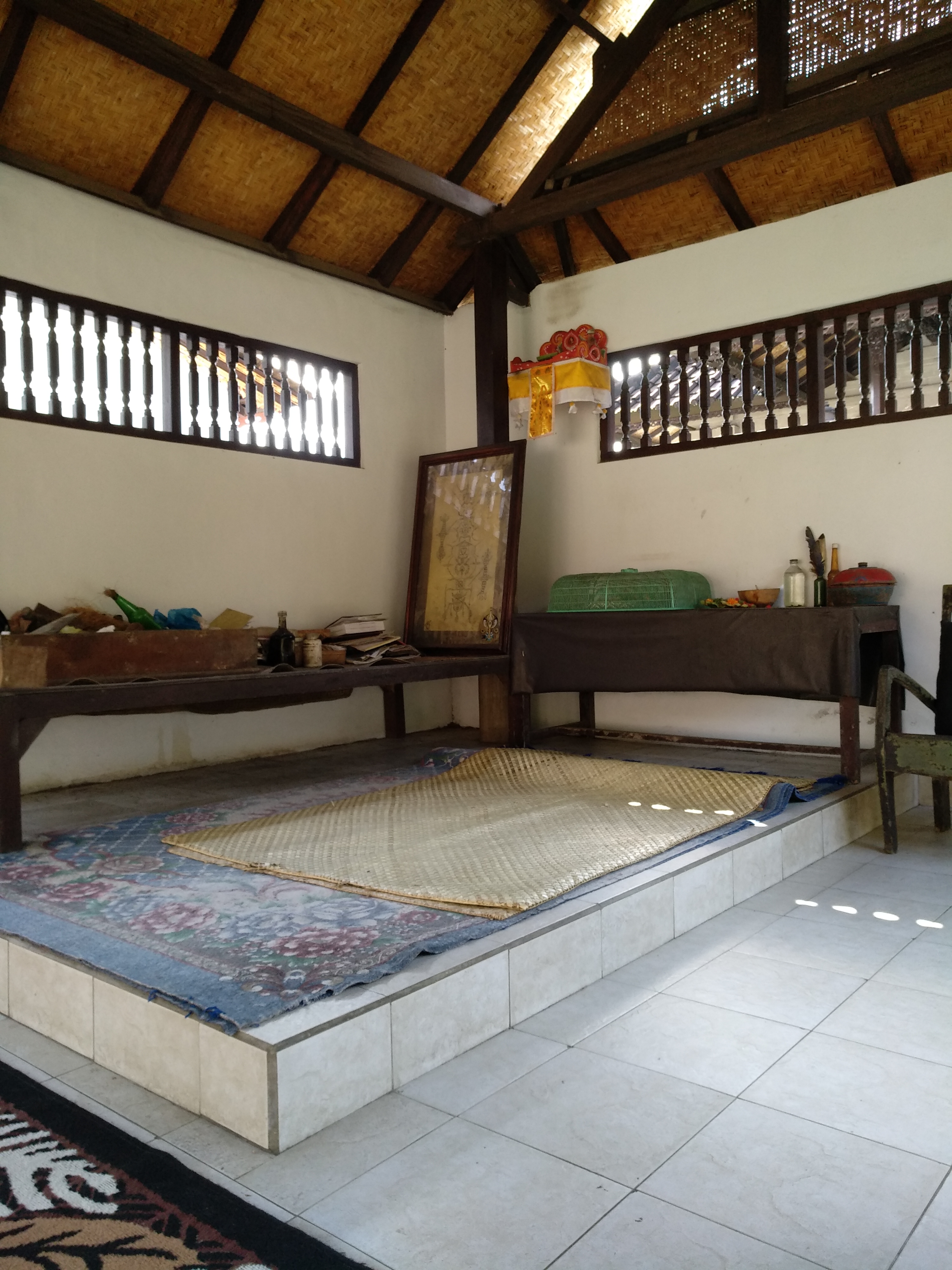
We were instructed to wait in an area that was his treatment space. Putu and I were the only people there.  I later found out that Cok Rai is basically retired.  Afterward, I realized what a privilege it was to see him. As I sat on the floor, I focused on the sights, sounds and smells that surrounded me.  My thoughts…..what would I say to him?……how should I greet him?…..next thing I knew he was in front of me.


IMG_20180819_092525.jpg


IMG_20180819_092210.jpg


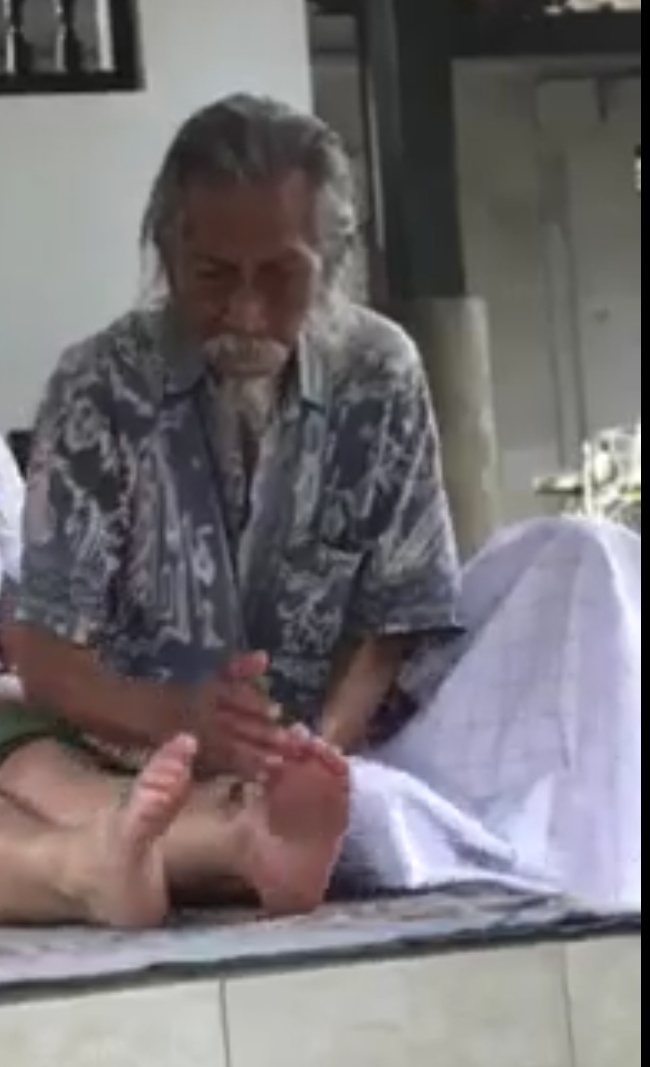
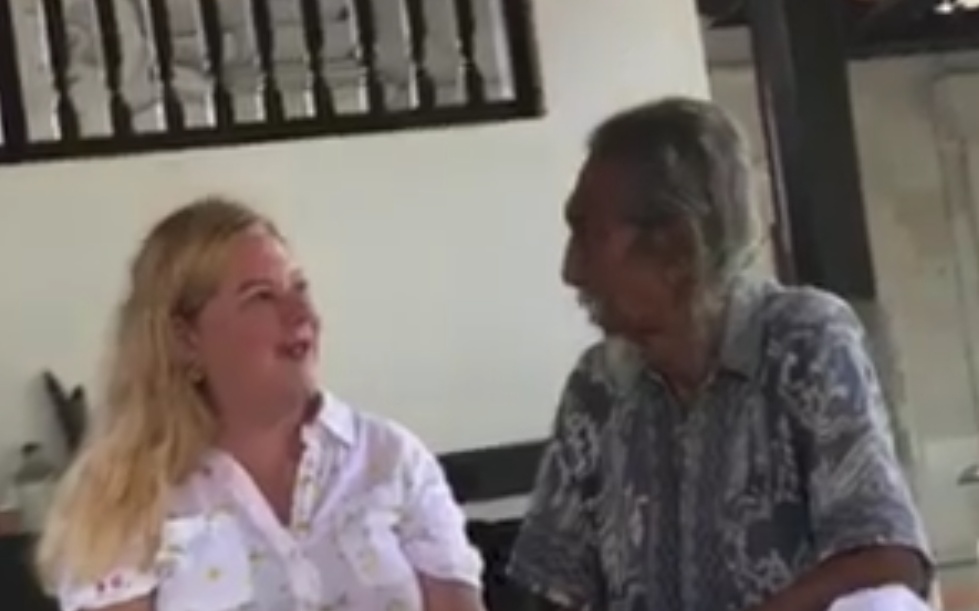
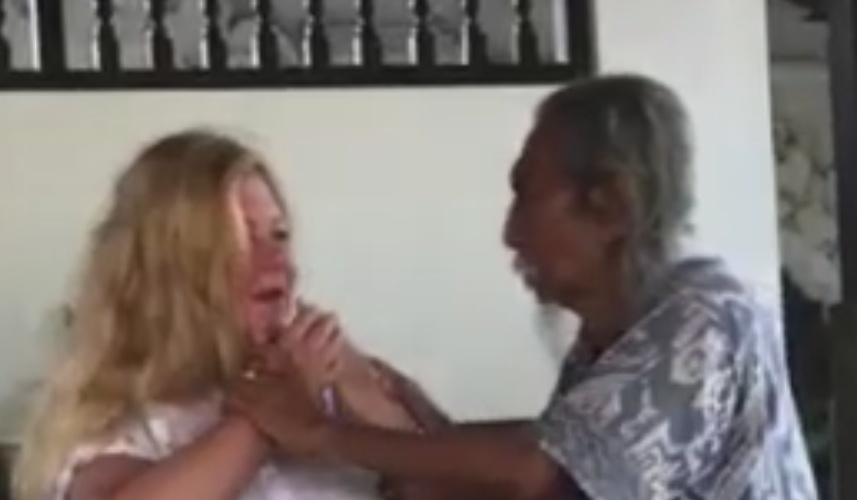
A slight man with long grey hair and a white mustache and goatee.  He had a soft comforting voice.  He sat in a wooden chair and instructed me to sit with my back against his legs. He placed a finger in each ear and applied pressure.  He also touched several pressure points on my head, temples, and base of my skull. He mumbled something about low back and then instructed me to lie down on the rattan mat which had a small bump for just under the base of my head.  He retrieved what appeared to be nothing more than a t-shaped stick.  Before doing anything with the stick, he just moved his hands over my arms and body, not quite touching them.  He said you have much energy, much electricity.  It may feel like a shock when I treat you.  I found this quite interesting because, in 2009, we were on a cruise of SE Asia (Thailand, Malaysia, Singapore, and Vietnam).  I don’t remember where we were, but I saw an acupuncturist.  They also told me my body gave off much electricity.  They told me they could feel it without even touching my body.  Next, the healer, using my left foot, pushed and poked first at my little toe and eventually all of my toes.  If I made a noise or implied I felt pain, he would say what part of the body it corresponded.  I am not sure which toes were which.  I do know at one point he pressed, and I let him know it hurt, he said: “stomach, you have had stomach problems”.  I told him, yes when I was in the states I had some issues with food that caused me troubles.   He then took the stick and followed what I believe are the corresponding channels or meridians for my stomach.  He then again poked the same toe and I felt no pain.  He said your stomach is healed.  I didn’t know it needed healing, but, ok.  Again, poked a toe, a little pain.  He said “female” and then moved his stick over my “female organs”.  He said, “can’t heal, don’t work, menopause”.  He then added, “but you still have passion, don’t lose it, it makes you happy.  You are happy now, don’t let the happiness go away”.  A few more pokes at my toes and a few more waves of his “magic wand” over my body until there was no pain in my toes.  He then had me sit up legs flat in front of me.  He asked what else he could do. I told him I had injured my right ankle in February and my left knee had been bothering me.  The prior 5 days with a lot of walking and standing, my left the knee and ankle were both quite sore, especially climbing steps.  He got up, went to a table on which was an urn.  He put his hands in the urn came back and rubbed oil and some type of leaf/herb which resembled tobacco leaves on both legs from the knees down to the toes.  One at a time he bent each knee and pounded my heel and then foot several times on the floor.  He then had me do the same without his assistance.  He then touched the big toes of each foot together, ran his hands from toes to knees and back down. On the down, he made like he was sending something out of my body.  I assume it was symbolic of sending the pain out.  He then instructed me to stand, which I did with minimal effort and no pain in the knee or ankle as I stood from a semi-squatting position.  He demonstrated deep knee bends while holding onto a post and then instructed me to do them. After several, he had me do without holding the post. He smiled at me and asked, “how does it feel”?  Surprisingly, I replied, “great”.  And it really did.  I thanked him for his time, gave him the “donation” of about $20 American.  Putu then took me back to Kenari House.  The climb to the 3rd floor was pain-free.  I later walked into Ubud. I had my tattoo touched up. I met some parrotheads from Paris for lunch. I walked around some more and went to Gin 1717 for a couple of cocktails and finally walked back home.  Over the next couple of days, I walked several times back and forth to Ubud. On my last day in Bali, I walked about 12K including a trek uphill on the Campuhan Ridge Walk to some lovely rice fields.  Amazingly, I had NO pain in my knees or ankle.  I was exhausted and decided an hour-long foot massage would be perfect.

It has now been 6 days since my experience with Cok Rai. I am pleased to say I am still totally pain-free.  I have since googled my Balian.  It seems he is one of the most famous healers in the Ubud area. The following link is to a short article on Balians.  http://www.taksuspa.com/page/balians-traditional-balinese-healers/

Did I heal myself or was it the Balian?  I can’t answer that question.  I am glad I went to visit Cok Rai and experienced a true Balinese Healer.  If the opportunity should present itself, I would do again.

Your strongest muscle and worst enemy is your mind.  Train it well.~unknown~spirit-over-mind-mind-over-matter-its-that-simple-quote-1.jpg

IMG_20180820_110140.jpgIMG_20180820_110205.jpg

IMG_20180820_110115.jpg

I Discovered the Secret of 兰州拉米恩 Lánzhōu Lā Mǐan

I Discovered the Secret of 兰州拉米恩 Lánzhōu Lā Mǐan

Okay, so it isn’t really a secret considering there are over 1000 noodle shops selling over one million bowls of 牛肉面 Niúròu miàn (beef noodles) per day in Lanzhou alone, according to xinhuanet.com. The secret being, how do they make it look so simple? Noodle pulling, that is. Although, after reading many blogs and articles on Lánzhōu Lā Mǐan (Lanzhou pulled noodles), it appears you may have to give up your first born and sign off in blood to get the “true” recipe that has been passed down for centuries and is written on cowhide and hidden away in some Lanzhou grandma’s basement. Just kidding of course, but people from Lanzhou insist their noodles are the only authentic ones. Whenever I travel to a new city in China, I usually ask for a Lánzhōu Lā Mǐan shop. I can say that traveling far and wide every Lánzhōu Lā Mǐan shop I have where I have eaten, has served me almost identical soup. Taste, texture, ingredients have always been consistent. Before, I get into my attempt at Lā (pulled) Mǐan (noodles) a little of what I have learned in this endeavor.

Why noodles? I think most people in the Western World equate China with rice more so than noodles. It is true China produces more rice than any other grain. With 75% of China’s population being farmers, rice is just less than 50% of all crop cultivation. There is also a distinct agricultural dividing line, rice is predominantly grown in the south while wheat is grown in the north. I found it extremely interesting to learn that only 15% of China’s land can be cultivated. This 15% also supports 20% of the world’s population and leads with 30% of the world’s rice population. The divide of rice and wheat into north and south sectors goes as far back as the Han Dynasty which reigned from 207 BC to 200 ad. According to the Wall Street Journal, a study conducted by psychologists for the Journal of Science, there is a difference in personality and traits of people of the north and south. People in the north that grow wheat and are “noodle eaters” are more individualistic and are more analytical in thought while rice growers/eaters in the south tend to be more traditional and more holistic in thought with lower divorce rates. I do have rice occasionally but living in the north has fueled my noodle addiction.

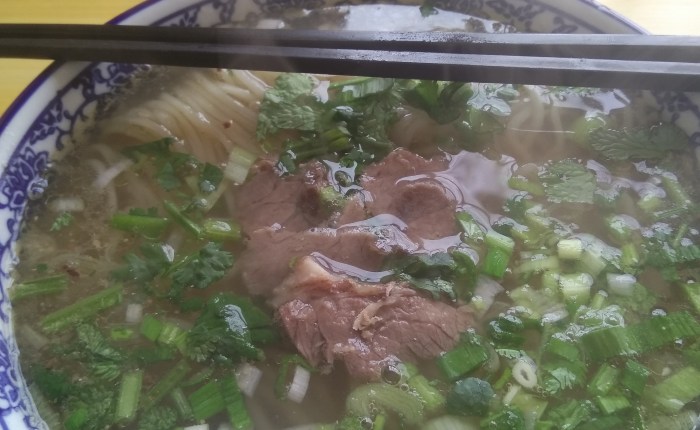
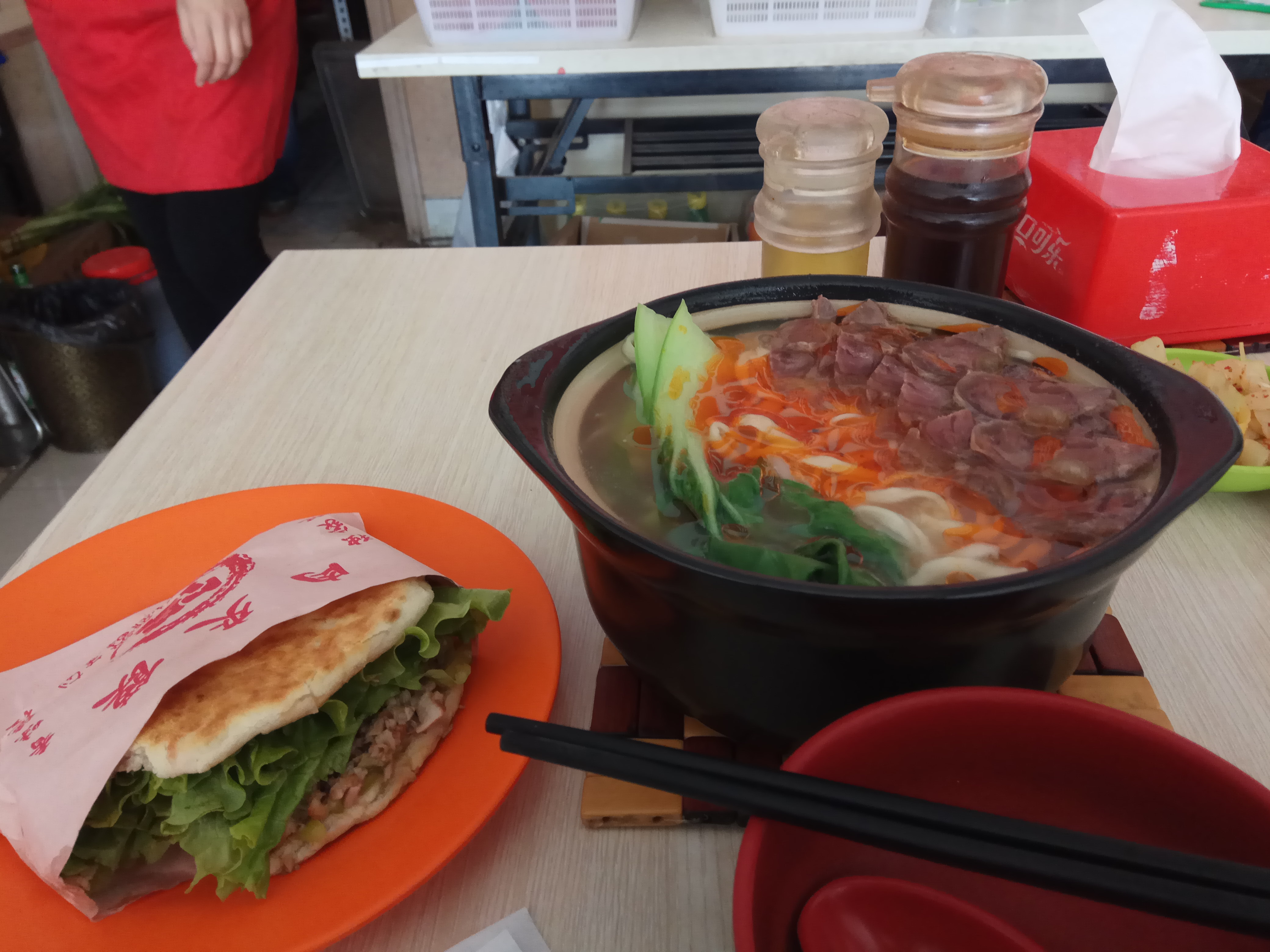
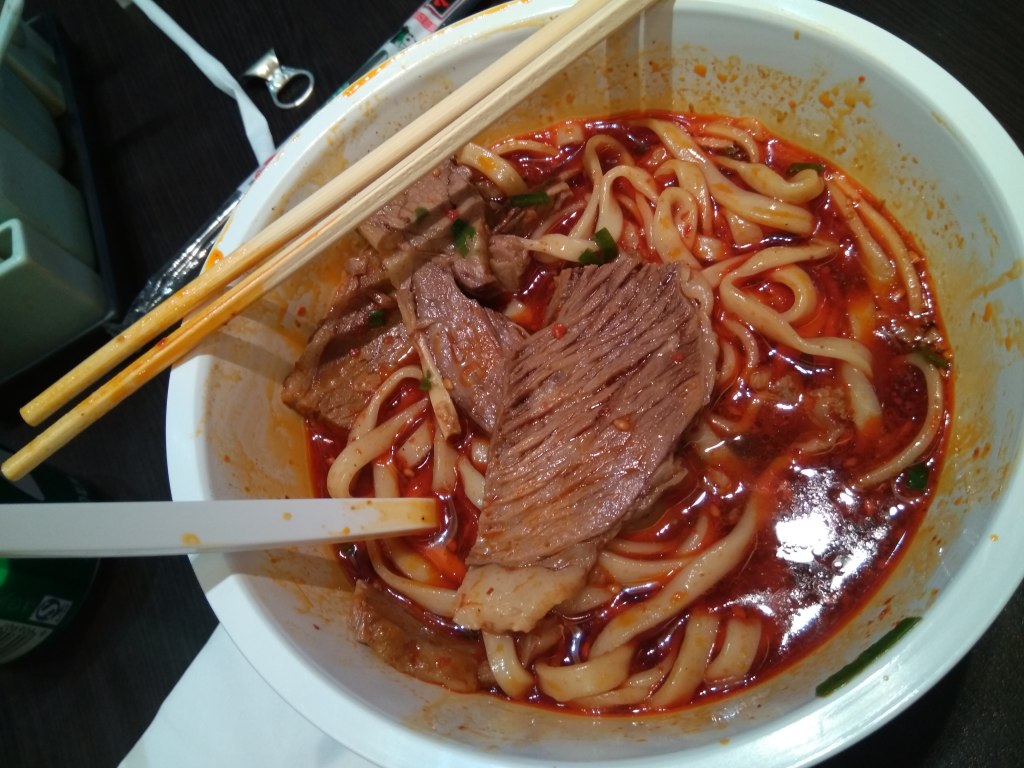
Next, I need to explain the difference between 牛肉面 Niúròu miàn and 兰州拉面 Lánzhōu Lā Mǐan. Niúròu miàn is as translated, “beef noodles” or beef noodle soup. It can be a spicy, tomato, garlic or herbal medicine based broth. Although Lánzhōu Lā Mǐan is technically a beef noodle soup, it is different in the way it is prepared and the history of its origin. I love any type of Niúròu miàn, but am currently obsessed with Lánzhōu Lā Mǐan and that will be the focus of the remainder of my blog.

IMG_20170325_120114.jpg
Niúròu miàn
IMG_20171007_163426.jpg
Niúròu miàn

Lanzhou is the capital and largest city of Gansu Province in Northwest China. Many of the lamian restaurants are owned by Hui ethnic families from northwest China. The Hui people are predominantly composed of Han Chinese and adhere to the Muslim faith. Therefore, many lamian restaurants are also halal and are the most common halal restaurants in eastern China. Centuries ago, noodle makers in Gansu learned that certain kinds of ash, called peng, had the effect of tenderizing dough, but more about that later. A young Hui man who sold the hot soup noodles topped with beef on the streets of Lanzhou during the Qing Dynasty is credited with developing the dish in its current form. Mao Baozi’s noodles became so popular that they literally define the traditional characteristics of the dish! In 1919, Mao Baozi opened his first restaurant in the city, leading to the eventual growth of thousands of beef noodle restaurants in Lanzhou. Outside of Lanzhou and Sichuan province, such noodle shops carry the title of 兰州正宗拉面 (authentic Lanzhou hand-pulled noodles), while in Lanzhou itself they are simply called beef noodles (牛肉面).

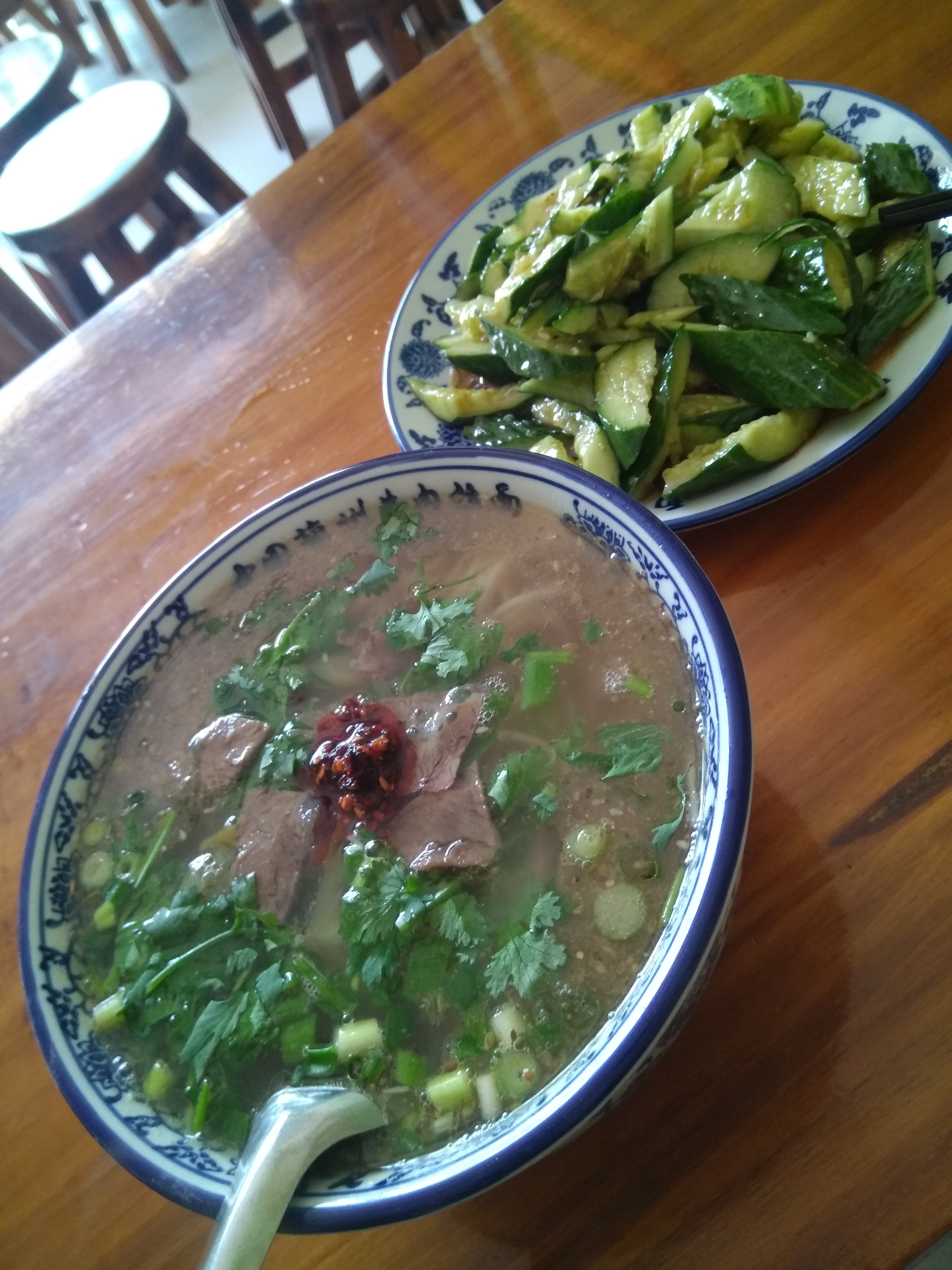
In order to be called authentic Lánzhōu Lā Mǐan, there are certain rules so to speak. Mao Baozi’s dish was said to be “1 clear, 2 white, 3 red, 4 green, 5 yellow” (一清、二白、三红、四绿、五黄) to signify respectively clear soup, white radish, red chili oil, green coriander, and yellow noodles. (Using the alkali ash or peng hui imparts a yellowish tint to the noodles, which actually do not use egg.)

IMG_20180611_111704.jpg
My Crack with a side of Spicy Cucumbers

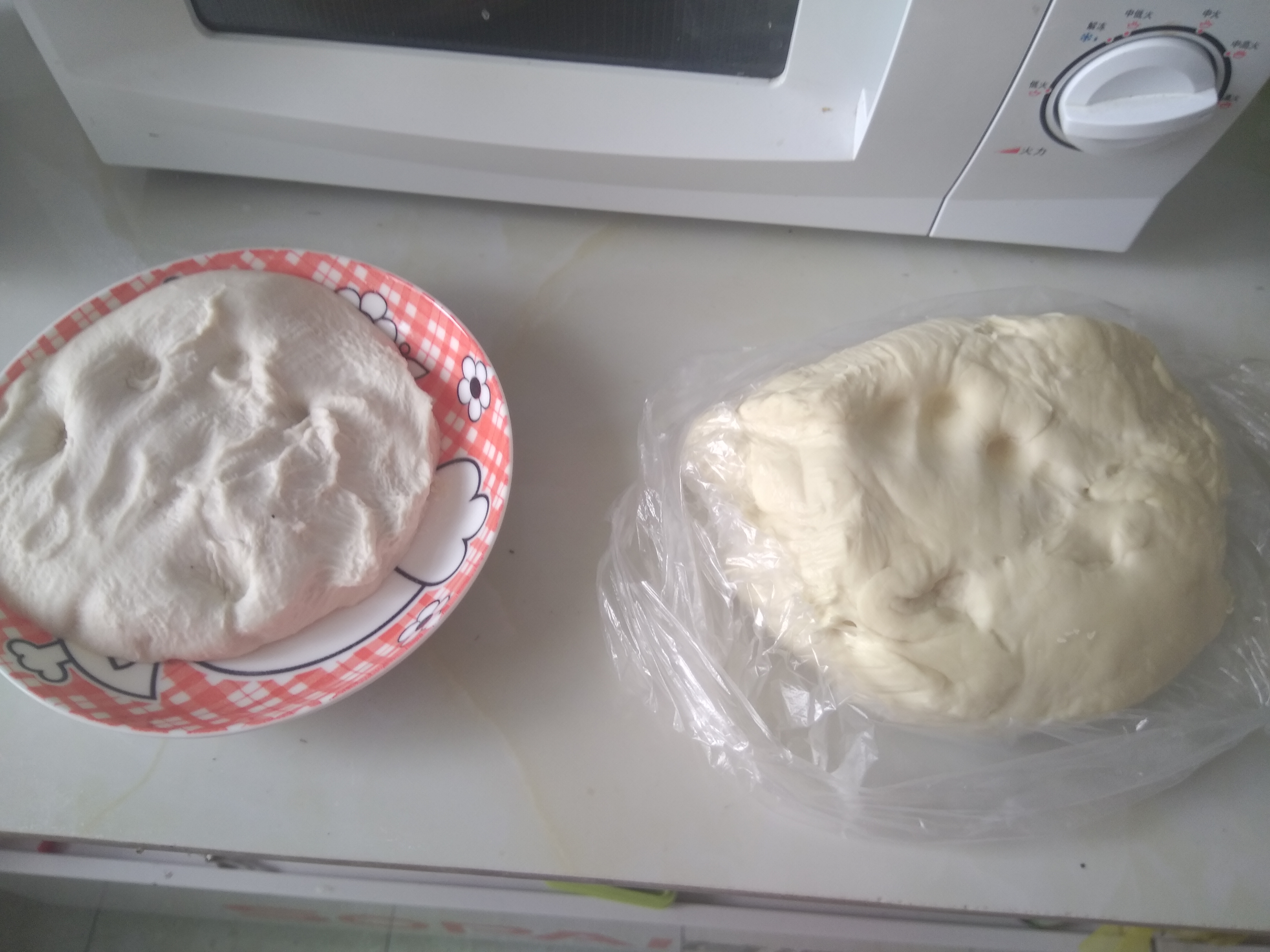
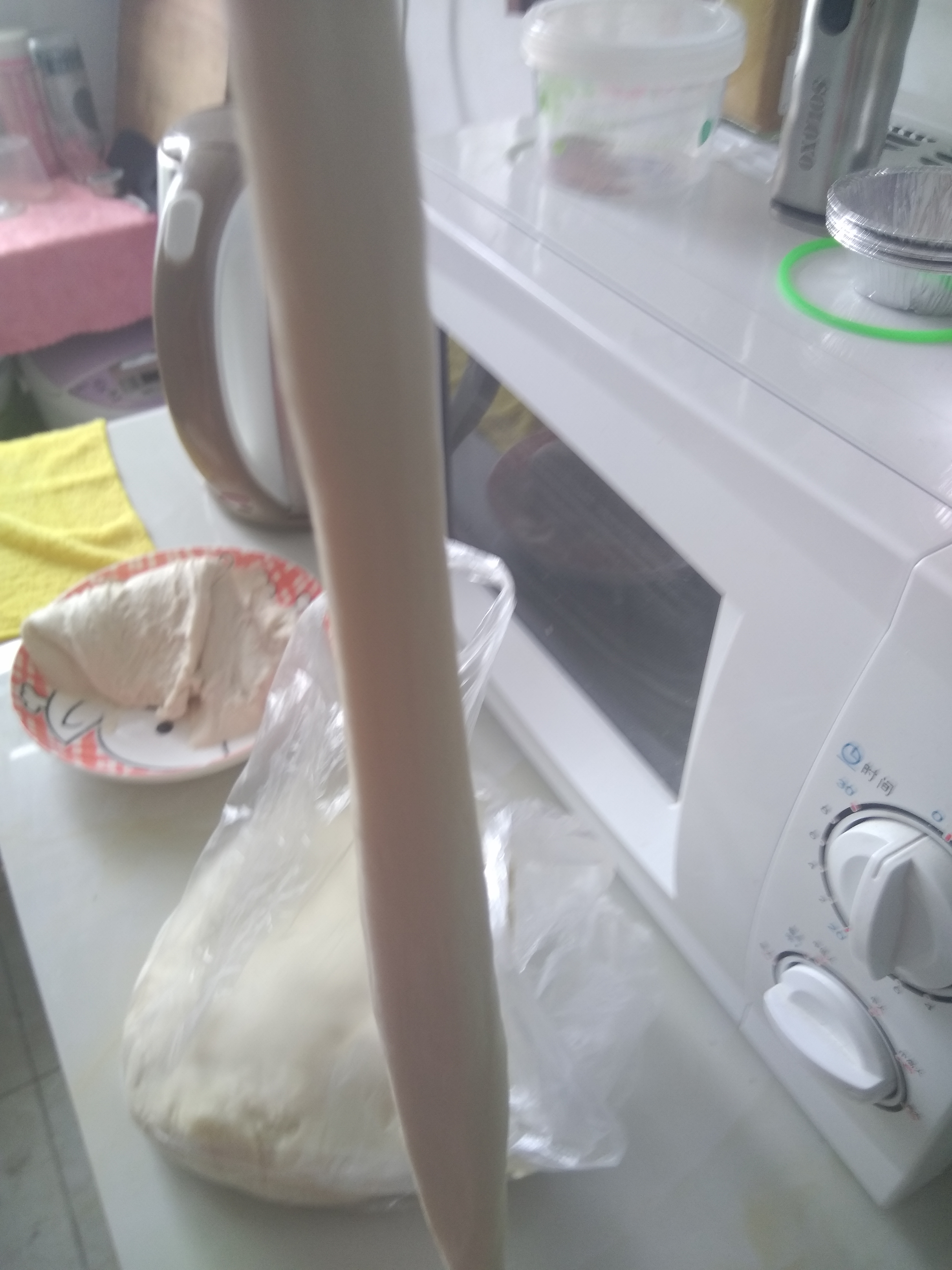
This post came about because of the peng hui. I usually eat at my local shop at least twice a week. On Sundays, I am in the city of Liaocheng and go to a noodle shop there for Niúròu miàn. Although I have had many different beef noodle soups all over China, the Lánzhōu version is easily my favorite and I have on occasion called it my crack. When my Lā Mǐan shop in Dong’e closed last summer for well over 6 months, I became obsessed with finding Lánzhōu Lā Mǐan shops everywhere I traveled, not just any old beef noodle shop. I also started researching to find out what made the Lanzhou noodle soup so delicious and consistent wherever I had it. I enjoy making Italian noodles and decided a bucket list item for me was learning to hand-pull noodles. I always watched the noodle maker at my local noodle shop. It really didn’t look that hard. I watched many YouTube videos and had also purchased a book, “The Mystery of Noodles” while I was in Suzhou. The book, written in Chinese doesn’t do me a whole lot of good but has great photos. Well, I finally decided I needed to just make some dough and give it a whirl. I was a bit surprised how little information, in English anyways, there was on the internet as far as recipes, particularly for the noodle dough. Basically, what I discovered, it was a simple mix of flour, water, and salt, so I thought. Although some articles mentioned baking soda, baked baking soda and lye water. I went with the basic flour, salt, and water. I determined it should be kneaded for 20 to 30 minutes and then let rest for up to six hours or overnight. Really, the noodle shops always have giant piles of dough they grab a hunk, twirl, slam, stretch, fold and finally pull. Made my dough, kneaded for 30 minutes and let it rest for 6 hours as I had errands to do. I returned home, kneaded some more and started to pull…….didn’t pull it more than 4 or 6 inches before it broke. Kneaded some more and put it to rest overnight while I did some more research.

IMG_20180608_145041.jpg
The “secret”… Peng Hui
IMG_20180519_110800.jpg
My Noodle Master

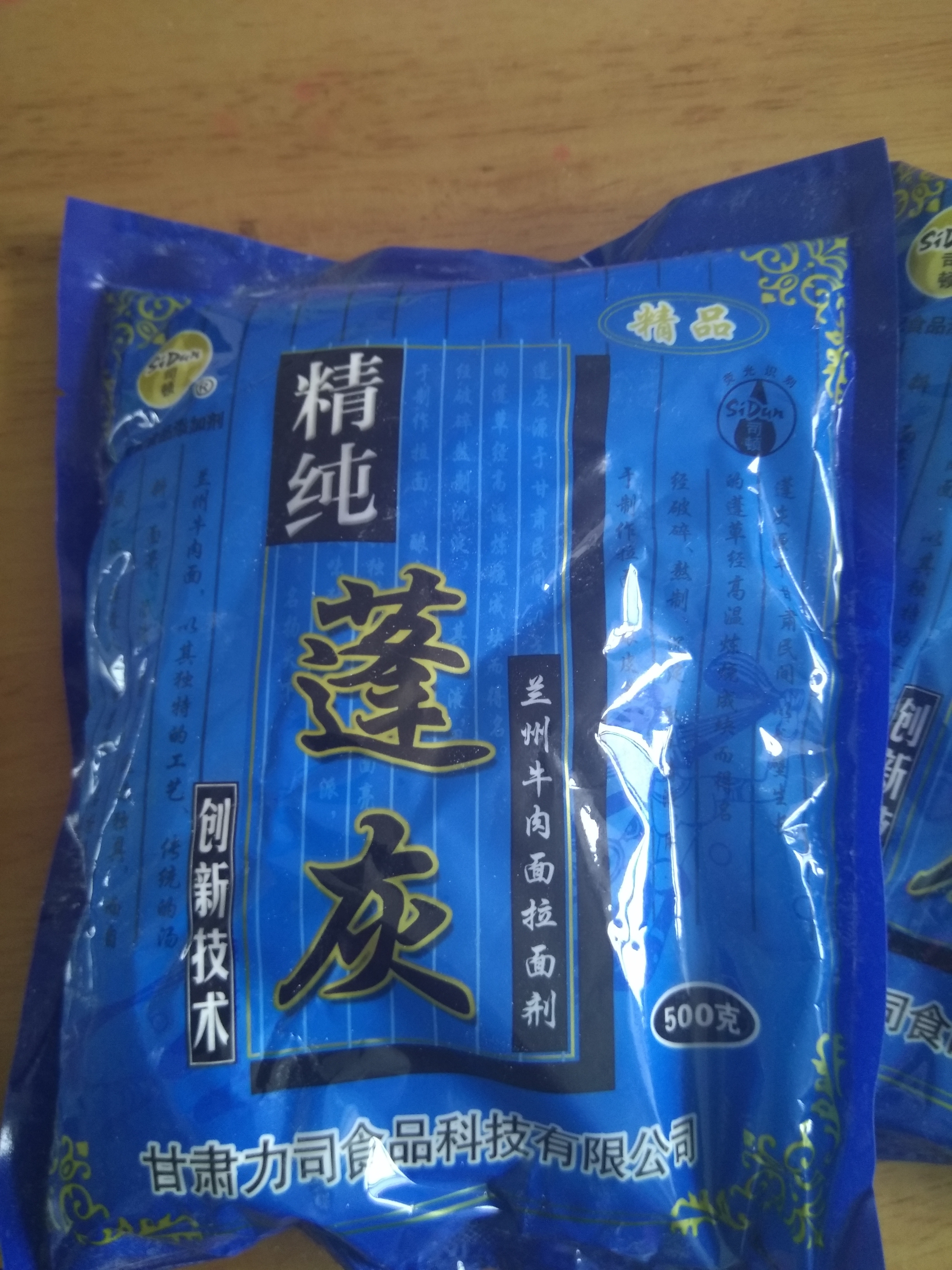
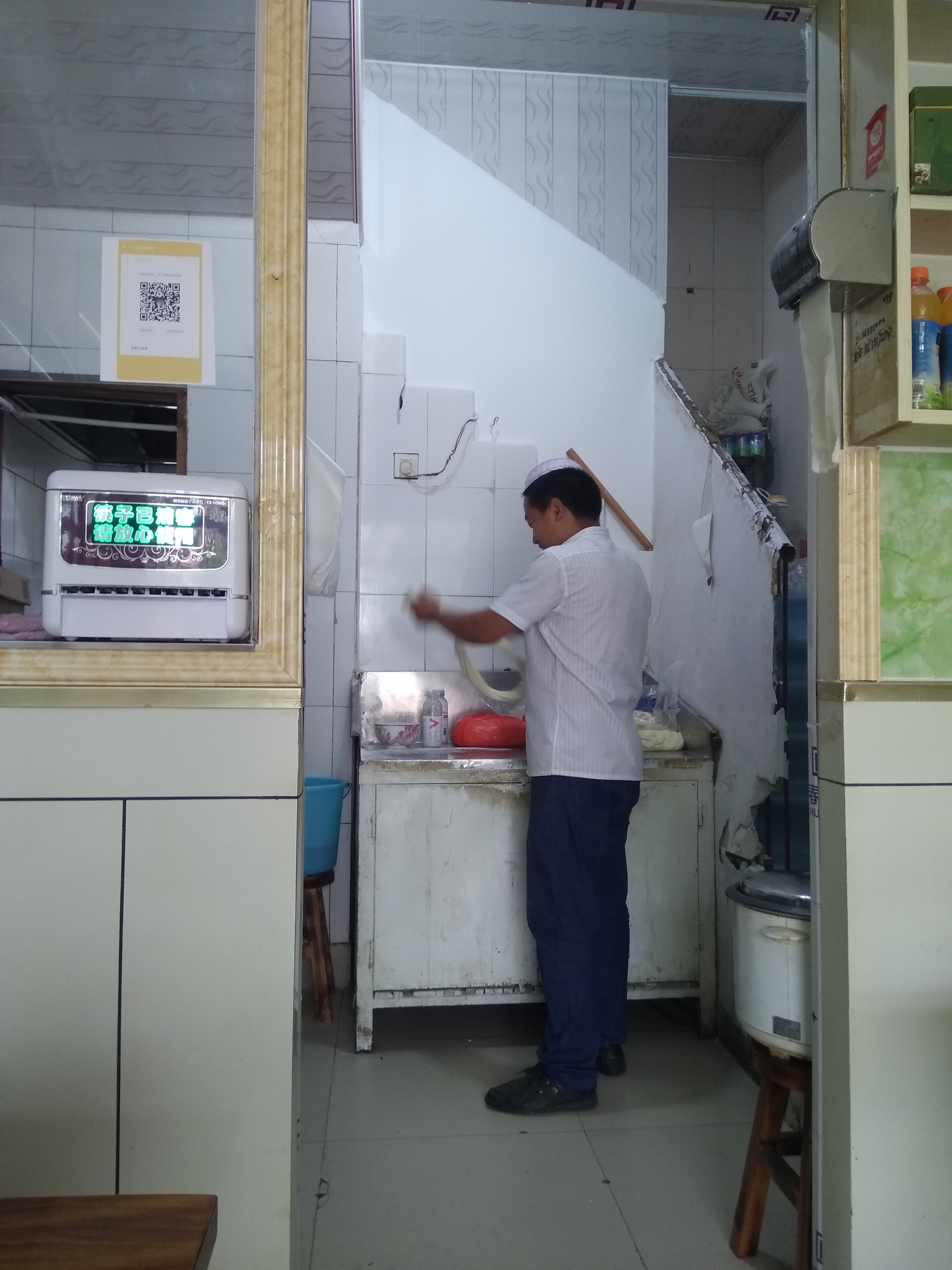
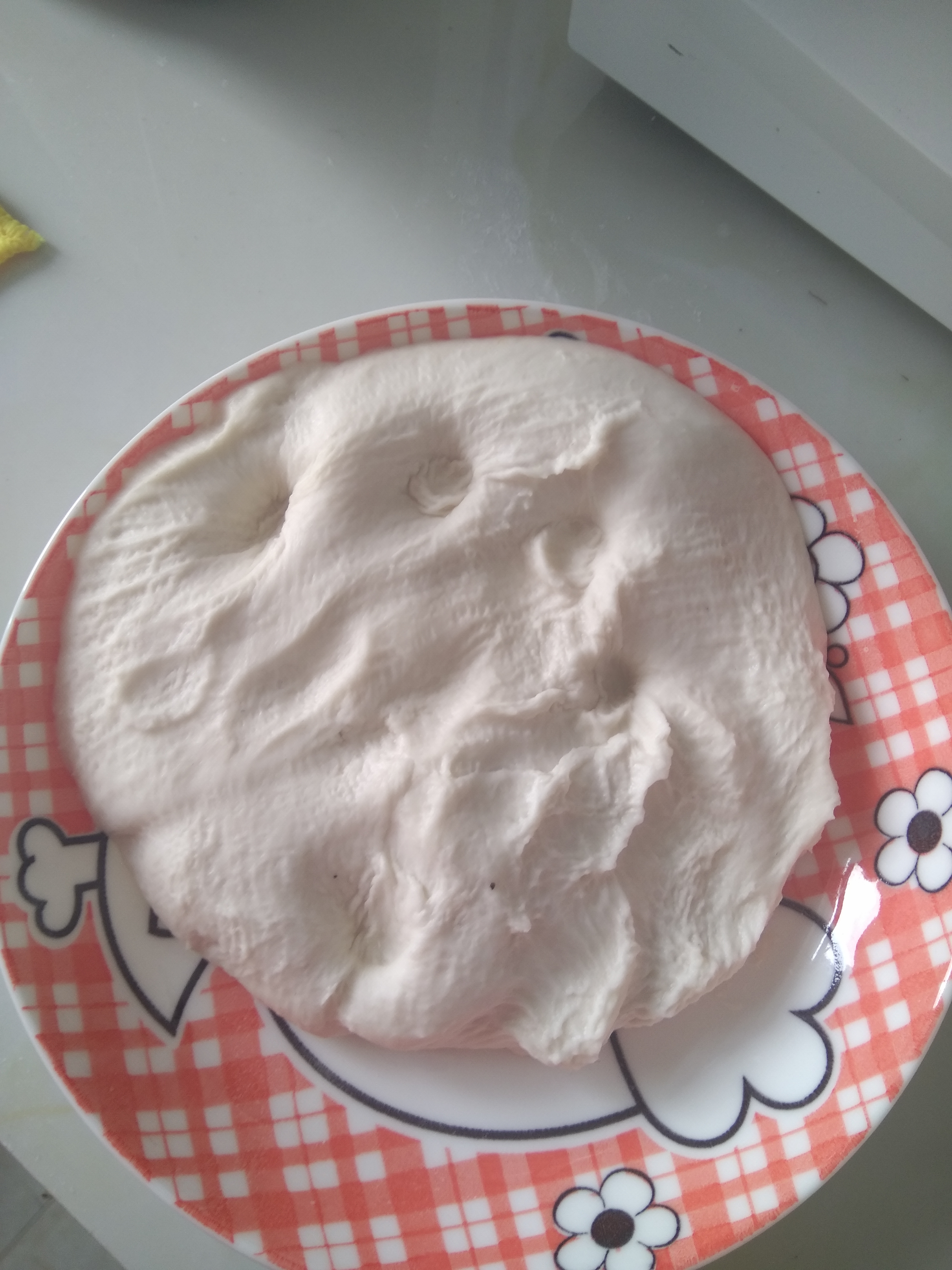
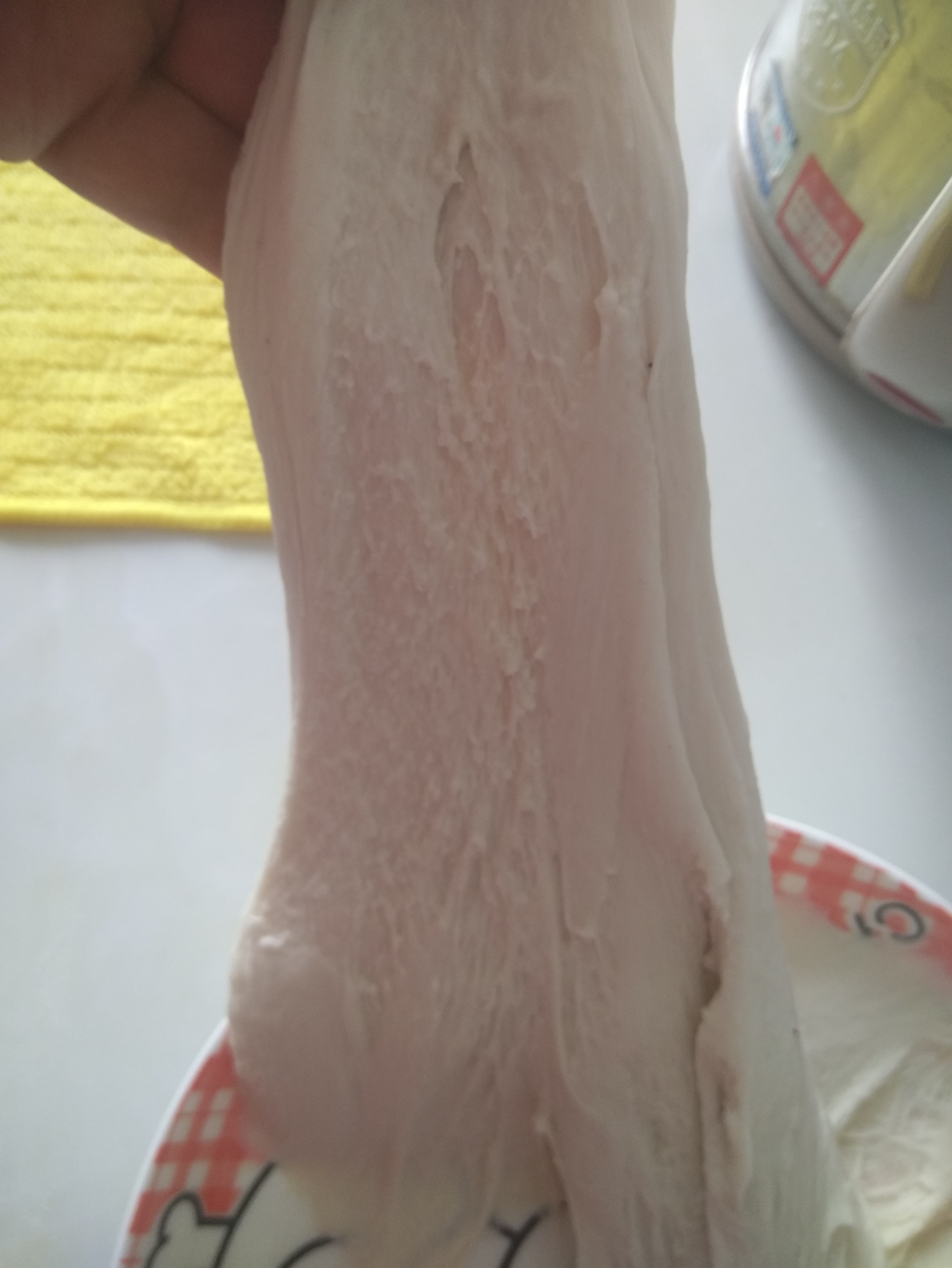
There are several styles of twisting the dough but they all employ the same concept: a piece of dough is repeatedly stretched and folded onto itself in order to align the glutens and warm up the dough for stretching. Then it is rolled out to a workable thickness and cut into workable portions. The end pieces of the starting dough are never used because the glutens are not as aligned as the middle pieces. Gee, guess I should have paid more attention in chemistry and physics, who knew noodle making was so scientific. So, I twisted and stretched and folded till my wrists ached……no luck. Maybe there was something to the baking soda or lye water, which doesn’t sound exactly healthy. At this point, I decided to pack up my dough and take it to the noodle shop. I have google translate, no problem. He took one look at my dough, gave it a poke and shook his head. He said my dough was too soft and it needed “limestone” or at least that’s what the translation said. He also told me he studied the making of the soup and noodles for 1 year. I thought I better at least eat lunch while I was there and I saved the google translate Chinese part from him to take to the supermarket to find “limestone”. I showed them the Chinese that the noodle shop had told me. They said ahhhh, peng hui, and then said Lā Mǐan, so I knew I was on the right track. The girls I was speaking with told me 没有 méiyǒu, meaning they had none. I then asked them where I could get it simply by using the word哪里 nǎlǐ which means where. They sent me to go to the old vegetable market. The miracle of miracles, the first shop I went to had it. 2 bags for 8 RMB or $1.25. Ok, I better stop back at the noodle shop and find out how much to add to my mix. The noodle maker happened to be outside the shop when I arrived. Peng hui comes in a powder form. Through my translator, I asked how much to add if I use 500 grams of flour. He shook his head and tried to explain something to me. Finally, he took me into the shop and gave me a big hunk of dough and then instructed me to wait as he put some water in a bottle. I had my answer. You mix the peng hui with water and keep it on hand. The water is added to the dough and this is what breaks down the glutens and gives the dough elasticity. Okay, I don’t quite have the whole answer as I need to experiment as to how much of the peng hui/alkali water to add. But what a difference between his dough with the peng hui and mine. I do know that the amount you add must be small because it has a strong sulfur smell. Also, finding out the name peng hui, I was able to get more information from the internet. I hope to spend some time at the shop observing. Interestingly, from what I understand, peng hui is not available in the USA. I did find it on aliexpress shopping. The two bags I purchased for $1.25 were $45 online and currently unavailable.

IMG_20180608_144336.jpg
My dough
IMG_20180608_144459.jpg
My dough started to break apart almost immediately.
IMG_20180608_144349.jpg
Notice the yellowish tint to his dough.
IMG_20180608_144735.jpg
It pulled so nicely, even if I didn’t get any noodles from it.


Penghui originally comes from a plant called jianpengcao 碱蓬草 (Suaeda glauca) that grows in the highlands of Alashan (north of Lower Gansu, in Ningxia and Inner Mongolia). After this plant has been charred in a pit for several hours it is compressed into a dark crystal block. That is later processed with water to make a solution that noodle pullers use on mixed dough. Now that I know the “secret” to the dough, along with practicing pulling noodles, I am now working on the broth, which also has certain rules or ingredients. I may not have mastered the hand pulling of noodles by the time I get to Warren, Ohio in July, but even if I make the broth and used handmade, not pulled, noodles, you might understand my addiction. I will leave you with the recipe I found from Wei of Red House Spice. https://redhousespice.com/lanzhou-beef-noodle-soup/

Ingredients

1400g/3lb large chunks of beef, 2 beef bones, 3000 ml/13cups water, 1.5 tsp salt (or to taste)

Spices and Herbs

2 star anise, 1 small piece cassia cinnamon, 2 bay leaves, 1 tsp Sichuan pepper, 1 tsp white pepper, 1 pinch fennel seeds, 1 pinch cumin seeds, 1/2 tsp ground licorice or 4 slices licorice root, 2 pieces sand ginger, 3 dry chili (optional), 1 thumb sized ginger, 3 stalks spring onion

You will also need

500g/18oz daikon (aka mooli, Chinese white radish), 3.5oz noodles per person, coriander/cilantro (chopped), homemade chili oil

  1. Put beef chunks and beef bones into a pot filled with cold water. Bring to a full boil. Skim off the froth on the surface.
  2. Add all the herbs and spices (use a closed tea strainer or cheesecloth to easily discard later) This also keeps the broth clear. Leave to simmer about 2 hours (until the beef is cooked through).
  3. Take the beef out to cool and discard the bones, herbs and spices. When cold, cut the beef into either thin slices or cubes. It is suggested to leave the beef to cool completely(best to be in the fridge overnight). This way it won’t fall apart when cutting through.
  4. Cut daikon into thin slices. Put into the beef broth. Cook for 15 minutes or until very soft to the bite.
  5. Cook noodles and drain.
  6. Plac noodles in serving bowls. Pour in hot broth and daikon. Top with beef slices/cubes. Garnish with fresh coriander/cilantro and homemade chili oil.

Homemade Chili Oil

Ingredients

For the Chili

1/2 to 3/4 cup chili flakes, 2 tbs toasted sesame seeds, pinch of salt, 1 tbs chili powder (optional)

For the Oil

1 cup vegetable oil, 1 tsp Sichuan peppercorn, 1 star anise, 1 bay leaf, 1 small piece cassia cinnamon, 1 spring onion (washed, dried, cut into big pieces) 3 slices ginger.

    1. In a bowl, mix all the ingredients for the chili. Have another empty bowl ready. The bowl should be heatproof and completely dry (glass or porcelain is best). Place a sieve over it.
    2. Pour oil in a cold pan or pot, add the ingredients for the oil. Cook it on low heat. Watch attentively. Turn off the heat immediately when spring onion turns brown (you should see smoke at that moment as well).
    3. Then pour the oil into the empty bowl through the sieve. Discard everything caught in the sieve. Put half of the chili mixture into the oil. You should see it bubbling intensively.

Add the rest of the chili mixture when the bubbling calms down. Stir well with a clean dry spoon.

  1. Leave it uncovered until completely cool. Wait at least 12 hours before using to allow all the flavors to combine. Then transfer to an airtight container(s). Chili oil will keep for about 1 month in the cupboard and up to 6 months in the fridge.

From Russia With Love, Part II or A 4 Hour Drive From Moscow to a “Golden Ring” Town

From Russia With Love, Part II or A 4 Hour Drive From Moscow to a “Golden Ring” Town

I have decided to jump to nearly the end of my journey in Russia and a visit to the small, ancient countryside town of Sudzal.  Probably nothing profound in the post, but just sharing some more of the history and beauty of the country I knew so little about.

Northeast of Moscow is a ring of ancient cities known as “The Golden Ring”.  These towns played a significant role in the formation of the Russian Orthodox Church.  The town of Sudzal, on the banks of the Volga River, is one of the oldest Russian towns dating to the 12th century.  It is also currently the smallest of the Golden Ring towns with a population of just under 10,000.   The last post, I introduced Yulia.  Yulia was my host, along with her mother, while I was in Russia.  She was also my roommate when I lived in Changning in Hunan Province.  Yulia’s father offered to drive us 4 hours to the town of Suzdal.  He wanted me to experience the Russian countryside.


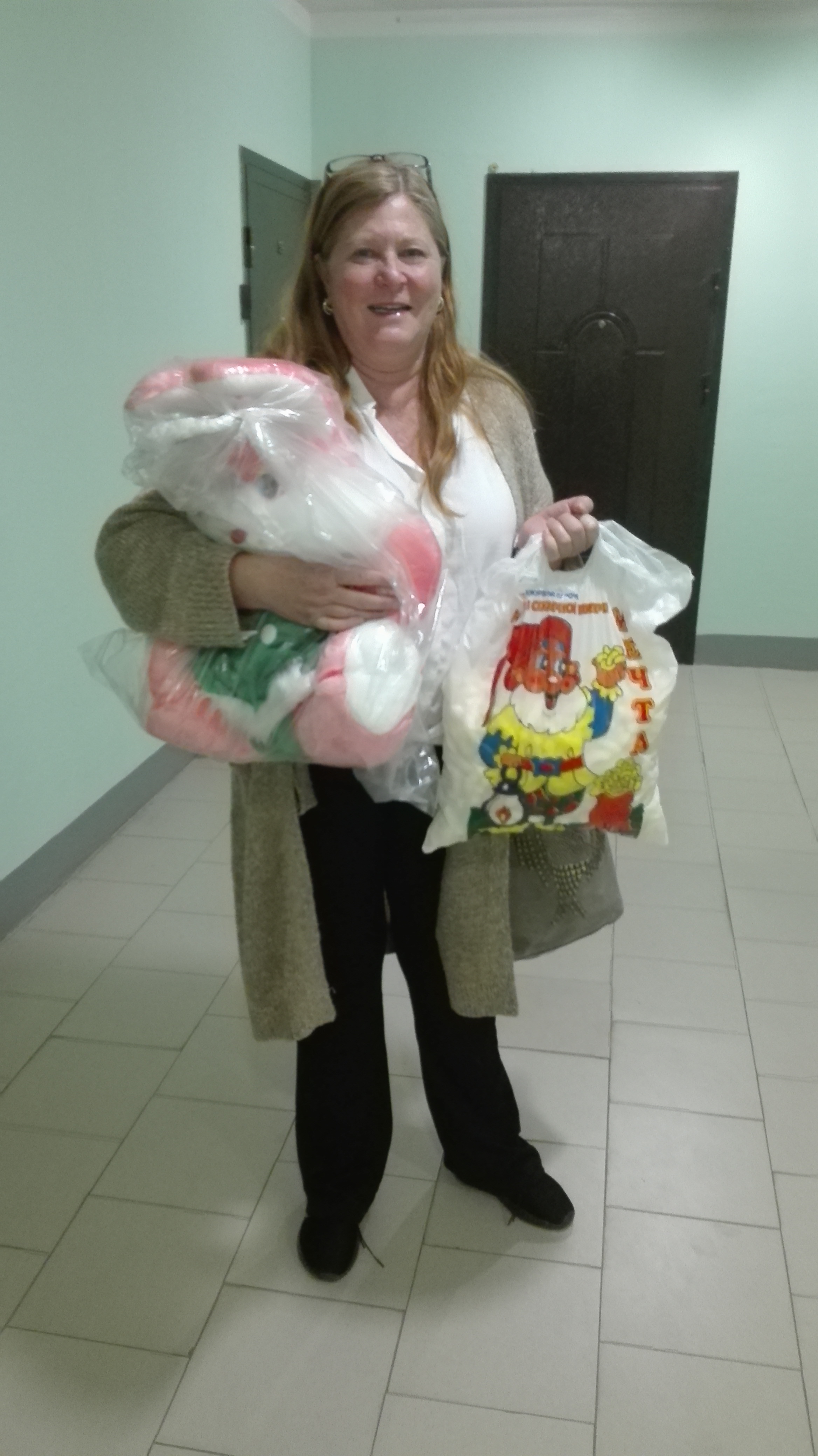
On a beautiful morning with sapphire blue skies and sunshine, Yulia’s father picked us up bright and early to start our journey.  Note, I am a couple (insert a cough cough) years older than Yulia’s father.  For some reason, in his eyes, he had a couple of 10-year-old daughters on a drive in the country…..cotton candy, cheese puffs, and a giant pink stuffed rabbit just for me.  I giggled and said, “thank you”.  Yes, the pink stuffed rabbit traveled back to the USA with me when I left Moscow for Beijing and then on to the states.

With his 2 “little” girls in the back seat, we started out on our journey.  When we were outside of the hustle and bustle of Moscow traffic, we made our first stop of the day at a small roadside restaurant.  Here we had coffee homemade donuts and chebureki.  Chebureki is a deep fried turnover stuffed with minced meat, onions, and dill.  It was amazingly delicious.  We ate and continued our journey through the sleepy countryside.  I was enjoying the picturesque scenery dotted with the onion domes of Russian Churches when after about an hour, dad pulled to the side of the road and jumped out of the car.  He trotted to what looked like a roadside vendor.  He returned to the car with the infamous giant pink rabbit for me and cotton candy and cheese puffs for both me and Yulia.  It was at this point I realized that for today whenever we were with “dad”, I wasn’t a 54, at the time, year old woman, but a young girl on a drive in the country. Thank goodness I was a grownup again when we went to dinner as we sampled several types of Russian alcoholic beverages.

Arrival in Sudzal, Yulia had arranged for young and handsome Alexander to spend about 4 hours showing us around and giving us the history of the town.  I won’t get into everything he covered or this will become a long and possibly boring post, but I would like to hit the highlights.   Again, Russia surprised me and I fell in love.  In my mind’s eye, Russia was a cold, grey, unwelcoming country.  Each day I spent in the former Soviet Union as I remember it being called, I realized what I thought about Russia was entirely wrong.  It is a warm, (I’m not talking climate because Yulia tells me Russian winters are brutal), beautiful country which is full of history and culture.

Alexander started our walking tour at the sight of the Kremlin, now basically a hill.  The Kremlin sight is also home to the Cathedral of the Nativity.  Without going into a lot of detail, Sudzal is home to 305 monuments, 30 churches, 14 bell towers, and 5 monasteries and convents.  We visited the Convent of the Intercession, founded in 1364, where it is said in 1698, Peter the Great had his wife exiled after they divorced.  Alexander continued to share the history as we toured many of the sights, including climbing to the top of one of the Bell Towers which is being restored.  After getting past the babushka wearing lady at the entrance, we made our way to the top for a beautiful view of the Russian countryside.  This was our final sight to visit and Alexander returned us to Yulia’s waiting father.

I am inserting an FYI here, just because I found it interesting.  I noticed that often throughout the countryside, I saw 2 churches right next to each other.  Alexander asked if I knew why this was. My first thought was male and female. That possibly there were times men and women could not attend church together.  Wrong!  One church is generally smaller and “closer to the ground”.  The second church is sometimes larger with soaring, often onion dome, steeples.  The smaller church was easier to heat being low to the ground, so it was the winter church.  The usually taller, larger church was the summer church. Bottom line, one is heated, one is not.

Our “dad” suggested we eat in Sudzal for some typical local dishes and alcohol. This was fine by me.   Alexander directed us to a lovely restaurant where we had a nice table on the porch. I can’t tell you all the food we consumed as I didn’t take notes.  I just know I got a taste of very traditional local food.  I also know that I was not a fan of the caviar ordered by Yulia’s father.  It was served on a bed of shredded beets. We had a couple of appetizer platters with bread, meat, cheeses, veggies and a lot of dill. I had a chicken dish with a sour cream sauce and mashed potatoes that was out of this world.  Yulia had a meat stew.  Before the meal even started, I had 4 “traditional” alcoholic beverages in front of me.  One was a honey mead and the others were vodka based and infused with local herbs or fruit. If I recall, I slept on a bit of the long journey home.

We finished our meal and started the drive back to Dolgoprudny.  We had daylight during much of the journey home as the sun doesn’t set until nearly 10 pm.  Of course, it gets daylight around 4 am also.  We finally made it home around 11:30 pm.  Me with my pink rabbit in tow, we were both ready to fall into the bed for the night as we walked about 18 km over the course of the day.  I was very grateful to Yulia and her father for taking the long trip into the historic countryside.  It gave me a totally different view of the country I knew so little about.


IMG_20170628_233553
Arriving Home


James Michener said,  “If you reject the food, ignore the customs, fear the religion and avoid the people, you might better stay at home”.  My eyes have been opened to the food, customs, religion, and people of Russia. What a beautiful, warm country.  I hope to see more of it in the future.

Some random photos from our day…….

I Survived a Chinese Hospital, Part II

I Survived a Chinese Hospital, Part II

Technically, this should be From Russia With Love, Part II, but, since I spent a good portion of today at the hospital, I pushed Russia aside and decided on part II of https://wendyjmarvin.com/2017/03/18/i-survived-a-chinese-hospital/. The first thing I will say is that this was a radically different experience than the first one.

Roll back to February of this year and Spring Festival.  I was traveling to Suzhou, Tongli, and Shanghai before leaving for my holiday in Bali.  My driver to the train station in Jinan dropped me off a short walk from the station.  I was pulling a small roller suitcase and came upon a small “fence” for lack of a better word.  Basically, it was an iron barricade blocking cars from pulling onto the square.  Me, thinking I am still young and fit decided to jump over the fence holding my suitcase.  Why didn’t I just set it over and then step over the fence, I have no idea, stupidity, I guess.  The fence was probably knee height and as I jumped my right foot didn’t make it. Yes, I was a spectacle landing on my suitcase with my ankle wrapped around the iron rail.  I jumped up as quickly as possible, which probably wasn’t quickly or gracefully and hurried on my way toward the train station not stopping to see who saw me face plant on my suitcase. I limped to the station, got my ticket and soon boarded the train for my approximately 4-hour journey.  Once on the train, I popped a couple of Advil as I knew soreness was in my future.


IMG_20180212_102806.jpg
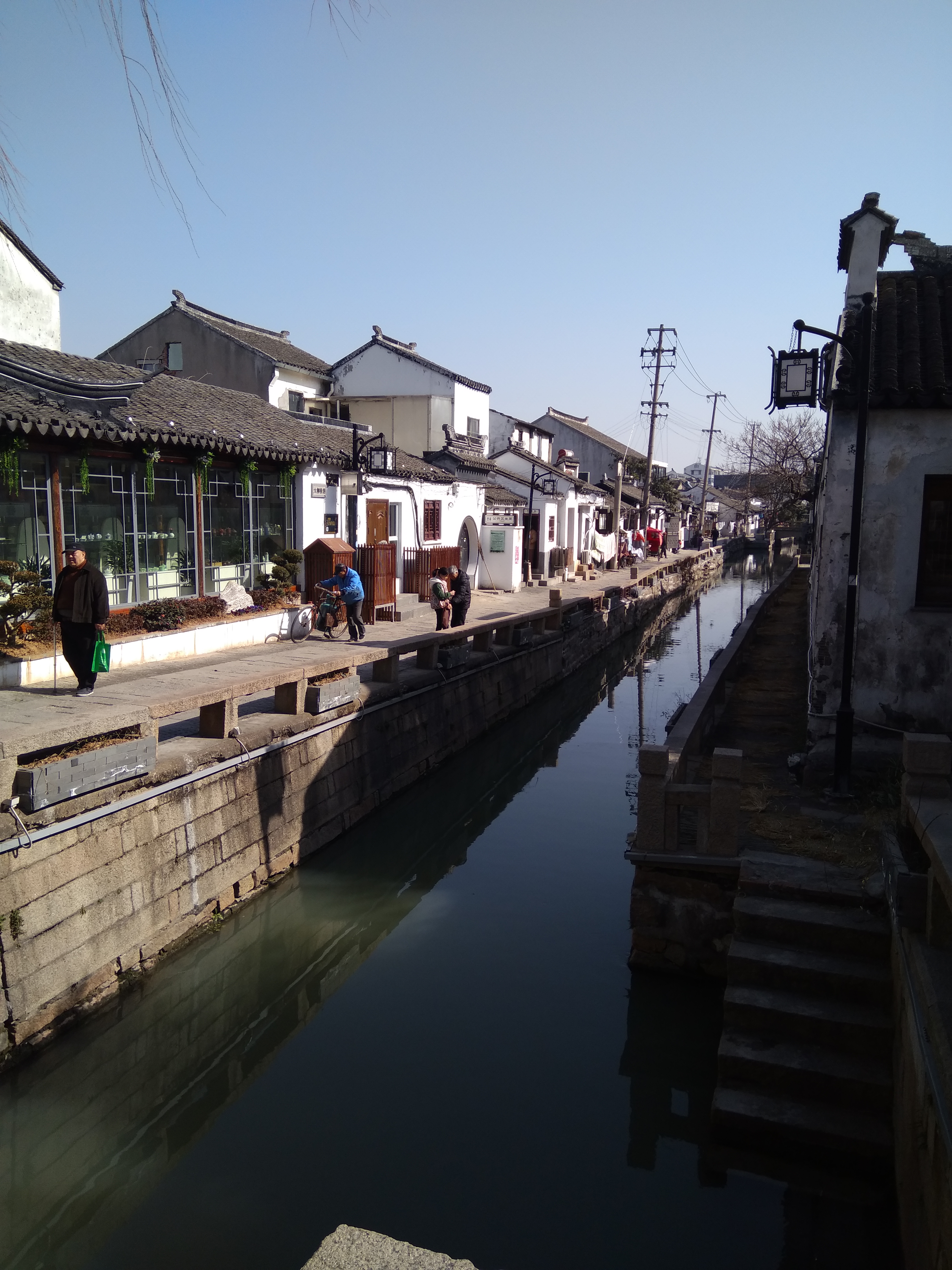
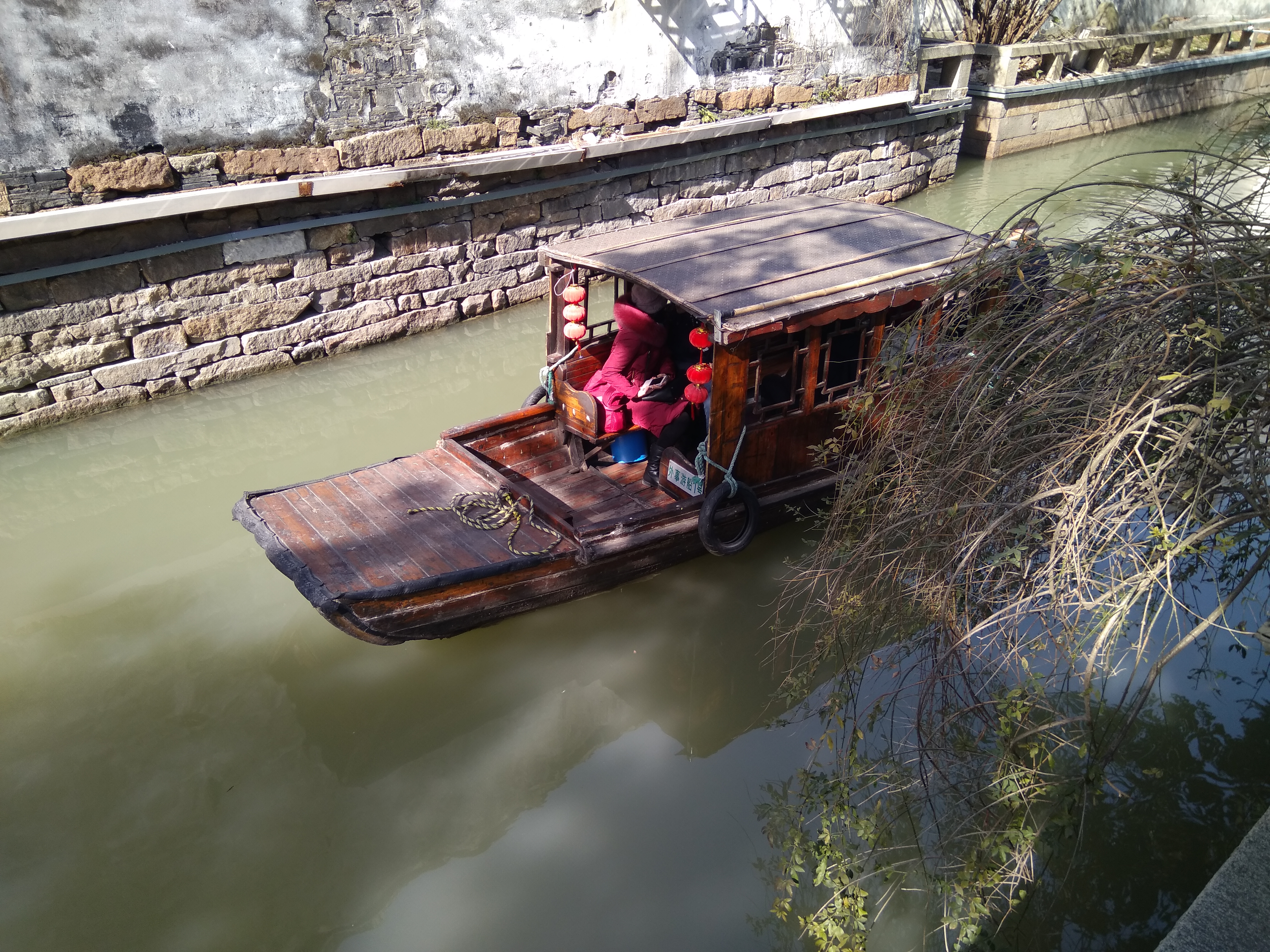
Suzhou


IMG_20180211_194235.jpg
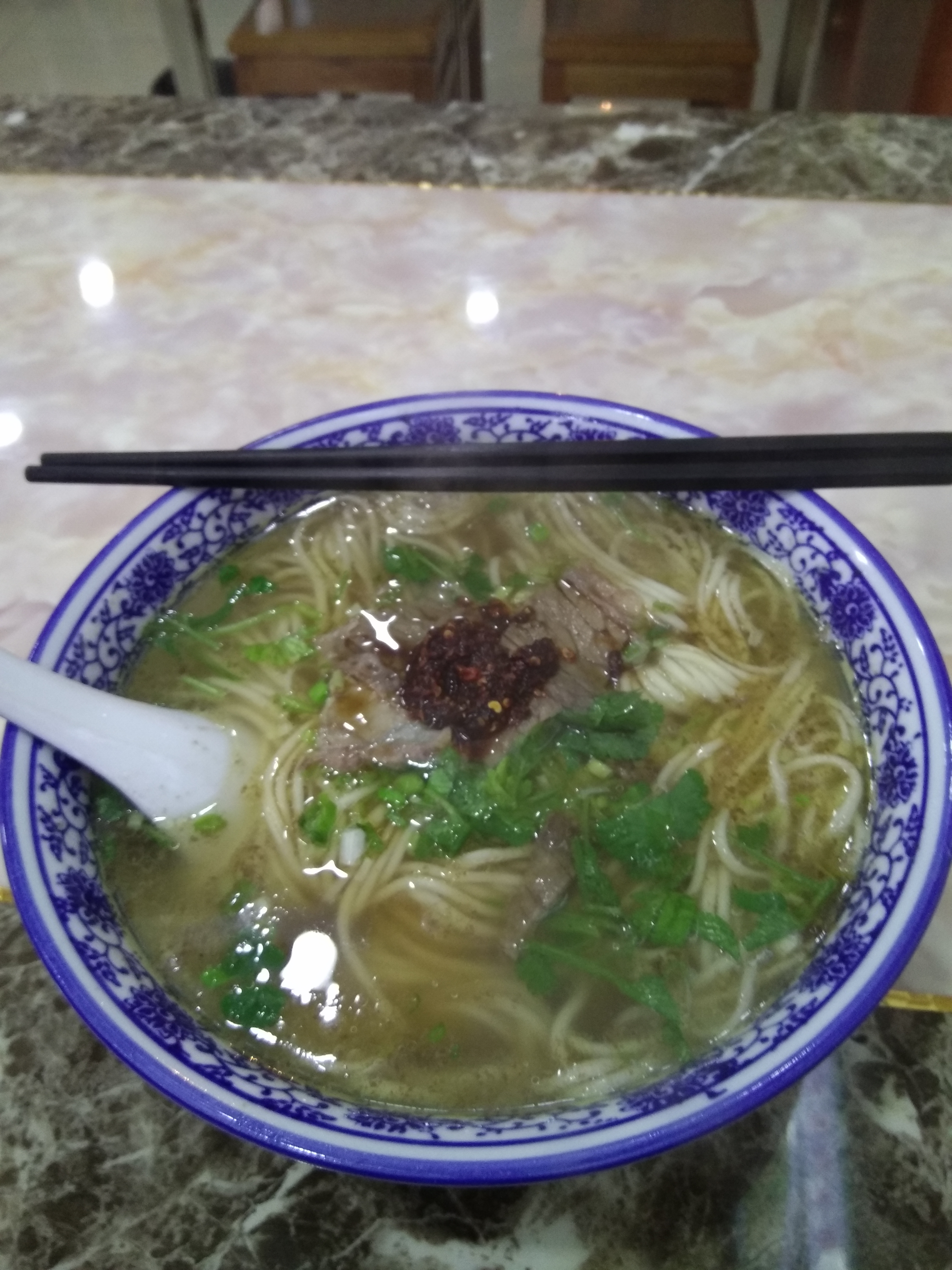
My Noodles


I arrived in Suzhou, found my hotel, which just happened to be next to a noodle shop, ate and went to bed as I knew I had a long day ahead of me tomorrow.  The ankle was a little sore when I woke so I took some more Advil as I planned on much walking on the canals in Suzhou.


IMG_20180212_102957.jpg
Suzhou


15km later I arrived back to the hotel for the night and planned to visit Tongling the next day, which included much more walking.  The following day I would head to Shanghai and more walking.


IMG_20180213_122848.jpg
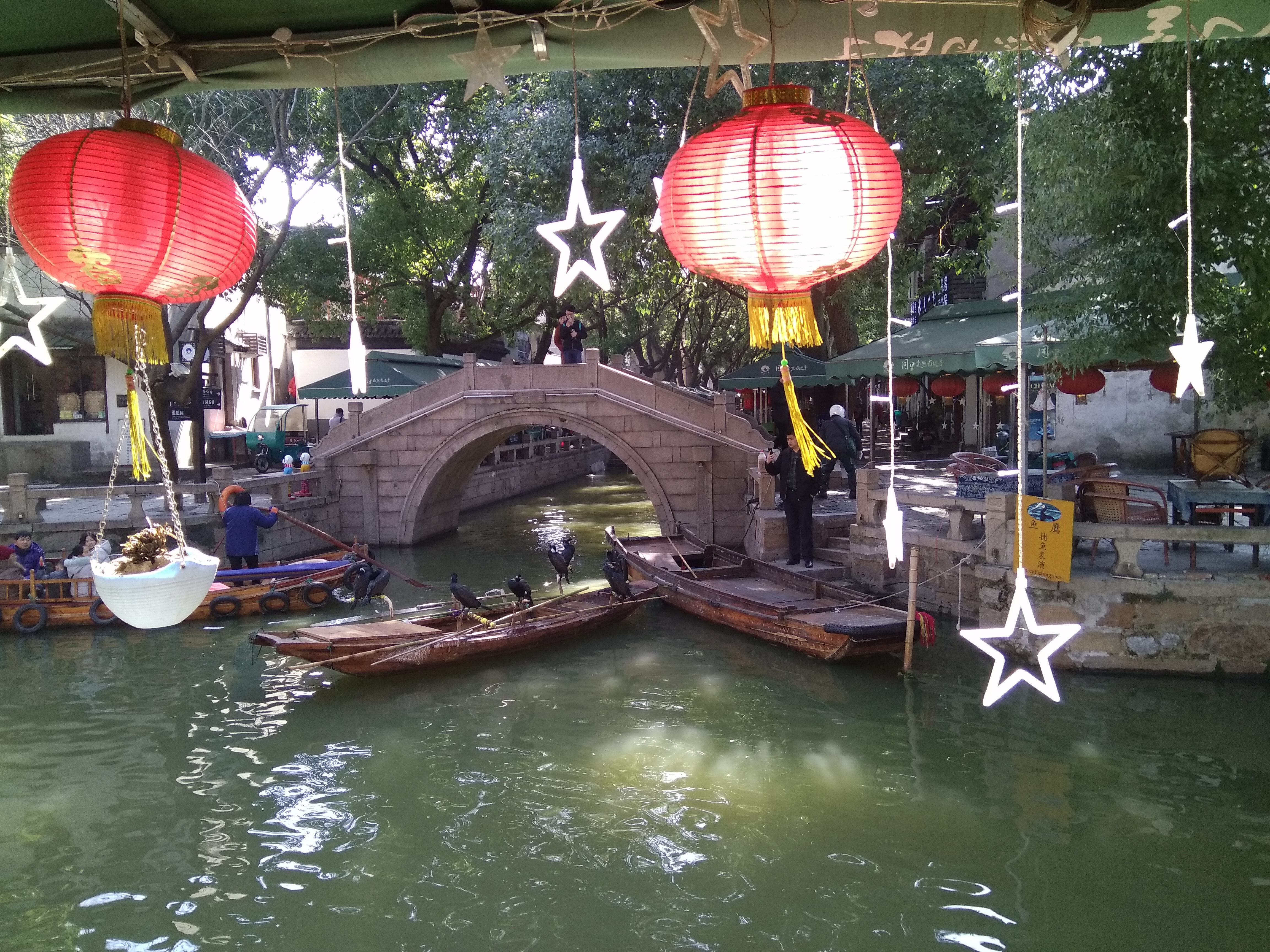
Tongling


IMG_20180213_113143.jpg
Tongling


mmexport1518756151583.jpg
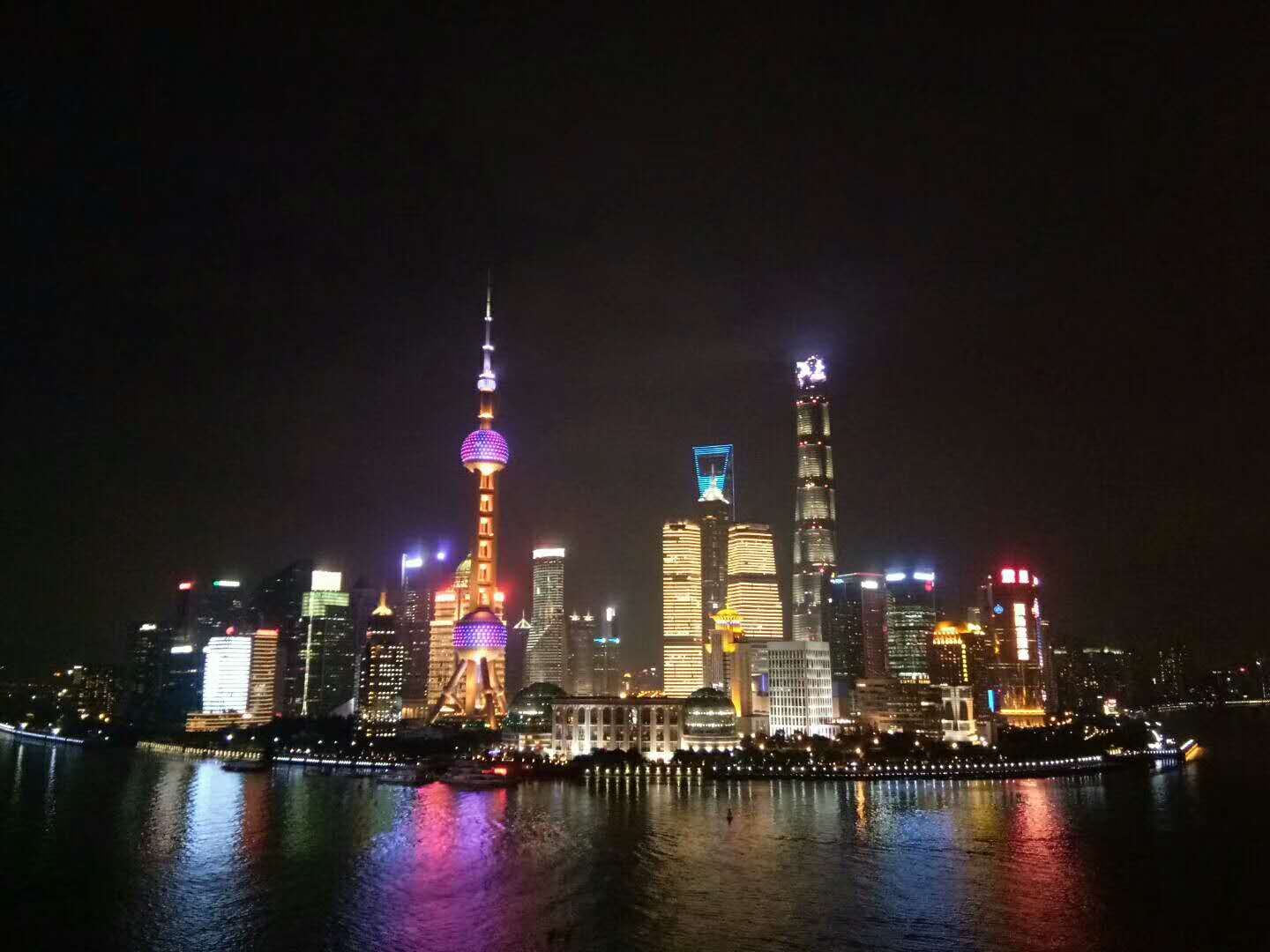
The Bund, Shanghai


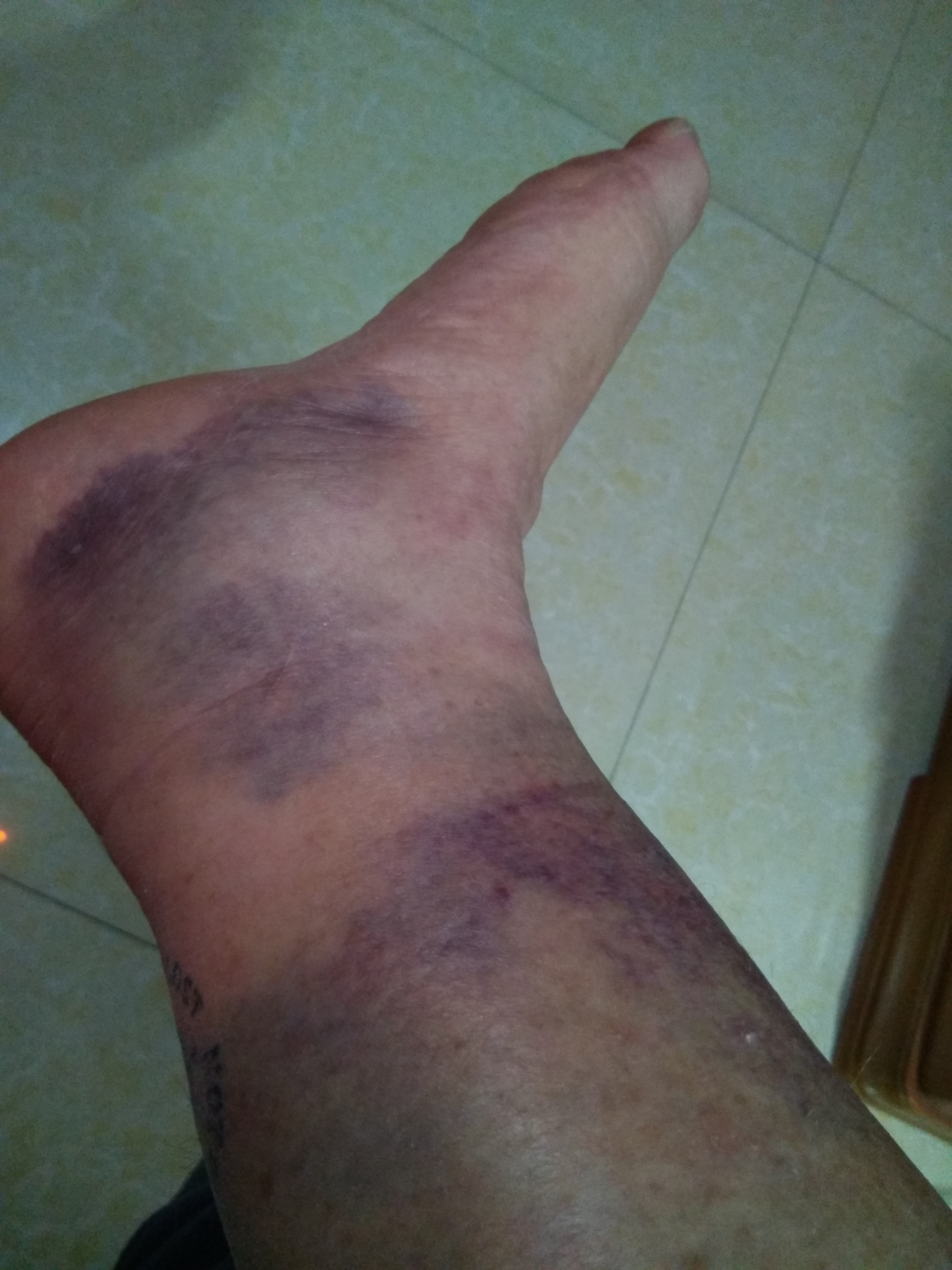
All this walking was probably a really bad idea, but, I wanted to see the sights, so I pushed on.  By the time I returned to Dong’e my ankle was lovely shades of purple.  Luckily, one of my little’s father is a doctor.  When he brought her to lessons, I asked him to look at it. He said it looked worse than it probably was because of all the walking.  He advised me to rest and elevate as much as possible before I left for Bali.  By the time I returned from Bali, it was pretty much back to normal.

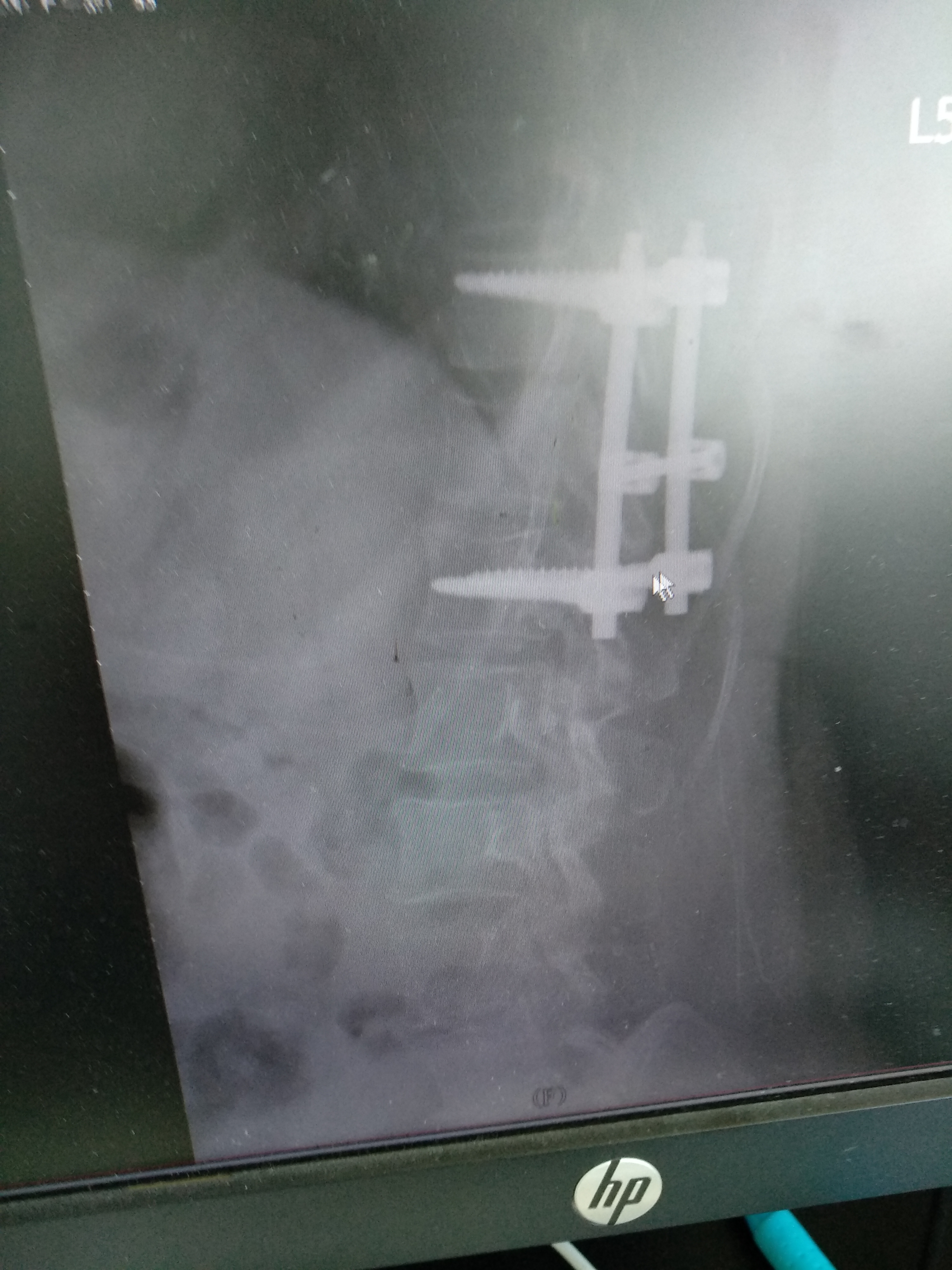
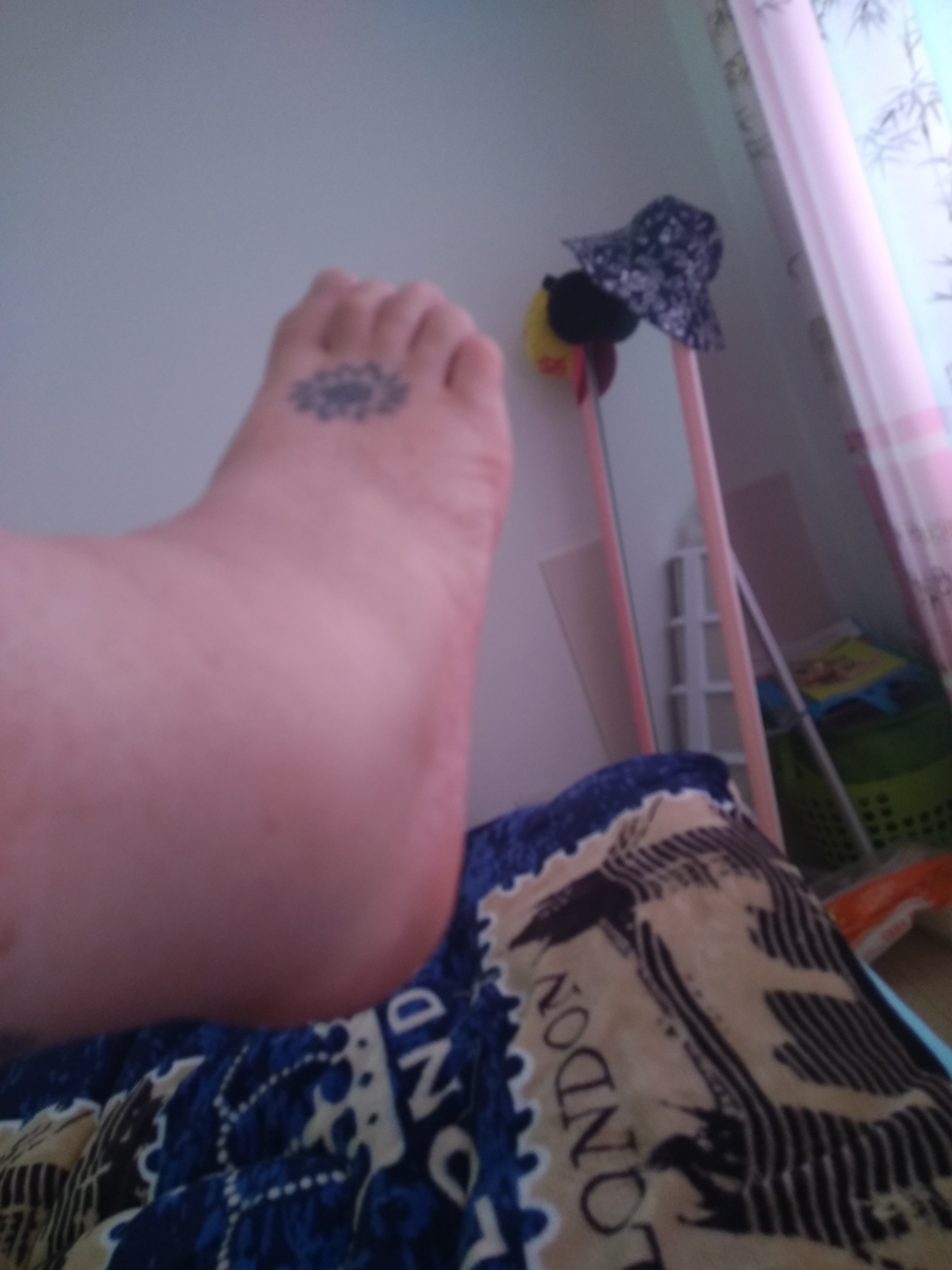
It’s now the end of April, I am jumping and dancing with my kids at kindergarten and twist the same ankle again.  No bruising this time, but boy did it swell up.  I elevated it and iced it which helped.  If I would stand for any length of time or do a little walking it was quite painful and would swell in strange tubular ways.  That is how I ended up at the hospital today.

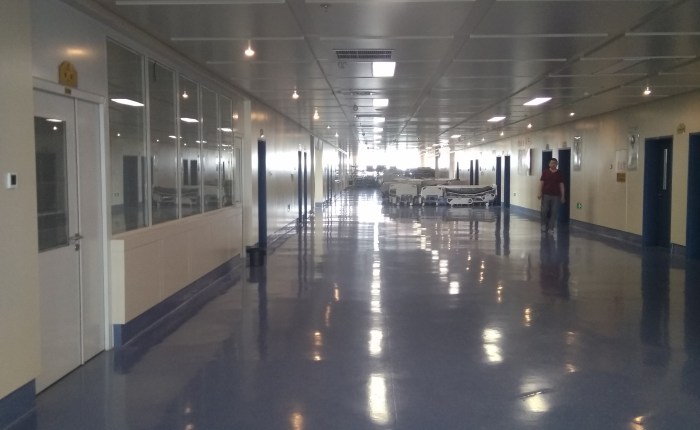
This time, we (me and one of my semi-English-speaking friends) went to “The People’s Hospital”.  This is not the same hospital as my first experience.  This hospital is fairly new, within the last 5 years, I believe.  The Dong’e People’s Hospital is actually a partner hospital with The Loma Linda University Health Global Health Institute.  There are also international nursing service opportunities through the Global Health Institute’s International Service Program, visit lluglobal.com/nursing for more information.  I just stumbled upon this information by accident.


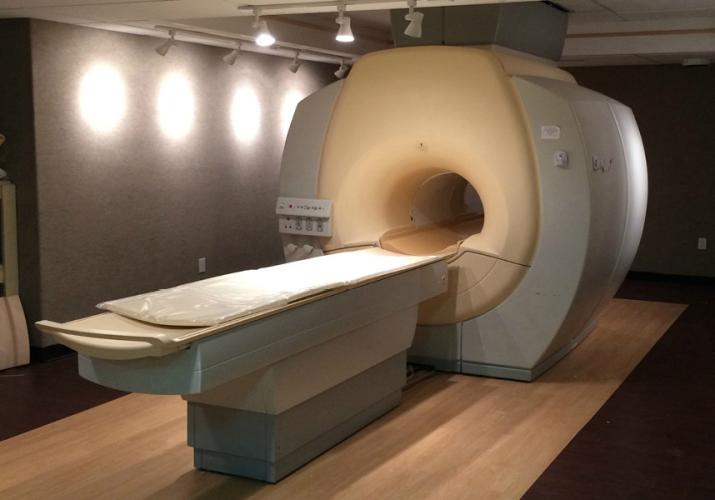
We left for the hospital at 8:00 am by scooters.  When we arrived, we had to check in at the desk and pay 200 RMB or about $30 which was to see a doctor and have an x-ray.  After the doctor examined my ankle, he decided I needed an MRI instead of an x-ray.  Back to the desk to pay another 300 RMB or about $45 since the MRI is a tad more expensive than an x-ray.  Next to wait for my turn for my MRI.  At this point, it was about 9 am.  With the number of people in front of me, I was told they would probably call for me around 10:40 am.  Ok, no problem, we would just wait outside the MRI area.  The hospital, I found out is also a teaching hospital.  As we were waiting, a group of doctors and students came by.  What?  A foreigner!!! They stopped to chat, and the lead Dr. spoke very good English.  He wanted to know why I was there, is there any way he could help me, etc.  My friend asked him to see if he could get us pushed up in the line.  He went to the office but came back and told us he couldn’t move us up.  No problem, thank you.  AND then they had to take pictures. Of course, this isn’t anything I am not used to.  Off they went and finally around 10:50 I was called for my MRI.  After having me remove my earrings, I followed the Dr. into the MRI room.  It was a nice open MRI.  He got me set up and 15 minutes later I was told the results would be available anytime after 2 hours.  We decided to head home for lunch and a nap and then return to the hospital around 3:00 pm.


43385-LexDiagnostic
The Open MRI, not my photo, but it looked like this.


IMG_20180504_152806.jpg
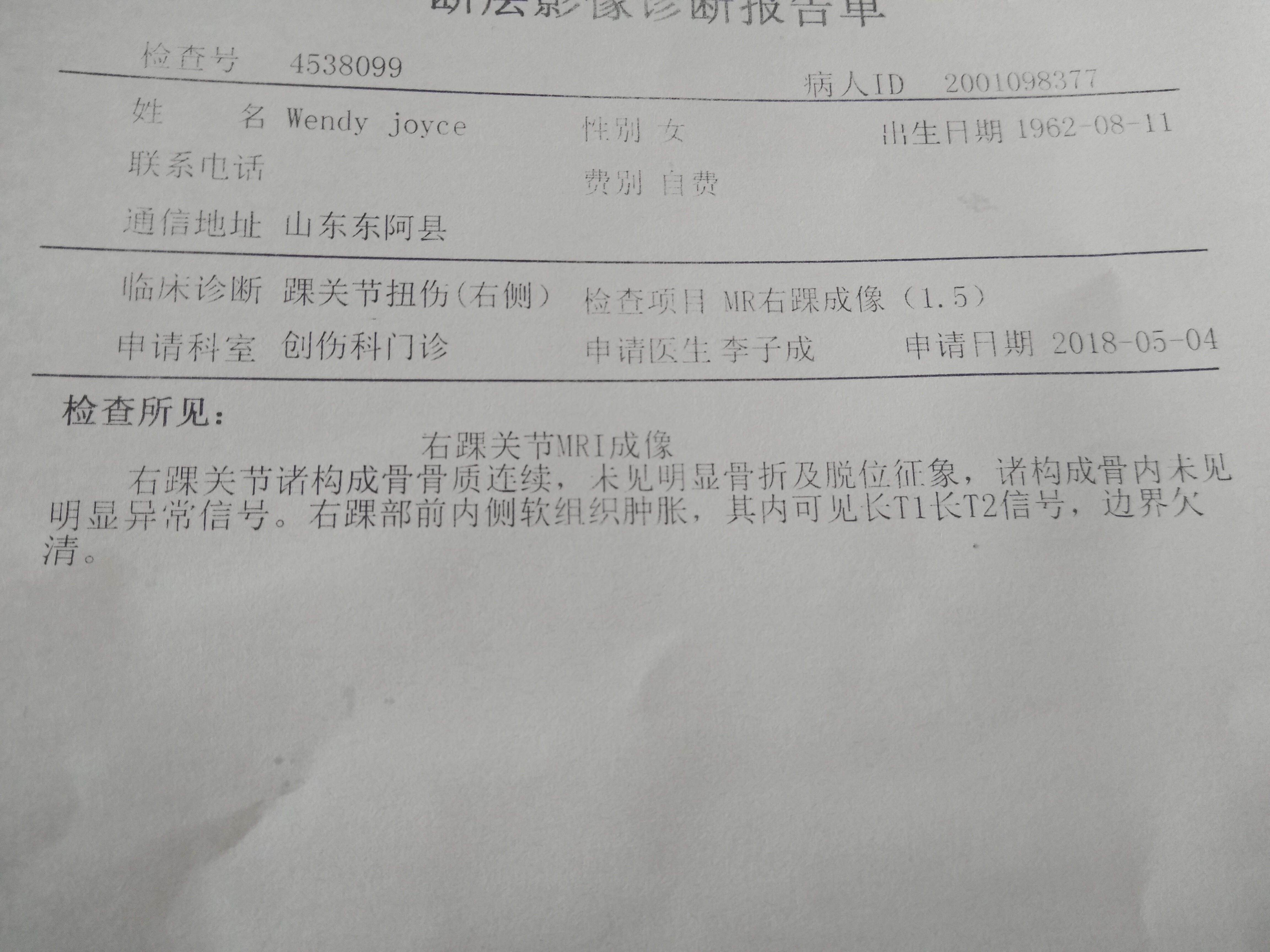
My report we printed from what looked like an ATM machine


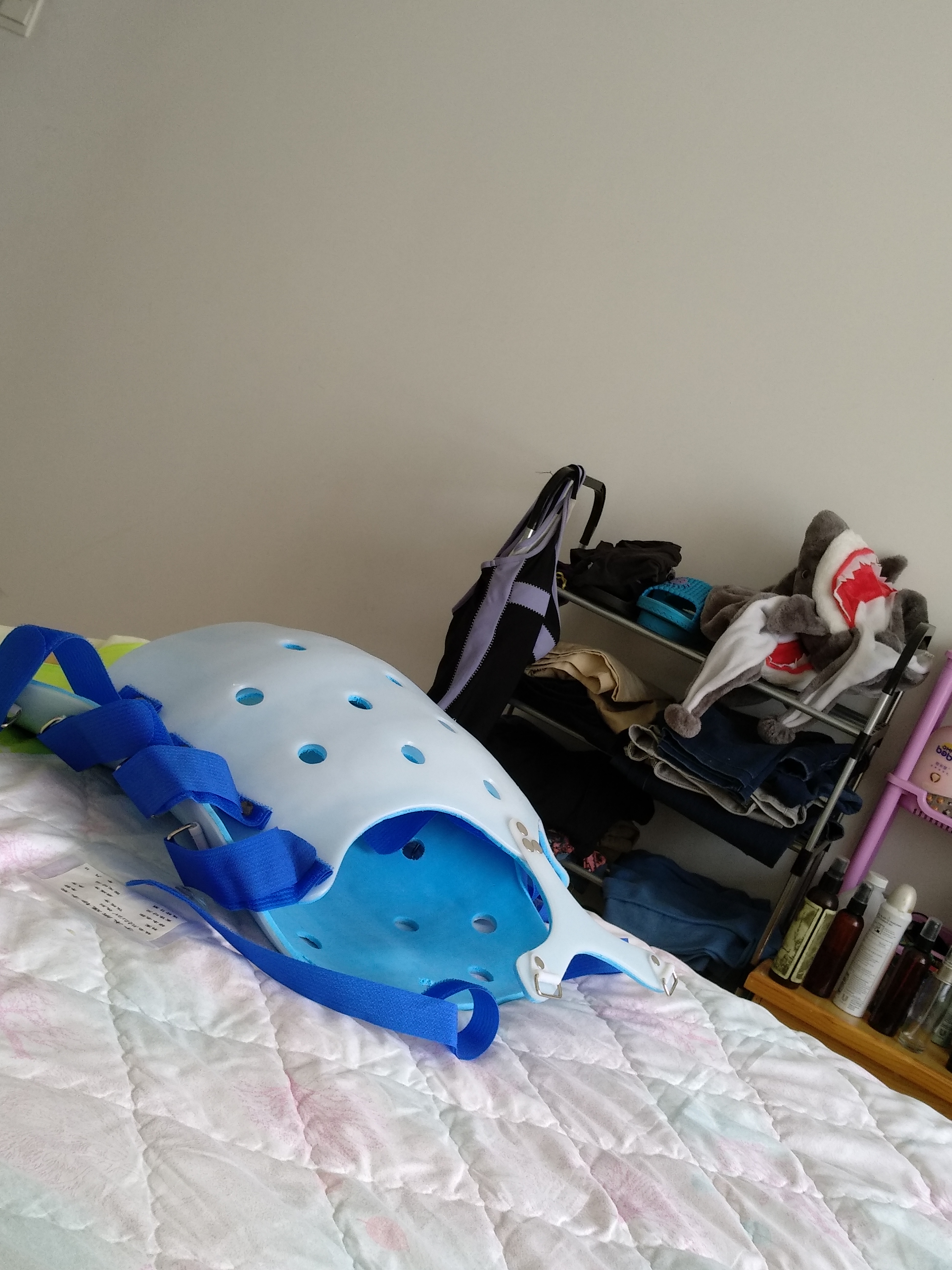
3:00 pm, we headed back to the hospital, checked in at the desk and got our instructions.  We were to return to the MRI area, swipe my card (I was given a type of ID card when I first arrived) at the machine near the MRI area and it would print my results. We were to take these results back to the original Dr. I saw when I arrived.  After viewing the pictures on his computer and reading the results he decided he wanted someone with more expertise to take a look.  Great! We were sent to the Orthopedic Surgery floor where another Dr. was waiting for us.  He reviewed the pictures and explained everything to me using a plastic model of the foot.  He explained there were no fractures and no tears in the ligaments or achilles.  Good news.  He did say my achilles was stretched which is why I was having pain there and that I also had soft tissue damage.  Treatment….4 to 6 weeks in a stabilizing boot.  Here’s the funny/not funny/funny thing.  They didn’t have the boot.  The Dr. had me order one from Taobao, the Amazon of China.  It will arrive in 2 to 3 days, until then, elevate and stay off my feet as much as possible.


IMG_20180504_152418.jpg
The surgical floor where they sent me.


Screenshot_2018-05-04-20-55-41-263_com.taobao.taobao.png
My fancy footwear for the next 4 to 6 weeks.


Not nearly as exciting as my first experience with a Chinese hospital, but I wanted to share this very positive experience.  I can’t say enough about the kindness and helpfulness of the staff.  That being said, I am not sure what an MRI cost in the states, but I saw 3 doctors and had an MRI for $75.

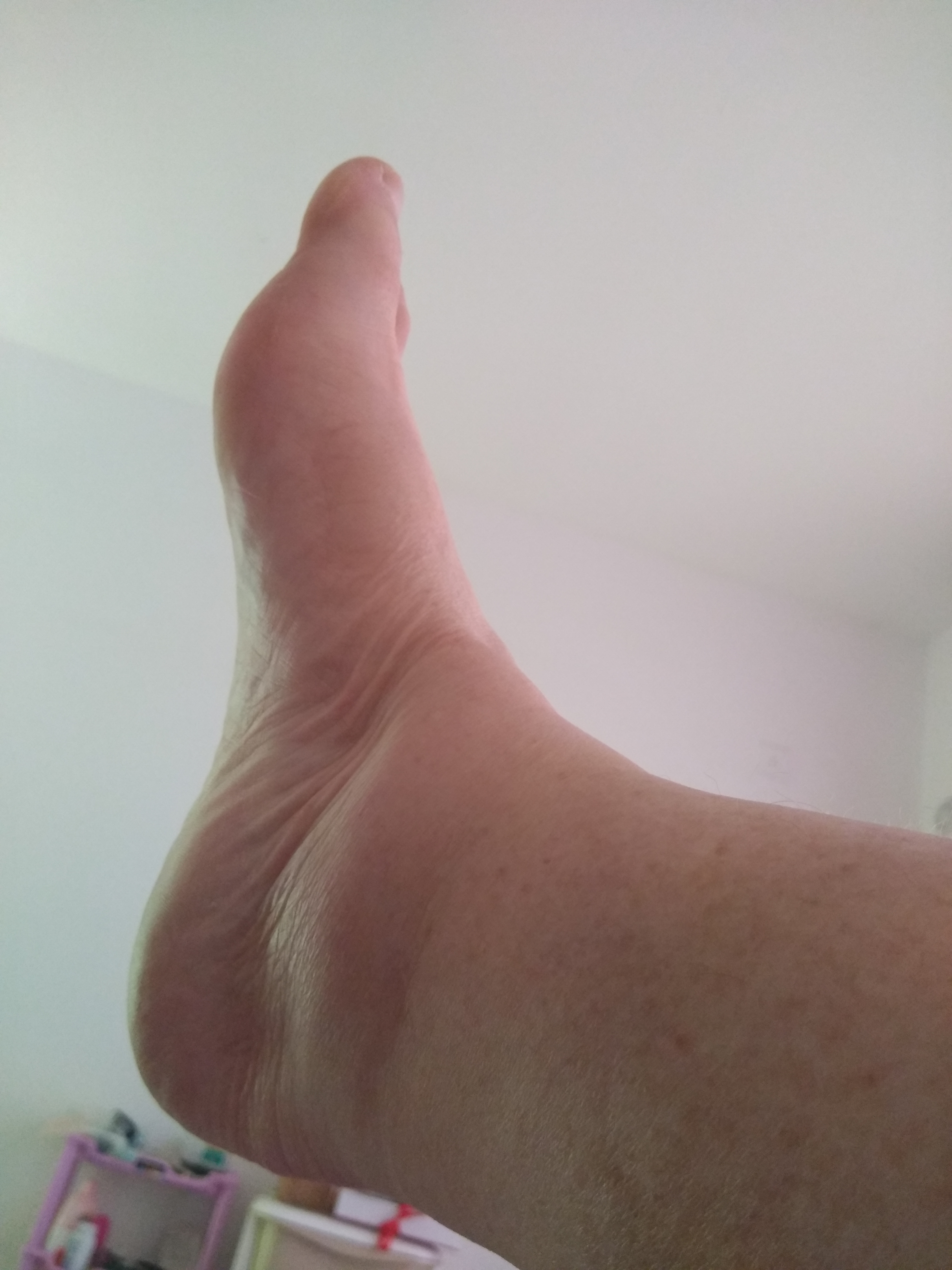
China never ceases to surprise me and here are some boring photos of my ankle, which I was glad a photographed as all the doctors looked at them.

I leave you with a quote from Peter Pan, “To live

IMG_20180429_171038.jpg
Weird tubular swelling

will be an awfully big adventure”.


IMG_20180216_200828.jpg
This was 5 days after my initial fall.


IMG_20180429_171048.jpg
Yup, it was a tad swollen


From Russia With Love, Part I, or I Never Expected Moscow to Steal My Heart

From Russia With Love, Part I, or I Never Expected Moscow to Steal My Heart

Roll back to March 3, 2016.  I left my home in the small village of Xiashan, that I had grown to love.  At 7:30 am, I boarded a train for a 10-hour ride to my new home in Changning, Hunan, China.  Upon arrival, I met my new roommate, Yulia.  Yulia was from Moscow, Russia, actually, Dolgoprudny Moscow Region and had spent a year studying Chinese in Suzhou.  Definitely a plus for me is she had fairly good Chinese language skills.  We moved into our apartment and soon became fast friends, both enjoying cooking and sharing an evening cocktail or two.  She often skyped with her mom and told me many stories of life in Russia and even made borscht for me after we acquired some beets during an excursion to Hong Kong.  I had planned on buying a scooter for my time in Changning, but couldn’t bring myself to do it after Yulia told me how she walked one hour each way to her University in Russia.  Our walk to school was 20 minutes at best and we also had a transportation allowance for taxis during inclement weather. Our time together, came to an end much too quickly, a mere 4 months.  We tried our best to be placed together for our next teaching term.  It just didn’t work out.  With promises of keeping in touch and me promising to visit Moscow, I moved to Qingdao and Yulia returned to Russia.  We all make those big promises to keep in touch and although we mean well, often it just doesn’t happen.  Every now and again, we would catch up on WeChat or Instagram, but that was pretty much the extent of it.


20160417_094403
Me and Yulia in Changning, Hunan CHina


Fast forward to June 2017, I had left Qingdao in February and landed in Dong’e County.  I would be making a trip to the states in July and found myself with some extra time at the end of June.  That promise to visit Yulia was always lurking in the back of my mind.  Honestly, Russia had never been a bucket list item for me, but living in China, I would probably never be closer to Russia than right now.  Out of the blue, I contacted Yulia and was like, hey, I’m coming to Moscow. Is that cool?  Where do you live so I can find a hotel? Luckily for me, she was on summer break from the school she where was teaching and she was thrilled I was coming to visit.  Her mother insisted I stay with them during my trip, to which I agreed.  Problem, we didn’t think about the visa I had to have.  I won’t go into that here because you can read about that madness in this post: https://wendyjmarvin.com/2017/11/06/visa-problems/

After solving the visa madness, I finally boarded a plane in Beijing on June 22 for Moscow, Russia.  Like I said, Russia was never a bucket list item and I realized I basically knew very little about it.  When I thought of Russia, I thought of the cold war and pictured a huge country grey, cold and unwelcoming.  I pictured Olga Korbut and the Russian hockey team overshadowed by chants of USA, USA, and a funny looking alphabet.  I thought of the letters U.S.S.R., but also pictured a gingerbread looking church of which I didn’t even know the name. I was thinking of St. Basil’s. I had heard of Red Square the Kremlin but thought the Kremlin was a building and of course, I knew Putin was the president, all Russians eat borscht and drink vodka.  There you have it, my so-called knowledge of Russia.  All of my excitement was about seeing Yulia and meeting her mom, other than that I really had no expectations.  Although, I did want a selfie at St. Basil’s.


IMG_20170624_060211
Beet salad, meat, cheese, black bread, and Georgian wine.


Arriving late afternoon, Yulia met me at the airport and we headed to her home in Dolgoprudny, which is considered Moscow region.  Her mother had meats and cheeses, a beet salad, black bread and Georgian wine waiting to welcome me.  An interesting fact, Georgian wine just became legal in Russia in 2016.  I told Yulia my only “must do” was a selfie at St. Basil’s.  She replied, “don’t worry, I have plenty of things planned for us to do”.  That evening, under beautiful blue skies and fluffy white clouds which I don’t often see in China, we took a stroll in the brisk air along the river near her apartment where the riverboat cruises travel. On our way home we stopped at an open-air restaurant for some traditional Russian food.  Back home we settled in for a rest as Yulia told me she had a big day planned for tomorrow.


IMG_20170623_182141
An evening stroll along the river


The next morning after some coffee, cheeses, meats and leftover beet salad we got ready to head into central Moscow.  The day was a bit dreary, luckily, the only one of my trip, we took a short 10-minute walk to the bus station, followed by a 20 minute or so bus ride to the first metro station taking us into the city.  Yulia told me I would LOVE the metro.  Boy, was she right.  The metro stations are like wonderful art museums.


IMG_20170625_132819
Beautiful Moscow Metro


The metro opened in 1935 with one 11 km (6.8 miles) line and 13 stations. The metro now has 212 stations covering 360 km (220 miles), making it the 6th longest in the world.  The Moscow metro is an artistic and architectural wonder.  The artists and architects designed a structure that embodied svet (radiance or brilliance) and svetloe budushchee (a radiant future).  With their reflective marble walls, high ceilings, and grand chandeliers, many Moscow Metro stations have been likened to an “artificial underground sun”. This palatial underground environment reminded riders that their tax rubles had been well spent on svetloe budushchee.  Thank you, Wikipedia.  If you get to Moscow, I encourage to spend time just traveling metro station to metro station.  Yulia and I often went extra stations and then turned around and went back just so I could see the beauty.


IMG_20170625_133934_HHT
Moscow Metro


Leaving the metro system we started walking toward the Moskva or Moscow River which flows through central Moscow to the Oka River a tributary of the Volga and finally into the Caspian Sea.  They were taking me on an hour-long river cruise to view Moscow from a different perspective.  They had wanted to take me to Moscow’s Cathedral of Christ the Savior, but, for the first time in over 1000 years, the bone fragments of 4th century St. Nicholas were moved from their resting place in Italy to the Cathedral in Moscow. The queues were hours/day long. St. Nicholas is a favorite saint among Russians (I don’t know why) and many Russian Churches are named after him.  We passed the massive queues and continued to the river for our cruise.  After the cruise, we walked to the Kremlin, Red Square, and St. Basils. These are all in the same area or basically on the perimeter of Red Square.  Let’s start with the Kremlin.  The Kremlin, my lack of Russian knowledge thought the Kremlin was a building. NOT…….it is a walled fortress. The word Kremlin actually means fortress inside a city.  The Kremlin is enclosed by the Kremlin Wall and Kremlin Towers of which there were originally 18. Inside the Kremlin Walls are 5 palaces and 4 cathedrals and the Grand Kremlin Palace.  The complex also houses the residence of the President of the Russian Federation, currently Putin.  He happened to be “in the house” when Yulia and I visited the Kremlin (on a different day) but she didn’t think it was a good idea to go knock on the door.


IMG_20170624_123636
Cathedral of Christ the Savior with the St. Nicholas’ Bone Fragments


We continued walking along the outside of the Kremlin Walls to the entrance to Red Square.  We passed the Eternal Flame at the Tomb of the Unknown Soldier and I got to see the end of the changing of the guards.  Then we walked through Alexander’s Garden’s which was one of the first urban public parks in Moscow. From here we came to the entrance to Red Square which is marked by kilometer zero.  It is good luck to stand on KZ and toss a coin over your shoulder, which I did and I consider myself to be rather lucky in this life.  I have now stood on kilometer zero in Madrid, Paris and Moscow.  Kilometer zero is supposed to be the point from which all distances in a country are measured.  After I tossed my coin and got a photo, we proceeded to the entrance to Red Square.  Before we entered, Yulia pointed out a small church. When I say small I mean like a room smaller than my bedroom.  I stopped in for a minute as there was a service going on.  I believe it was St Peter and Paul, but I haven’t been able to find any info.  We then walked through the gates and there was St. Basil’s in all it’s glory. And, yes it does look like a gingerbread church.  Yes, I got my selfie.  The Cathedral of Vasily the Blessed is commonly known as St. Basil’s and was built 1555 to 1561.  The building is now a museum. Also on Red Square is Kazan Cathedral and the GUM Department Store and was known as the state department store during Soviet Times.  GUM is amazing and takes up an entire city block and definitely worth a visit.


IMG_20170627_215806
Kremlin Wall and Tower


Wow, what a day. After leaving Red Square, Yulia had chosen a lovely restaurant for our dinner and then we headed home.  I had thought it was the time change that had kicked my butt, but Yulia’s mom, Marina, checked her watch or whatever calculates mileage and we had walked 12 km or 7.5 miles.  No wondered I was pooped and this is only really day one.


IMG_20170624_163845
A toast to friendship


Day one, I have already fallen in love with Moscow.  In the words of Frederick Buechner, “ One life on this earth is all that we get, whether it is enough or not enough, and the obvious conclusion would seem to be that at the very least we are fools if we do not live it as fully and bravely and beautifully as we can”.

Stay tuned for From Russia With Love or I never Expected Moscow to Steal My Heart Part II

IMG_20170624_140245
Tomb of the Unknown Soldier


IMG_20170624_141437_HDR
Small Church at the Entrance to Red Square


IMG_20170630_142522
Red Square


IMG_20170630_124049
Selfie with Kremlin Guard


IMG_20170629_190954
Selfie with the bus driver


IMG_20170627_220623
GUM Department Store


IMG_20170624_145807
Required Selfie at St. Basil’s


Wendy and the Search for Happiness

Wendy and the Search for Happiness

Happiness: ha-pē-nəs  The state of being happy.  Simple, right?

New Year’s Eve, a holiday, even more so than Thanksgiving or Christmas, that leaves me feeling melancholy.  This year, I spent New Year’s Eve quietly home alone, not lonely, there is a difference, with a glass of pink champagne, well actually, sparkling wine, although it was from France.  Confession, I did have a martini, well maybe two, until it was time for bubbles at midnight.  So, what does all this have to do with Down the Rabbit Hole ~ My Adventures in the Middle Kingdom?  A LOT!  I started contemplating my life.

As usual, my melancholy had my head spinning.  Am I happy?  Have I ever been extremely unhappy?  Was I a happy child?  How did I end up in China? Am I happy in China?  What was the best day of my life?  Where is home?  Am I ready to go back to Warren, Ohio?  If I am not ready, do I want to stay in Dong’e? Were my parents happy?  Would they be happy with the path my life has taken?  Was my relationship really happy?  And so on and so on…..you get the picture.

It’s now 5 days later and some of these questions and more are still running around my head.  I’m not losing sleep or anything trying to answer them, but after a couple outings with new and old friends and a couple of movies that made me think, even more, I decided, hey, write about it, even if it opens up emotions I have kept to myself.  So, here goes….

I probably would have gone to sleep and forgotten my melancholy, but on January 2nd, I decided to watch a movie I had read about, “Paths of Souls”.  A documentary chronicling the 1200 mile pilgrimage of 11 actual residents traveling from their Tibetan village to Lhasa. The pilgrims included a young girl and her pregnant mother who gave birth on the pilgrimage and her father.  They (all 11) made the journey on foot wearing animal skin aprons and wooden blocks on their hands.  This is because every few steps they must “dive” to the ground or kowtow, followed by touching the earth with their forehead and clapping the boards together to complete the ritual. I was blown away by the dedication of these people. They ended each day in prayer, song and for the most part happiness no matter what obstacles they had faced that day.  It made me reflect on my time in Tibet and what a peaceful feeling I had there.

IMG_20160624_120615


IMG_20160624_120620
Little girl kowtowing at the Potala Palace


The next night, I chose “Hector and the Search for Happiness”.  A movie I had for some reason downloaded.  After watching, I figure it must have come up in a list of travel/wanderlust movies.  I initially thought it was a movie about a child.  I quickly found out that although Hector often reflects back on a vision of himself as a child, it was definitely not a movie about a child, or was it?.  Hector is a psychiatrist who lives a very organized, routine life in London with his girlfriend Clara.  One day Hector decides he needs to search for happiness and boards a plane for China.  Of course, I was hooked at this point.  Clara slipped a journal in Hector’s carryon and he scribbles pictures and notes on happiness, such as, “Happiness is a long walk in beautiful, unfamiliar mountains”.  My personal experience with this, “Happiness is watching the sunset and sunrise on the beautiful, powerful Mount Everest”.  As Hector travels around the world seeking happiness and jotting down happiness phrases, I started putting myself in those phrases.

6c090b2144152143bc0ea80ec5dd9150

Hector noted,  “A lot of people think happiness is being rich or important”. I grew up on a dead-end street that most people didn’t even know existed.  We definitely weren’t rich, I remember my mom counting change to put gas in the car.  Important, ha, far from it.  My dad was self-employed because an accident had left him with a head injury that made holding down a normal  9 to 5 impossible. I do know they loved us and our happiness came before theirs.  My personal take on Hector’s note, I know now that rich doesn’t necessarily mean monetarily rich and you can be important to more people than you ever realize in your lifetime.  My father died at age 63, far from rich and important only to his family, so we thought.  We had planned 2 hours for his calling hours.  That sad afternoon brought much happiness to me, my mother and brother.  People came, he was my baseball coach, he used to buy me ice cream, you guys had the best tree fort, etc. 5 hours later we were finally ending a tribute to a man that wasn’t rich in dollars and unimportant, so we thought.  Two years later at 60, my mother also passed.  She had the same tribute.  Yes, I had a happy childhood.

“Happiness is doing a job you love”.  I loved my job at the YMCA until I didn’t.  There came a point in time I no longer looked forward to going to work.  What used to be fun and rewarding had become one of losing sleep and dreading the next catastrophe.  This also, unfortunately, coincided with the decline, demise, end of my relationship.  I made a decision, I am definitely not happy right now.  What makes me happy?  Travel! Paris! How can I combine the two?  First thing I did was run away, yes, I ran away.  I decided to spend Christmas in Paris, away from everything, everyone, away from unhappiness.  I was happy in Paris. When I returned, I started researching how I could travel and still make money.  I got my TEFL certification from the University of Miami of Florida and I haven’t looked back since.  Things didn’t work out with my work visa for France, but I had an opportunity in China.  So that’s how I ended up in China teaching English.  When you are almost knocked over by a group of kids when you walk in their classroom, you have to smile.  “Happiness really is doing a job you love”

mmexport1507720516063.jpg

“Happiness is to be loved for exactly who you are”.  This is so true.  Living abroad really teaches this lesson.  Walking away from a secure job, that was making me unhappy, ending a relationship that was for the most part, at least in my opinion happy, until it wasn’t, can change who you are.  Those pounds I put on, used to bother me, but tell the truth, I like to eat and drink, it makes me happy.  Nobody abroad knew me “then” and guess what? They like me for who I am NOW! I have made friends all over the world and they don’t care who I was back then.  They like the person I am now, so yes, that is happiness.

Well, if you are rolling your eyes at this point, I don’t blame you.  I will try to wrap it up even though Hector has many more happiness points.  I will say I do agree with his point, “Happiness is feeling completely alive”.  Life abroad and the opportunities it gives me for travel to places most people only dream of make me feel completely alive.  Camping on Mount Everest, Tibet, Angkor Wat, Moscow, camel riding in the Gobi Desert, living in Paris, Tokyo, Seoul, Vietnam and Dubai to name a few….traveling makes me feel completely alive!

thumbnail (2)

Finally, am I happy? Yes, most of the time.  Have I ever been extremely unhappy? Yes, and I ran from unhappiness.  Was I a happy child?  My memories say yes.  Was my relationship really happy? It was until it wasn’t.   How did I end up in China? I ran from unhappiness and I’ll always have Paris.  Am I happy in China?  Most of the time.   What was the best day of my life?  Maybe I haven’t had it yet, although I have had many amazing days.   Where is home?  I have discovered the world is my home.  Am I ready to go back to Warren, Ohio?  I really did ask myself this question several times this week.  The answer was always no.  If I am not ready, do I want to stay in Dong’e?  The answer was no I am not ready to go back to Warren, but I am considering a change of venue.  I have applied for some jobs inside and outside of China for later in 2018.  Were my parents happy? For the most part, I would say yes.   Would they be happy with the path my life has taken?  Definitely and I know they would try to visit me wherever my journey takes me.

If you stuck with me through this random post, thank you!  Back on track to Moscow next post, I hope!

PS, I recommend both movies.

6d7360c149bd00e3f2fd4e7a9786e770

If I Were in America, Would I Accept This Situation?

If I Were in America, Would I Accept This Situation?

As I arrived to the kindergarten in the countryside this morning, I realized how many things that are now “norm” for me in China.  Things, I would either not accept or probably complain about in America. It is also funny how I refer to my country as America and not the United States.  I often get the deer in the headlights look if I say the United States and then usually say 美国 Meiguo followed by America.  I had originally planned on a post about Moscow to follow up my visa experience, but as I sit in the office at Teeny Oak Kindergarten in Yaozhai wearing my coat, sipping hot water and typing with cold fingers, the plan shifted.

IMG_20171207_193604.jpg
In my coat and wool sweater at the kindergarten

When it comes to heat in China for the winter, it is either feast or famine.  The kindergarten, unlike my apartment, has individual units in each room.  Smaller rooms have wall “air conditioning” units while larger rooms have bigger free standing units.  The units in the classroom only get turned on during certain hours. Roughly 8 am to 12 noon then 2 pm to about 4:30 pm and they are not to be set above 23 celsius or a reasonable 73.4 degrees.

IMG_20171205_083438.jpg


IMG_20171205_085554.jpg


Now some of the children come to school looking like they walked out of “A Christmas Story”. You know the scene, the one where the kid waddles because he has so many layers under his snowsuit and when he falls down, he can’t get up.  Okay, I am sure you have a visual by now.  As far as the offices in the 3 kindergartens I visit, they have yet to have any heat turned on.  When I asked why the principal of the school where I am currently writing this told me she is rarely in the office so she doesn’t turn it on. I explained to her that in America we turn the heat on and leave it on, adjusting as needed, but, I would never sit in an office wearing my coat if there were heat available.  She pretty much shrugged it off while telling me she was also cold.  Now, my kindergarten in the other countryside, JiangLou, usually escort me to a room and turn on the heat, just for me, but by the time it warms up to comfortable it is usually time to give lessons.  As for the kindergarten in the city, I am never in the office long enough to worry about the heat.  Although, I know that the accounting person is in there the majority of the day, never has the heat been on while I was there.  It is also not unusual to have entrance doors open in winter which means the hallways are always cold. When you see people in my photos wearing coats indoors, it is just a “norm” here.  Even in rooms that are heated or somewhat heated, people still wear coats.

IMG_20171205_105716.jpg
At least 3 layers and it really isn’t that cold here yet.
IMG_20171205_105718.jpg
I was showing a Christmas song video.


Now, as far as my apartment, heat goes on November 15th and off sometime in March.  You know how you people in Ohio can have the heat and air on in the same day?  Not happening here!  If it happens to be one of those days where you just want to take the chill out because it got a little cold overnight, forget about it.  But, let me tell you this, when it does come on, you get heat.  When I was in the tiny studio in Qingdao, I think I spent most of the winter with my window cracked.  Here, in Dong’e, my apartment is quite large, 3 bedrooms, 2 baths, living room, dining room and kitchen.  It also has large floor to ceiling windows in most of the rooms, so it isn’t quite the sauna I had in Qingdao.  I do tend to keep the bathroom window cracked to let some air in as it is still quite warm. Warm being you can sit in a t-shirt and be comfortable.  The best part is the heat is hot water in the floor. Getting out of bed barefoot, I step on nice warm porcelain tile.

IMG_20171117_122751.jpg

I do have to tell you that on November 15th, I didn’t have any heat. Not to be one to complain right away, I did a bit of investigating.  Sure enough, the valve on the heating unit was perpendicular.  Luckily, thanks to Steve Alexander teaching me the ropes about heating a building the size of the Trumbull County YMCA, I turned the valve to the correct position and waited.  Hmmmmm, the next morning, still no heat!  Come to find out, my whole district (as they call my complex) didn’t have heat.  The factory that supplies our water did not get the pressure and water temperature up to what was needed in time for the November 15th “heat”.  The said, “give it a couple days”.  A “couple days” turned into a week. Okay, I am getting stories relayed to me from 3rd party sources, etc., time to take the bull by the horns and go to the office myself.  Thank God for google translate and also that the word fuck/fucking is universal.  “Insert apologies here if I have offended anyone!”  Needless to say, the crazy, yellow-haired foreigner, got some attention.  They sent the maintenance person to my apartment and he bled the lines.  Again, give it a day or two, you are on the 24th floor, the hot water has to get up there.  I will admit, the radiator, got slightly warm almost immediately, but and that should be a capital BUT, it was cold by morning.  Okay, let me go about my business and see what happens…….NOTHING!  So, we arrive at day 12 (I feel like I should insert the McKenzie Brother’s 12 days of Christmas here, eh, Cathy?). Day 12, no heat.  I had a plugin heater that heated the space within 2 feet around me. Back to the office, I go.  Sorry, yes I dropped a few more F-bombs, well, at least I knew they understood that word.  Then with the help of google translate, I explained I had guests coming in 4 days.  Crazy, yellow-haired foreigner had the attention of the district manager.  He took me and showed me the stats for the water entering the district, it was still below pressure, the temperature had reached 45, that’s Celsius, and it should be 60.  Give it a couple days……to which I responded, are you F’ing kidding me, my heating unit is cold, it has no warm/hot water coming to it.  He finally accompanied me to my apartment.  Guess what, the main valve from the hallway to my apartment was off.  He apologized, turned it on, bled my lines again, which in my bathroom there is a wall unit that, well, gave him a shower, in his suit and tie.  It should start to warm up by tomorrow he told me.  Later that evening a maintenance man knocked on my door to check the situation as he did the next day also.  My guests arrived for Thanksgiving and all was warm and cozy.  Feast or famine…..

IMG_20171207_192141_HHT.jpg
Wall unit in my bathroom

I had intended this post to have a little more variety and it ends up all about heat.  In closing, here are a few other “norms” in China that wouldn’t fly in America.  Taxi drivers smoke, they do open the window, but bottom line, they smoke.  I once had a taxi driver watching a movie while he drove me to the kindergarten in Qingdao.  People smoke on buses.  They say no smoking but move to the back, open a window and have at it, because no one will say anything.  People smoke in restaurants. Expect hot water when you go to a restaurant. Don’t even think about asking for冷水 bingshui or cold/ice water. Napkins or tissues, bring your own unless you are in a better restaurant.  The same goes for toilet paper, bring your own, this applies to EVERYWHERE!   There is no such thing as a queue and forget ladies first. It’s every man/woman/child for themselves.

I could ramble on and on, but as I sit here, too warm in my fleece (the adult beverage may also have a slight warming effect) finishing this post that I started when I was wearing my coat and typing with freezing fingers at the kindergarten, you may ask, why do I do it?  Why do I put up with some crazy things in a country I only know a few words of the language?  Truthfully, in the beginning, it was an escape.  Why do I stay?  Because I can, but more importantly, I am seeing the world from a different perspective.  I want to experience as much as I can.  Yes, it does your soul good to be riding your scooter down the road and the little old man who does bike/scooter repairs gets a huge grin when you zoom by and wave to him. Have you ever literally been knocked off your feet by 15 4-year-olds who all try to hug you at the same time? Have you walked out on a still night and looked at the stars and listened to the deafening silence and realized, WOW, I am sleeping on base camp at Mount Everest?

mmexport1507720516063.jpg

Here are a few “travel” words that sum it all up for me. Peripatetic, a person who spends his time wandering.  Querencia, a place where one feels safe, a place where one feels at home.  Sturmfrei, The freedom of being alone and having the ability to do what you want.  Novaturient, a desire to alter your life; the feeling that pushes you to travel. Strikhedonia, the joy of being able to say “the hell with it”.  Solivagant, wandering alone! Fernweh, an urge to travel even stronger than wanderlust.  Eudaimonia, the contented happy state you feel when you travel.  Why? I am happy and content and yearning for new adventures!

09-02-22-unusual-words-17.jpg