About an hour’s bus ride from central Paris, on the far edge of the city sits Chateau de Vincennes. What began in the 12th century as a royal hunting lodge became, over centuries, a fortress fit for Charles V, and later a prison that held notables like the Marquis de Sade and Mirabeau. The chateau sits against the Bois de Vincennes. A little-known forest at the city’s edge.
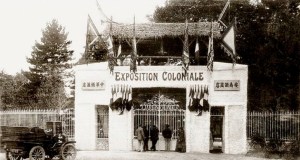
I had visited the chateau before but never wandered into the forest itself. Tucked in one corner lies the Jardin d’Agronomie Tropicale. First created in 1899 as a research garden with greenhouses for cultivating colonial crops, the garden’s primary function was to test whether tropical and non-native plants and crops like coffee, vanilla, cacao, and banana could be grown in France. It was later transformed, in 1907, into a grand Colonial Exhibition. Afterward, it served briefly as a military hospital during WWI, then as research grounds, before slipping into neglect. When the city of Paris acquired it in 2003, the garden was reopened to the public in 2006, its overgrown ruins and monuments left as quiet witnesses to France’s colonial past.
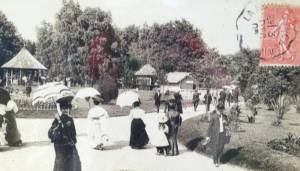
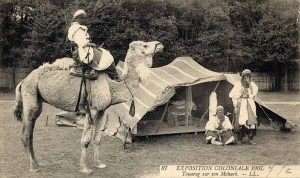
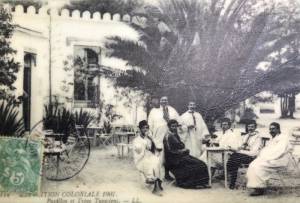
Among the faded gateways and pavilions lingers a darker chapter, one many visitors may not know. In 1907, the garden also held a human zoo. People from the colonies were brought here and displayed in fabricated “villages” turned into living exhibits for curious crowds.
In April, my friend Cathy joined me in Paris. That day, I didn’t tell her where we were going. I wanted her to feel the full weight of the discovery. We boarded a bus to Nogent-sur-Marne and stepped off in an almost forgotten corner of the city. When we arrived the park was nearly deserted. No children’s laughter, no footsteps crunching on gravel, only stillness in every direction.
I came here knowing what this place once was, and perhaps that is why the silence felt so heavy. It was here, not centuries ago but within living memory, that men, women, and children were displayed like curiosities. The thought is barbaric, almost unimaginable, and yet it had happened right here beneath our feet.
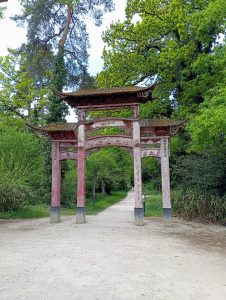
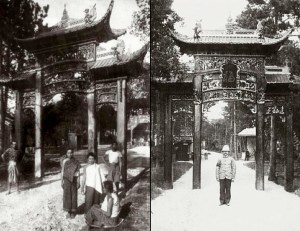
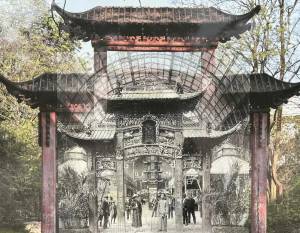
The first thing we encountered was an ornate Chinese gateway, its colors dulled by time but still commanding attention. We wandered deeper into the garden, where vines curled over cracked stone and paths led to abandoned buildings. We passed only two other visitors. The emptiness made it easier to imagine the buzz of past crowds, voices rising in fascination while those on display endured their stares. In that silence the ghosts of the place made their presence known.
As we wandered, I couldn’t help but think back to what once stood here in 1907. Different “villages” had been constructed, each meant to represent a piece of the French colonial empire in Africa, Asia, and Oceania, including Madagascar, Sudan, Congo, Tunisia, Morocco, Laos, Cambodia, and Vietnam. The designers of the exhibition went to great lengths to recreate the life and culture of these places, or at least their version of it, right down to the architecture. The buildings, however, were only the stage. The “exhibit” was the people.
From May to October that year, over one million visitors passed through this garden. They came to watch men, women, and children, entire families, brought from the colonies, lured to Paris with promise of pay and opportunity, only to find themselves transformed into objects of spectacle. The line between human and specimen blurred until it all but disappeared. Behind wooden barriers, they became nameless faces, living displays to satisfy European curiosity.
What happened when the exhibition ended is a question without a clear answer. Few, if any, returned safely to their homelands. Many were likely swept into circus-like troupes that toured internationally, their lives reduced to performances for the rest of the world.
And Paris was not alone in this cruelty. Between 1870 and the 1930’s it’s estimated that more than 1.5 billion people visited similar exhibitions worldwide in cities such as Hamburg, London, Milan, Amsterdam, as well as New York and Chicago. Even as late as 1958, almost within my lifetime, the Universal Exposition in Brussels included a display of Congolese people behind fences. A so-called “village” of living humans. It was the last of its kind, finally closing when the exposition ended that October.
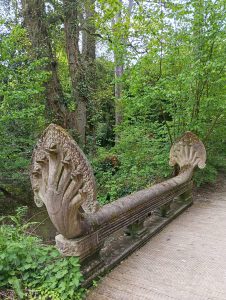
The Jardin d’Agronomie is hauntingly beautiful. We wandered through what remained of the villages. The pavilions sagging under the weight of time, their architecture now more a suggestion than structure. There is a manmade stream that winds toward a still and murky pond. The air is heavy with the silence of a place that once held noise, laughter, spectacle, and most likely sorrow.
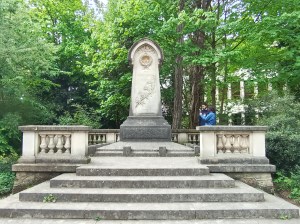
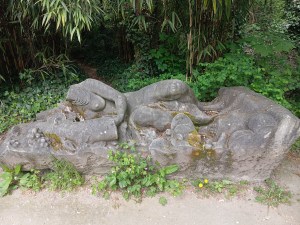
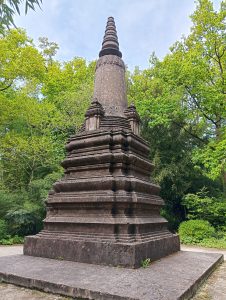
Here and there, statues and war memorials from the 1931 Colonial Exhibition stood among the trees like guardians of memory. The garden itself was haunting, not just because of what remained, but what could no longer be seen. The people whose lives once filled this space. The war memorials told one story. The pavilions whispered another. Together they made a strange harmony of beauty and unease.
As we circled back to the ornate Chinese gateway, I found myself thinking about what it means to travel. Travel, I realized is not only about what delights the eye, but about where the heart hesitates and where history unsettles us. In the Jardin d’Agronomie Tropicale, beauty and cruelty lie side by side, and the ruins remind us that memory is fragile. It is our task not to look away.
Paris dazzles with its light, but here in this forgotten corner, I found its shadows. To walk these paths is to become a witness, to listen to what the silence is still trying to say. As James Baldwin once wrote, “Not everything that is faced can be changed, but nothing can be changed until it is faced.”
Some places you visit for beauty, others for truth. This garden holds both. And Paris may call itself the City of Light, but here, the shadows insist on being seen.
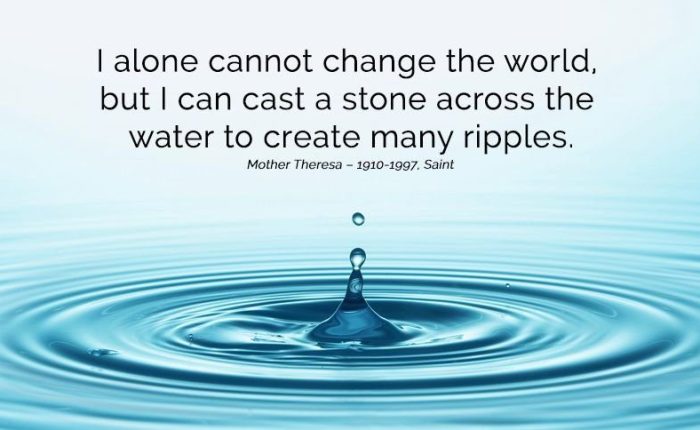
“I alone cannot change the world, but I can cast a stone across the water to create many ripples.” – Mother Teresa
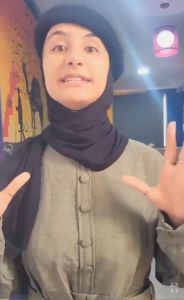
Fatima Ezzahra
We never really know the ripples we leave behind in the lives of others. Sometimes we wonder if the small things we do make any difference at all. Then, out of the blue, a message arrives that reminds us, yes, they do. Sometimes it’s just a passing smile, sometimes it’s a conversation that lingers, and sometimes, it’s a connection that changes you both.
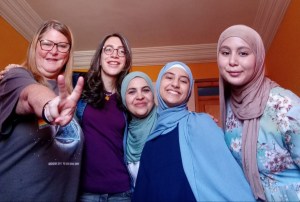
I’m a 63-year old woman from Ohio now living and volunteering in Kelaa, Morocco. Here, at the English School, I meet students from all walks of life. There are students from elementary to adults. All bright, curious, searching, each one with their own dreams and challenges. In February, I met her, Fatima Ezzahra, on an ordinary afternoon at the school in Kelaa. She was 18, a Muslim girl with wide eyes and words that tumbled out faster than I could catch them, I teased her about how much she talked, and she laughed with a kind of sparkle that made me laugh too. Something clicked right there, the in-between space of two strangers from very different worlds.
Later we sat down together to record a podcast. We expected to stumble, to edit, to need multiple takes. Instead, the conversation flowed as if we had rehearsed it all our lives. Back and forth, idea to idea, like a well-played tennis match, laughter woven in between. We finished in one take, surprised at how seamless it felt. Our paths crossed only occasionally after that, but each time carried the same easy rhythm, as though no time had passed.
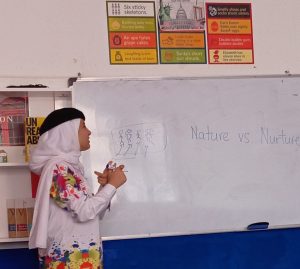
Fatima ended up studying every language offered at the English School, French, Spanish, Italian, German, and English. Little did I know at the time that this was her passport to the world, an avenue that would help her secure the visa to join her family in Italy.
When new foreign volunteers arrived, she was eager to meet them, anxious to share the beauty and history of Morocco. She would proudly show them her traditions and even teach them a few phrases of Moroccan Darija. When she finally completed her certifications in all the languages, she wrote a heartfelt farewell to the school.
In that letter she said that every volunteer, every culture, every accent had opened a new window for her. As I neared the end of her words, my eyes grew moist. Then came the final paragraph, and the tears fell freely:
“A very special thank you to Wendy. You may not realize how deeply you impacted me, but your words were like planting a small seed in thirsty soil. Today, that seed has started to grow within my soul.”
It made me pause and reflect on how often we underestimate the ordinary. A shared cup of tea, helping with English or Darija, or laughing over mispronunciations. These moments seem small at the time, but they can be turning points, even transformations. What felt natural and every day to me became lasting and meaningful to her. And she, in turn, has impacted me just as deeply. That is the quiet miracle of connection. We teach, we learn, we inspire, often across generations, cultures, and faiths.
Fatima, you have no idea the impact you made on me. From the moment I met you, I knew we were kindred spirits. Your passion for life and all that it has to offer touched me deeply. There is a quote by Ralph Waldo Emerson, “To know even one life has breathed easier because you have lived. This is to have succeeded.” If I have planted a seed in you, or anyone else at the English School, then I will always believe that my time here in Kelaa has been successful.
Not long ago, the time came for her departure from Morocco. She was heading to Italy, stepping into a new life with both excitement and uncertainty. Four days before her departure, she came to see me. Our visit was lighthearted, short, and sweet. No long, drawn-out tearful goodbye, just the comfort of knowing the connection was already woven deeply between us. Before she left, she handed me a handwritten letter, the edges burned, rolled carefully and tied with a red ribbon. Along with it was a pen…simple, symbolic, and perfect for me as a writer. I believe it was her way of saying that our story together was not finished, that the ripples would continue long after the farewell.
Since her arrival in Italy, we’ve exchanged a few short messages. She told me of her ups and downs, of missing Morocco and the familiar streets of Kelaa. Yet, within each note, I could feel her gradually sliding into her new life, her roots from that seed reaching toward new soil.
Unbeknownst to her, these past couple of weeks, I haven’t been able to find the words to write, neither for my book nor my blog. The pages stayed blank. This was after I had already shared some of my earlier writings for my book with her.
Then yesterday, out of nowhere, she sent me a reel. It simply said: I would love to read your book. There’s just one problem. You have to write it. Later that very day, I saw a story she posted about our meeting and connection.
It hit me hard. I have always believed my purpose in this world was to see and to share this life through different eyes. I hoped in some small way I might make a difference, be the change I longed to see. And yet, here she was turning that mirror back on me.
Last night, after those small exchanges with Fatima, the words returned. They poured out too quickly for my pen to keep up.
A couple of things that stood out in her story:
“When I met her, I was standing on the edge of one world, and she on the other. Yet destiny carved a path between us. It was a small encounter in its form, yet immense in its meaning. A meeting that proved the universe is far greater than the geography that separates us, and that hearts need no maps to recognize their kindred.”
“She did not merely read my words-she read me. As though I were an open book resting in her hands. Few possess that rare gift: to see beyond words, to understand the silence, to decipher the tears that have not yet fallen. She was one of those rare souls.
“They say our differences are too many, enough to raise walls between us. Yet, I discovered that differences do not prevent souls from meeting. They may even become the bridge that draws us closer. Similarity might comfort us but difference teaches our hearts to expand. I will never forget her, for she was not just a passerby in my story, but a turning point, an indelible mark upon my journey.”
Her words were humbling. To her I had been a stone cast across her waters, a ripple she would carry into her new life. To me, she was the same. A reminder that the smallest connections can hold the deepest weight.
I saw in her my younger self. The dreamer, the romantic, the little bit of save the world. I feel as if my hopes and dreams will live on through Fatima and all who she touches long after I am gone.
Travel teaches you many things. How to navigate streets and public transportation, how to stumble through unfamiliar languages, how to show respect in different cultures, and that we all smile in the same language. But the greatest lessons I’ve found, come from the people who let you into their lives. We think we are only passing through, yet somehow we become part of each other’s stories.
I don’t know how far the ripples of our time together will travel…into Italy…into the years ahead of her life, but I do know this…they have already reached me and I am changed.
As I finish writing, I realize this story is not mine alone to tell. It belongs to both of us. I’ll close with the last words Fatima wrote in her story:
In her, I saw something of myself, something that made me believe that great encounters are never in vain, that the heart already knows its way home, and that nothing in this vast design is meaningless. Every moment, even the simplest, is but a chapter in a grander story we only understand when we look back and read it once again.”
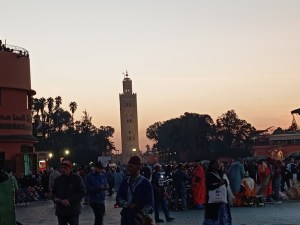
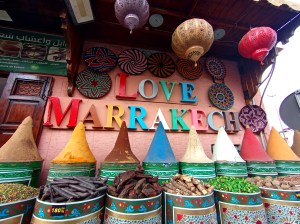
By the time I landed in Poland, February 3, 2020, I had already lived through years of goodbyes – each one leaving its own ache. Cities blurred into each other, friendships formed fast and ended faster, and I had become practiced in the art of leaving. I thought I knew how to keep things temporary. How wrong I was. China was meant to be 6 months and turned into four years. Poland was meant to be just another stop – Eighteen months, maybe less. But something unexpected happened. I stayed almost five years. Life there unfolded gently. Life in Poland was easy: trams ran on time, quiet cafes where hours slipped by, twenty minutes to the airport and I could be anywhere in Europe in under three hours, and those Friday night deep conversations with people who knew me in a way only time allows. I had roots, rhythms and a sense of belonging I hadn’t planned to find. And then, suddenly it was mid-December 2024, I was in Marrakech, Morocco…a land of heat and dust, where nothing moved quietly. While Poland had been calm and predictable, Morocco pulsed with noise, color, and movement…exhilarating, disorienting, yet comfortably familiar. I had been here before, yet each moment felt newly alive, as if the country were reintroducing itself with every step.
My plan (keyword..plan..because we know about the best laid ones) was to spend around ninety days in Morocco before continuing my travels ahead of a commitment in Bulgaria at the end of June. After some rest and relaxation in Marrakech, I had arranged a WorkAway opportunity near Ouarzazate. I would be living with an Amazigh or Berber family, helping the father build a social media presence for his Sahara tour business and teaching English to his six children.
The Amazigh people are considered the original inhabitants of North Africa predating the arrival of Arabs. Many Berbers prefer to be called Amazigh. Traditionally, many Amazigh/Berber tribes were nomadic within the Sahara Desert. Now, some Amazigh populations have settled in rural areas and rely on agriculture and herding, others maintain a semi-nomadic or fully nomadic lifestyle. The term “Amazigh” means free people in their language. They speak a language called Tamazight, which is part of the Afro-Asiatic language family.
When I arrived at the bus station in Ouarzazate, I was greeted by two of the young girls from the family. With only my limited French and Google Translate to rely on, our communication was strained, but the look on their faces said more than words ever could. They saw me, small rolling suitcase, backpack, and an extra bag in tow, and I could immediately tell something was off. As it turned out, they had walked more than an hour from their home to meet me, and the idea of walking all the way back with my luggage clearly wasn’t going to work.
Sensing the tension, I smiled and said, “No problem, we can take a taxi.” That only seemed to make them more uneasy, until I realized their concern was the cost, which ended up being 50 dirham or about 5 euro. Once I assured them I’d cover the fare, their expressions softened, and we soon set off toward what would be my home for the next five weeks.
About twenty minutes by taxi from Ouarzazate, we arrived at the top of a dusty road in the small village of Tabounte. We unloaded my bags and began a short walk to what would be my new home. The first dirt road gave way to another, narrower one, until we finally stopped in front of a modest, two-story concrete building. One of the girls knocked, and a few seconds later, the door opened…and I stepped into another world.
The Amazigh people live in a way that’s both humble and deeply rooted in tradition. I was about to learn just how simple life here could be. Just inside, to the right, was a large room lined with carpets and low cushions.
Sitting quietly in the corner was an older woman, wrapped in what looked like several layers of clothing and thick blankets. I learned this was the mother of the patriarch Brahim. Though the sun still warmed the afternoon air outside, the house held a lingering cold. One that made her layers of clothing and blankets seem less like comfort and more like necessity.
To the left was a simple bathroom – just a sink and a squat toilet. Further in, to the right, was a large room with a refrigerator and a low table and a stack of plastic stools. To the left of this space was a small kitchen, equipped with a propane stovetop, a sink with only cold water, and shelves lined with spices, dishes and pots and pans. At the far end of the house were two bedrooms: one with a bed for the parents, the other a shared room for four girls, furnished with wicker mats, blankets, and a small wardrobe.
Next, they grabbed my bags and led me upstairs. To the right was a room similar to the one below where the woman had been. To the left was another bathroom, this one with a sink, a squat toilet, and a shower with hot water. Beyond the bathroom was a room with a counter and a propane-fueled oven, which I would soon learn was used daily to bake bread. That oven would become my morning refuge, offering warmth in the chill of the house. Each day, I would join Naima as she baked, sitting near the oven to soak in its comforting heat.
At the end of the floor were two more bedrooms, similar to those downstairs. The room to the left held two single beds for the boys, while the one to the right – with a single bed – would be mine. One more flight of stairs led to a rooftop terrace. Beneath the enclosed section was a washing machine. Outside was a plastic table, two chairs, a web of clotheslines, and a scattering of random toys. I would spend many late afternoons on this terrace soaking up the warmth of the setting sun.
When I arrived, Brahim, the head of the household, was away on a desert excursion. But the rest of the family, including his mother, wife and five of his six children, welcomed me with open arms. With my limited French and the help of Google translate, we managed to communicate. To me, figuring out creative ways to communicate is part of the fun and adventure. The family’s English was minimal, but that only added to the charm of the interactions. I also hoped it was a chance for me to improve my French. Fortunately, Brahim’s brother was visiting from Hawaii and joined us for a late couscous dinner around 22:00 (10 pm). His English made the evening go smoother and allowed for easier conversation. After a meal and a few laughs, I was worn out from the journey. I said goodnight to my lovely new family, already excited for the experience the next several weeks would bring.
After a solid night’s sleep, I woke around 09:00 to the smell of warm, freshly baked bread. Breakfast was simple and satisfying, bread with olive oil, jam, or honey for dipping and a plate of olives served with hot tea. After we ate, we said goodbye to Grandma, who was returning to her home in Zagora with her visiting son.
Once they departed, I watched Naima prepare chicken Tagine we’d have for lunch. She smiled and told me that tomorrow, I would help. As the tagine simmered low and slow, I took a hot shower, washed my hair and headed up to the rooftop terrace to let it dry in the warmth of the seventy-degree sun.
By mid-afternoon, the children returned from school, and we shared the fragrant tagine together. After the meal, I walked around the corner to a little neighborhood shop to pick up a few supplies, and most importantly coffee. I’m not much of a tea drinker. It didn’t take long to discover that in this part of the world, dinner is never a rushed affair, rarely appearing before nine or ten at night. Mornings follow a similar pace, most of the house doesn’t stir before 09:00, save Naima, already up with the dawn to knead and bake the day’s bread, her quiet rhythm is the heartbeat of the household.
The biggest surprise of the day came when Ismail, the oldest son showed up at the front door unannounced. He was on break from his university studies in Agadir and had decided to make the long journey home without telling anyone. Naima’s face lit up and the younger kids squealed and clung to him. There was an instant air of excitement, the kind that comes with an unexpected homecoming. It didn’t matter what plans we had for the rest of the evening, everything shifted to celebration.
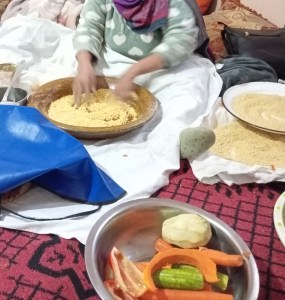
By the time I woke the next morning and made myself a cup of coffee, Naima was already deep into breakfast preparation. A bowl of dough sat nearby, soft and rising. The kitchen was filled with the warm savory aroma of sautéed vegetables. Through a mix of French, hand gestures, and the ever reliable Google Translate, I learned that she was making her version of Berber-style pizza for breakfast. When I arrived in Kelaa, I discovered this was basically like the msemen we ate.
The filling was a fragrant blend of grated carrots and other vegetables, seasoned with herbs and spices and mixed with a small amount of sheep fat…something like lard, rich and flavorful. Naima worked the dough into softball-size rounds, flattening each slightly before adding a scoop of the veggie mixture to the center. Then, with practiced hands (I tried and mine were a disaster), she folded the edges up and sealed the filling inside, reshaping it into a tidy ball. Each one was flattened again and placed on a hot griddle to cook.
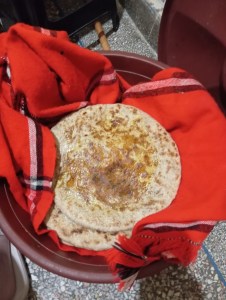
As each pizza came off the heat, she wrapped them in a towel-lined basket to keep warm. When the last one was done we all gathered around the table. Naima, her family minus Brahim, and me shared another simple breakfast. The flavor was earthy, the bread crisp on the outside and tender within. The joy of sharing a morning meal together made me feel as part of the family.
One of the unexpected joys of life abroad is discovering what breakfast looks like beyond the borders of home…dishes that would never make it to an American table, yet somehow feel just right as the day begins, like noodles in Asia.
It was a blustery day in Tabounte, just outside Ouarzazate. It was a cold, grey Saturday that seemed more suited to staying under a blanket than venturing out. There was a light drizzle and the wind whipped through the alleyways like it had something to prove. Though the temperature hovered around fifty degrees Fahrenheit, it felt much colder and I almost wished I had gloves.
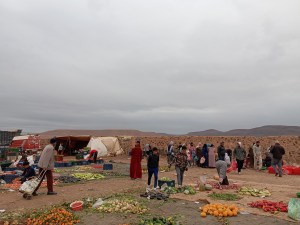
After the younger kids went off to school for their Saturday classes, Naima, her eldest daughter Fatima, and I bundled up and made our way toward the weekly souk. A sprawling outdoor market held only on Saturday and just over a kilometer from their home. If we didn’t go now, we’d be out of fresh produce for the entire week.
The souk was a blur of color and movement. There were rows of vivid vegetables piled on tattered tarps, vendors shouting prices through chattering teeth and the smell of wet earth and spice filled the air.
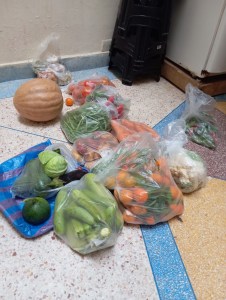
We selected plump tomatoes, root vegetables still dusted with soil, a couple huge pomegranates, and a large bag of mandarins. For just 145 dirhams (14.50 euro) we gathered more than we could comfortably carry. Our arms ached and the bags bit our fingers. Before heading home, we stopped to pick up a kilo of mixed, briny, spicy olives because no Moroccan kitchen is ever truly complete without them.
Sunday morning began with a welcome surprise. Naima, taking a rare day off from making her own bread asked if I’d like to join her on a short walk through the village. We were off to buy the day’s bread…freshly baked not in a propane oven like we had back home, but in traditional, fire fueled clay ovens tended by women from the neighborhood.
The air was crisp, the streets were quiet and peaceful in the early morning. We arrived to find the women working with ease, their hands moving skillfully as they chatted. Laughter rose now and then, suggesting that a bit of village gossip might be sprinkled in the conversation. Their hands were dusted with flour as they pulled the round loaves from the glowing ovens. The intoxicating scent of wood smoke and freshly baked bread was irresistible.
They welcomed me with warm smiles and invited me to step closer for a better look. I was captivated. Soon, with a bundle of warm bread wrapped in cloth, we walked back home. Naima then scrambled some eggs and we filled the still warm bread with spoonfuls of the mixture. Another unforgettable breakfast and another quiet moment of Moroccan life I knew I’d carry with me.
And just like that, it was Christmas. Not my first where December 25th passes like any other day. I was tucked in the life of an Amazigh home in southern Morocco nestled beyond the High Atlas Mountains and known as the gateway to the desert. I was surrounded by warmth, laughter, and a family that had accepted me into their daily life like I had always been there.
Though they didn’t celebrate the holiday themselves, they hadn’t forgotten it was mine. That morning, Naima handed me a small glass jar of Moroccan saffron and wished me “Merry Christmas”. The bright threads were like strands of sunshine, more precious than gold here. My eyes teared up. It wasn’t just a gift. It was recognition. A gesture of love across cultures.
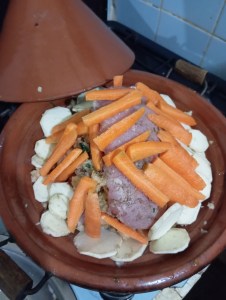
In return, I planned a Christmas turkey tagine. I’d found a huge turkey breast at the butcher shop a day or two earlier. With Naima’s help, because she knows all the secret herbs and spices, we turned it into something worthy of any holiday table,
I managed to get in a chat with my brother and sister-in-law that helped bridge the thousands of miles between us. That evening, as we scooped the last bits of turkey from the tagine, I looked around the table and smiled. No lights, no presents, no carols…just a beautiful Christmas. Simple. Joyful. Full of heart.
Life in Tabounte was beginning to take on its routine. Brahim eventually returned from the desert and with him came a new sense of purpose. Rather than lazy mornings next to the bread oven followed by breakfast and afternoons on the terrace, I found myself with a few small tasks to help with his tour business, Caravans, Peaks, and Dunes. Social media updates, a bit of writing and odd jobs that made me feel like a proper digital nomad.
Most mornings started the same. I’d join Naima near the warmth of the bread oven. Then after a simple breakfast, I’d head out to the local coffee shop, just an eight-minute walk from the house. It’s not exactly a place that draws tourists, but I was always greeted with smiles, a few curious looks, and even the occasional free refill.
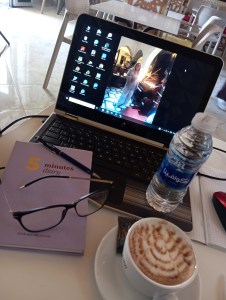
I’d spend a few hours at the café working on my laptop. Sometime after mid-day, I’d get a message from Naima telling me the kids were home and lunch, usually tagine, would be ready soon. That was my signal to pack up and head home.
After lunch, our routine shifted to the rooftop terrace. The house, made of concrete holds the chill of the night air long after the sun has risen. Actually the house never really warmed up and the terrace became our space of sunlight and warmth. We’d sit on the terrace, sometimes sipping tea. While I helped the girls with their English homework, Naima tended to her endless loads of laundry. Hanging everything along clotheslines zig-zagging like a spider web. With a family of eight, the laundry never seemed to stop.
One day I decided to finally do my own laundry. Washed, I hung it on the web of lines and checked it before I went to bed. It was still damp and I left it to hang overnight. Of course, that night, an unexpected rainstorm swept through leaving my laundry dripping. All I could hope for was a breezy, warm, sunshiny day to follow. Lesson learned…don’t trust a desert sky to stay dry.
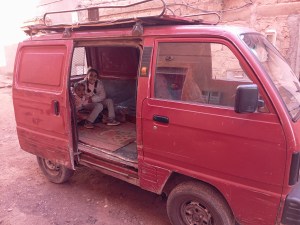
We closed out 2024 with another turkey tagine and a celebratory cake. The first morning of 2025 dawned sunny and clear so we decided to kick-off the year with a picnic several (I didn’t realize how “several” LOL) miles from home. The day was filled with laughter, games, and plenty of good food. Although we had hired a van to get us there, Naima announced we would be walking home. It was more than I bargained for, but somehow, I made it. Rewarded with a stunning sunset along the way made every step worthwhile…almost…I was exhausted by the time we reached home.
A few days into the new year, I had to leave my family in Tabounte and head to nearby Ouarzazate. A friend was coming to visit me in about two weeks, so I needed to find accommodations and get things organized. He’s a magician, and I also planned to look into possible venues where he could perform. Brahim, not being on an excursion, offered to meet me in the city and show me around. He even recommended a few local spots for me to eat.
I spent a few days getting things in order for Eric’s arrival. Brahim did his best to help me arrange performances at local schools and clubs for his magic act, but it turned out to be more complicated than either of us expected, and ultimately, I couldn’t make it happen. So, I let go of that plan and shifted my focus to something simpler…introducing him to the magic of Morocco, one day at a time.
After a long weekend in Ouarzazate, I returned to my family and the familiar rhythm of life in Tabounte. Days passed quietly, each one mirroring the last in its simplicity. Before I knew it, the time had come for Eric’s arrival. I had rented a modest two-bedroom apartment in Ouarzazate to serve as our home base. His journey would take him beyond the tranquility of southern Morocco. He would also be spending time on his own exploring the chaotic charm of Marrakech and the buzzing metropolis of Casablanca. The contrast between those cities and the calm of Ouarzazate and Tabounte would be striking. We also planned a desert adventure, but that’s a story for another post.
Sneak peak at our desert excursion
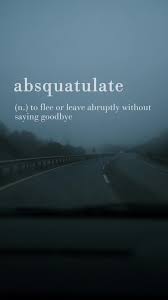
I used to think I had mastered the art of leaving. I was skilled in absquatulating or the Irish goodbye. Eleven years of travel had trained me to move lightly, to slip in and out of places without unraveling. But Morocco, somehow, had undone all of that.
My five weeks in Tabounte were meant to be just that…five weeks. A temporary glimpse into Amazigh life, a cultural exchange, a new story to add to my journey. Somehow, between the shared meals, quiet mornings at the café, and the daily rhythm of family life, it carved out a place in me. I arrived as a guest and left as something closer to family. Leaving felt heavier than I expected.
From Tabounte, I traveled to Kelaa. I told myself I would stay through Ramadan, meet my friends, Dawn and Margaret in Marrakech the first week of April, then fly to Paris where I would meet up with my friend Cathy. I would spend 2 weeks in Paris and then continue my journey to yet undecided destinations.
I returned to Kelaa after Paris, expecting to stay for a little while. That while has quietly stretched into more than six months. And now, I should be on the edge of yet another departure, but, back injury aside, the truth is, the longer I stay, the more Morocco wraps itself around me. Friends and family back home say they can sense it too. How this place has left a deeper imprint, as if Morocco is writing a different version of me.
Maybe the art of leaving isn’t about becoming good at goodbyes or slipping away gracefully. Maybe it’s about allowing yourself to be changed and learning how to hold on, even as you go.
And when the time comes to leave Kelaa, that will be Part Two.















 By the time I landed in Poland, February 3, 2020, I had already lived through years of goodbyes – each one leaving its own ache. Cities blurred into each other, friendships formed fast and ended faster, and I had become practiced in the art of leaving. I thought I knew how to keep things temporary. How wrong I was. China was meant to be 6 months and turned into four years. Poland was meant to be just another stop – Eighteen months, maybe less. But something unexpected happened. I stayed almost five years. Life there unfolded gently. Life in Poland was easy: trams ran on time, quiet cafes where hours slipped by, twenty minutes to the airport and I could be anywhere in Europe in under three hours, and those Friday night deep conversations with people who knew me in a way only time allows. I had roots, rhythms and a sense of belonging I hadn’t planned to find. And then, suddenly it was mid-December 2024, I was in Marrakech, Morocco…a land of heat and dust, where nothing moved quietly. While Poland had been calm and predictable, Morocco pulsed with noise, color, and movement…exhilarating, disorienting, yet comfortably familiar. I had been here before, yet each moment felt newly alive, as if the country were reintroducing itself with every step.












 Down the Rabbit Hole