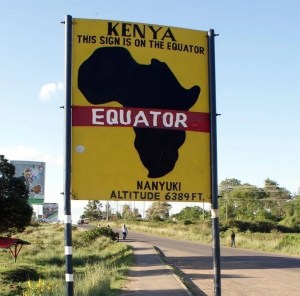
March 1st I arrived in Nanyuki, Kenya, still very much a newcomer and still finding my footing in a new place. Sometimes travel moves slowly, giving you time to settle into a place before it surprises you. And sometimes, just a week after arriving, you find yourself sitting in the middle of a celebration for International Women’s Day with women from the Maasai community.
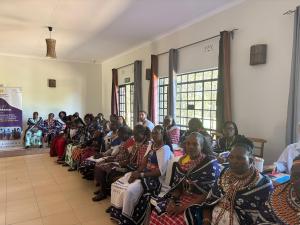
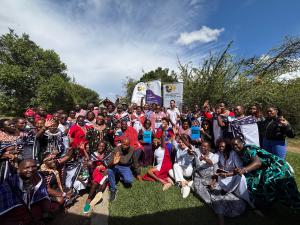
They had gathered to celebrate empowerment and resilience, sharing stories of strength, change, and hope. I didn’t always understand the language being spoken, but sitting in that circle of women, listening, watching, feeling their energy, I realized I didn’t need to. The joy, the power, and the determination of these women shaping their families, their communities, and their futures spoke clearly enough. In that moment, the language was universal.
It was one of those unexpected gifts travel gives you. The kind where you realize you’re not just passing through a place, but you’ve been invited to witness something important.
But to truly understand the strength in that circle of women, you first have to understand the realities of life in a pastoral community.
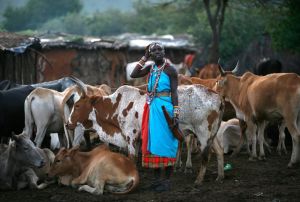
A pastoral community is a social and economic system centered around the herding of livestock, primarily cattle, goats, and sheep. These animals are not just a source of food or income; they shape daily life, social roles, and cultural identity. For Maasai women, being part of a pastoralist society often means a life of intense labor and responsibility.
While speaking with a woman I met in Nanyuki, someone who works closely with Maasai communities and runs a safe house for young people with disabilities, I began to understand some of these realities more clearly. Many of the children she cares for were shunned by their communities, sometimes because disabilities are believed to be a curse, and sometimes simply because families lack the resources to support them.
She also explained how the demands of pastoral life affect families. When grazing becomes scarce, the person responsible for the herd (the mother) may leave the community for months at a time, moving livestock to areas with better pasture and water. During those periods, families rely heavily on extended networks of co-wives, relatives, and elders to care for children and maintain the household.
Before I share more about the IWD gathering itself, it helps to understand a few key aspects of life for Maasai women. Their role within pastoral communities is both central and complex. Women carry much of the daily responsibility that keeps families and villages functioning, yet they often have limited access to resources such as land or livestock ownership. Alongside these economic realities, they also face cultural challenges from traditions like female genital mutilation (FGM) to the pressures of maintaining households in a changing world. At the same time, these roles are slowly shifting, as education, advocacy, and community leadership open new possibilities for Maasai women and girls.
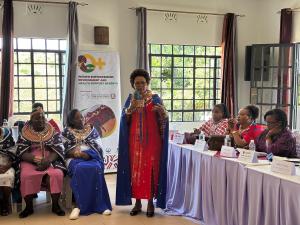
It was against this backdrop that the three-day International Women’s Day gathering was held at Storms Resort just outside of Nanyuki. I was invited by Sharon, who works with Laikipia Permaculture. The event brought together Maasai women from across the region and was funded by the Italian Agency for Development Cooperation – AICS through its Development & Health Support program in Kenya, allowing the women to participate at no cost.
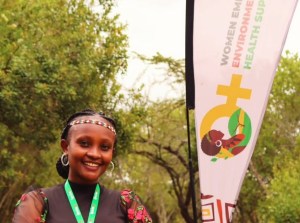
At the end of the event, Sharon shared with me a document titled Women’s Memorandum of Issues – Sauti ya Mama Workshop 2026. The memorandum was developed/written during the first two days of the workshop by the participants and outlines many of the challenges women and girls continue to face despite legal protections meant to guarantee equality. It addresses Advocacy and Legal Protection, Land and Environment, Leadership and Governance, Livelihood and Innovation, and GBV (Gender-Based Violence) and SRHR (Sexual Reproductive Health Rights).
As the document states:
“Despite constitutional, legal, and international commitments to gender equality, women and girls continue to face significant and systemic barriers that hinder their full participation in social, economic, and political life. This memorandum outlines critical issues requiring immediate policy, legislative, and social interventions to ensure safety, equality, and dignity.”
Reading those words gave deeper meaning to what I experienced that afternoon.
What also struck me that afternoon was the presence of male public officials and respected representatives of the Maasai community. Their attendance and their willingness to sign a document in support of the women’s concerns signaled that the conversations happening that weekend were meant to reach beyond the gathering itself. The memorandum outlined a wide range of issues affecting women and girls.
While the memorandum spans more than twenty pages, a few of the issues it highlighted stood out.
One section addressed “Cultural and Social Barriers to Women’s Land Ownership.” The recommendations called for community awareness and education around women’s land rights, with outreach directed toward men, elders, youth, and the wider community.
Another issue identified was “Low Literacy Levels Among Women,” which can limit women’s confidence and ability to participate fully in community and civic life. Among the recommendations were the introduction of community-based adult literacy programs for indigenous women and stronger support for the education of girls and young women.
The memorandum also addressed the “Exclusion of Women from Decision Making.” Recommendations included implementing affirmative action policies to increase women’s representation and providing training and capacity-building opportunities for women in governance and leadership roles.
Closely related were “Cultural Barriers and Gender Norms” that discourage women from stepping into leadership positions. Cultural expectations tied to marital status and traditional gender roles can restrict women’s participation in public life. The memorandum recommended community education around gender equality and inclusive leadership, along with encouraging greater engagement from men as advocates for equality.
Because women and girls in Narok and Laikipia counties continue to face challenges in accessing quality health services and exercising their Sexual and Reproductive Health (SRH) rights, the memorandum also devoted significant attention to issues related to gender-based violence and reproductive health.
One concern identified was “Myths, Misconceptions, and Cultural Barriers to SRH Services.” Recommendations included community education encouraging safe hospital deliveries and promoting greater use of maternal health services in health facilities.
Another critical issue was “Weak Gender-Based Violence (GBV) Reporting and Justice Mechanisms.” The memorandum called for stronger pathways to justice for survivors through formal legal systems, as well as improved confidentiality and protection mechanisms.
The memorandum outlined the issues and recommendations. That afternoon, I witnessed the voices behind them.
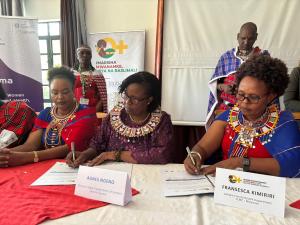
In her closing speech, Agnes Ngeno, County Director Gender, State Department for Gender Narok, summed up the purpose of the gathering. She reminded the audience that the theme for International Women’s Day 2026 was “Rights. Justice. Action. For All Women and Girls,” and is a call to move beyond rhetoric. Gender equality, she said, is rooted in fundamental human rights and requires strong legal protections, real justice, and immediate collective action to ensure that no woman or girl is left behind.
She also emphasized that International Women’s Day 2026 is a critical moment to reaffirm Kenya’s commitment to the rights of women and girls. While progress has been made, the world continues to face overlapping crises and an erosion of rights, including the rising threat of femicide. The day, she explained, serves both as a platform to confront systemic barriers and as a moment to celebrate the achievements of women leading the way in areas such as STEM, leadership, and financial inclusion.

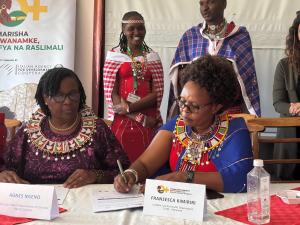
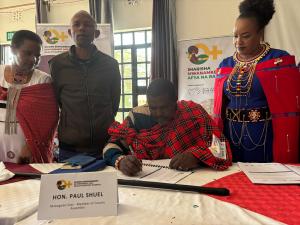
Following her remarks, the memorandum was formally signed by representatives present at the gathering: women leaders who helped draft the document, government officials, and male representatives of the Maasai community who voiced their support for the issues and recommendations raised during the weekend.
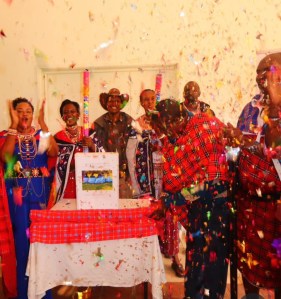

As the gathering ended and the memorandum was signed, the room shifted from solemn determination to celebration. A cake was brought out, and soon voices rose in singing, laughter, and dancing as the women marked International Women’s Day together. Earlier that afternoon, I had sat quietly among them, listening to voices I could not always understand, but by the end of the day, the meaning was clear. These women were claiming their rights, their dignity, and their place in shaping the future of their communities.
Sitting in that circle, I was reminded that “we are more alike, my friends, than we are unalike” (Maya Angelou). Their stories and strength were both unique and universal. And as Margaret Mead said, “Never doubt that a small group of thoughtful, committed citizens can change the world; indeed, it’s the only thing that ever has.” In that room, I saw it happen. Women, steadfast and courageous, shaping the future for themselves, their communities, and generations to come.


 Down the Rabbit Hole
Witnessing what is surely history in the making … impact! Thank you so much for sharing and allowing us to connect in some small way, knowing and understanding it is the little moments where change begins. Dr. Marla Brady “Inspired by Possibilities-Driven by Purpose” MBConsulting – Career Direction Professional * *561-376-7348 – http://www.marlabrady.com http://www.marlabrady.com/
LikeLike