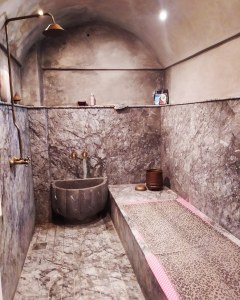
 Back in September 2021, I wrote a piece titled “That Time I let a Stranger Bathe Me – My Experience at a Moroccan Hammam”. At the time it seemed like a bold immersion into Moroccan culture. But now, after living in Morocco for five months, I can see it for what it truly was: a Westernized introduction. The hammam I experienced then was tucked inside a luxurious spa in the Riad where I was staying. It was private, serene, and indulgent – what many would call “the royal treatment”.
Even in that controlled setting, the experience pushed boundaries. After all, allowing someone to bathe you – scrub you – is intimate, vulnerable, and far from anything most Westerners are used to. Still, it was more spa than tradition, an experience meant to ease foreigners in gently. You might call it “hammam-lite”.
Living here now, I understand just how different the real thing can be.
In Arabic, the word hammam means, “spreader of warmth”. A hammam is a place of bathing, and they can be public and private. When I arrived in Kelaa in January of 2025, I discovered one of my students had a spa which I visited almost immediately. I also learned they had a hammam – perfect timing, since the villa I was living in had no hot water. A warm, relaxing weekly hammam quickly became a luxury.
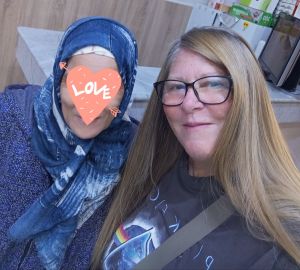 These days, although my hammam is still inside a spa, I have my own kessala. A kessala is the woman who performs the scrubbing ritual in the hammam. Mine is named Fatima. She’s Moroccan and only speaks only Darija (the dialect of Arabic spoken in Morocco), a few words of French – maybe even fewer than I do – and she can’t read which rules out Google translate. Still, we smile in the same language and somehow, we always understand each other.
There’s a threshold you cross when you step into the hammam. The door clicks shut behind you, and the outside world—its traffic, schedules, languages, and labels—fades. The air is thick, ancient, and pulsing with warmth. It wraps around you like a memory.
Without giving too much detail, I’ll just say this: it’s a wet room. I am unclothed, and so is Fatima, aside from the briefs she wears. Most days I am the only one there, but now and then, the room fills with three or four women. I don’t mind public hammams – in fact, I’m quite comfortable in them – but I’ve grown fond of having Fatima each week. I also take advantage of other spa perks while I am there, like massages or a quick hair treatment.
But make no mistake – this is not the Westernized, serene experience I had the first time around. It’s raw, real, and deeply human. And I’ve come to love it.
I used to think the hammam was about scrubbing – peeling away the layers of dead skin, and even a sense of foreignness. In my first post, I described the complex emotions it stirred in me, including the vulnerability of letting a stranger bathe me. It felt like surrender, like exposure. Over time, though, visits to the spa’s hammam became not just a luxury but a weekly ritual. For nearly three months, I never missed a Saturday. Then came a two-week holiday to Paris and Rome. By the time I returned to Kelaa, it had been more than three weeks since I’d had a proper scrubbing.

When I stepped back into the warm, steamy room and greeted my kessala something had shifted. The ritual no longer felt foreign or performative. My first step into the hammam felt like stepping into another world: warm and dim, with steam swirling in the air and the fragrant scents wafting around me. Fatima, the softly smiling kessela with kind eyes, led me gently through this cleansing ritual. She let me settle on the marble bench, her strong hands massaged the soap over my skin. Then, for a moment, I flinched as she scrubbed me vigorously with the coarse kessa glove. Such rough exfoliation would feel harsh back home, but afterwards I noticed the rosy flush of fresh skin and felt a surprising glow.
There is no hiding in the hammam. Not from your body, not from your heart. The scrub doesn’t just strip away skin – it uncovers the invisible layers, the ones you didn’t realize you were still carrying. My limbs were limp beneath her rhythm, and something unexpected stirred. A memory, maybe—a moment I’d forgotten. A person I haven’t forgiven. The heat opens doors I didn’t know were still closed. That quiet Saturday, I wasn’t scrubbed, rinsed, or handled. I simply dissolved. Surrounded by steam and silence, I stopped feeling like a self-conscious outsider. I became water.
Afterwards, I sat on the white leather chaise, wrapped in a towel that clung to my damp skin. My hair was slicked back, my cheeks flushed, and I felt raw in the best possible way. Maryam came in and offered me mint tea and water. I sipped in silence. I had been undone and reassembled, no longer the water I had melted into.
When I went outside, the sun felt too sharp, too fast. The world started to spin quickly again, but something inside me was slower. Emptied. Calmer.
When I leave Morocco, I know I will miss the colors, the call to prayer, the clinking of tea glasses. But more than anything, I’ll miss the ritual of the surrender – the hammam. I’ll miss the sound of echoing water and the quiet acceptance of bare skin. I’ll miss being just another body, melting into the steam, reminded again and again that letting go is its own kind of cleansing. I will miss becoming water.


 Down the Rabbit Hole
I love reading your blog. You are amazing. The experiences you have. Enjoy. Love ya
LikeLike
Thanks for taking the time to read and comment.
LikeLike